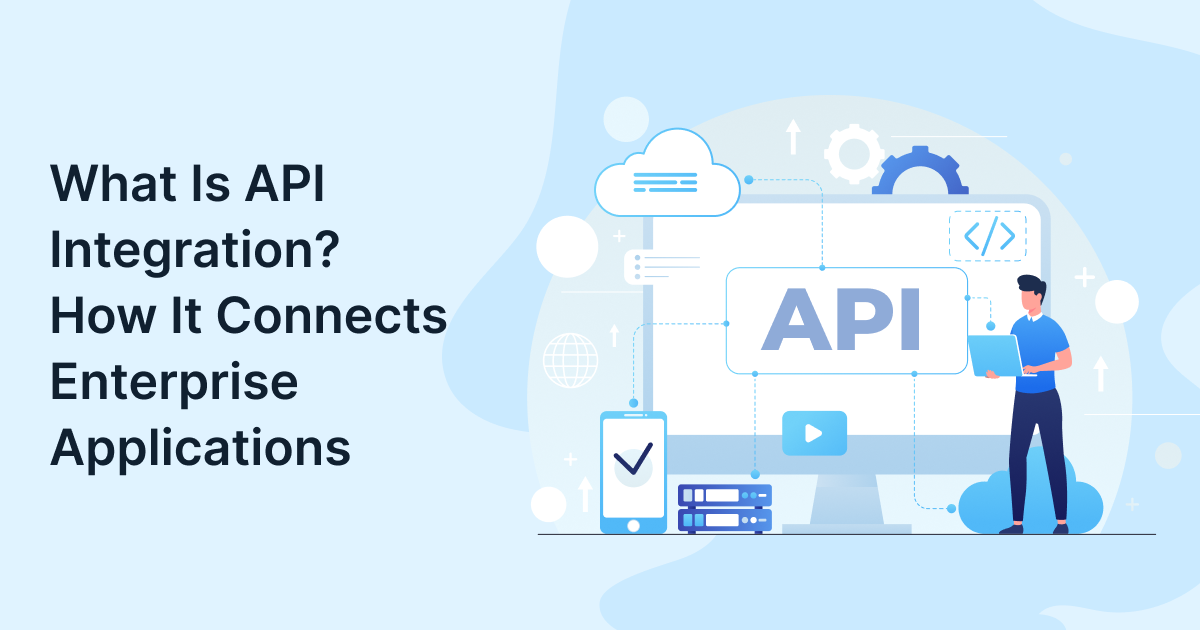
API integration is the working connection between two or more applications, built on their APIs, so they can exchange data and trigger actions without manual effort. The API is the interface a system exposes. The integration is the logic, security and error handling that make two systems behave like one process.
This guide explains what API integration means in practice, how a single request moves across your stack, which patterns suit which jobs, and what separates a quick connector from an enterprise-grade one. If you are already scoping a programme, Ledgesure’s integration engineering services cover architecture through to managed operations.
API Integration Meaning: The API Versus the Integration
An API (application programming interface) is a contract. It states which data or functions a system offers, what a request must contain and what the response will look like.
An API integration is what gets built on top of that contract. It decides when to call the API, how to authenticate, how to translate fields between systems, what to do when a call fails, and who gets alerted. Think of the API as a door and the integration as the route, schedule and security checks that get goods through it.
So “the CRM has an API” describes only the door. The routing, mapping and failure handling are where the real effort and risk sit.

How Does API Integration Work? One Order, Four Systems
An API integration works by passing a structured request from one system to another, transforming the data on the way, and confirming the result. Following a single business event shows the moving parts more clearly than a definition.
Worked example (hypothetical). A distributor’s customer places an order on its e-commerce site. Here is what a well-built integration does next:
- Trigger – The storefront emits an “order created” event or calls an integration endpoint.
- Authenticate – The integration presents a token (typically OAuth 2.0) to the ERP’s API, so access is scoped to orders only.
- Transform – Storefront fields such as “sku” and “qty” are mapped to the ERP’s material and quantity fields, and currency and tax codes are normalised.
- Deliver and confirm – The ERP creates a sales order and returns its ID. The integration then notifies the warehouse system and writes the order status back to the CRM.
- Handle failure – If the ERP is down, the message is queued and retried. An idempotency key stops a retry from creating a duplicate order.
- Observe – Every step is logged with a correlation ID, so support can trace one customer’s order across all four systems.
Most tutorials skip steps 5 and 6, yet they decide whether the integration survives a busy sales day.
Common API Integration Patterns and When to Use Each
The right pattern depends on how many systems are involved, how fresh the data must be and how often the connection will change. Choosing it well is the first decision in any enterprise integration architecture.
Ledgesure Connectivity Fit Matrix
| Pattern | How it works | Best fit | Watch out for |
| Point-to-point | One system calls another’s API directly | Two systems, one stable use case | Becomes brittle beyond a handful of links |
| Hub-and-spoke / middleware | A central layer routes and transforms messages | Many systems sharing common data | The hub becomes a bottleneck if poorly scaled |
| API-led (layered) | Reusable system, process and experience APIs | Large estates where teams reuse the same data | Needs design discipline and an API catalogue |
| Event-driven | Systems publish events; others subscribe | Real-time updates, high volumes | Harder to trace without good observability |
| Scheduled batch via API | Bulk data moved on a timer | Reporting, nightly reconciliations | Data is only as fresh as the last run |
Mature enterprises usually blend these: events for orders and inventory, batches for finance, and API-led layers so new channels reuse existing services. For a deeper look at how these styles compare with older integration approaches, see our guide to how modern API integration services differ from legacy integration.
API Integration vs iPaaS, API Management and Middleware
These terms are often used interchangeably, but they describe different layers of an enterprise integration architecture.
| Term | What it does | Simple analogy |
| API integration | The working connection that moves data and triggers actions | The delivery route |
| API management | Publishes, secures, throttles and monitors APIs | The gatekeeper and meter |
| iPaaS | Cloud platform for building and running integrations | The logistics depot |
| Middleware / ESB | Older, often on-premises layer for routing and transformation | The legacy warehouse |
The distinction matters during modernisation. Many organisations still run critical flows on ESBs such as TIBCO BusinessWorks, BizTalk or SAP PI/PO, and rebuilding those interfaces one by one is slow and error-prone. Genova IQ, Ledgesure’s AI-assisted migration accelerator, addresses this by discovering existing interfaces, mapping them into a canonical model and re-architecting them for platforms such as SAP Integration Suite, with human approval gates along the way. Choosing platforms and sequencing that work is the core of “planning API integration services at enterprise scale”.
Why API Integrations Now Decide AI Readiness
API integrations have become the access layer for AI. An AI assistant or agent can only act on data and systems it can reach through a governed interface. In the same Salesforce research, 94% of IT leaders agreed that AI agent success will require a more API-driven architecture, and an estimated 27% of APIs remain ungoverned.
Did you Know?
“Developers are only partly ready: Postman’s 2025 State of the API Report found that 89% of developers use AI, but only 24% design APIs for AI agents.”
Clean, well-documented APIs also open commercial options. Once internal services are stable, some can be offered to partners as paid products, a route explored in our article on why API monetisation is gaining ground.
What Makes an API Integration Solution Enterprise-Grade?
An enterprise-grade API integration solution is secure by default, observable end to end, and built to survive change in the systems it connects. Before approving any new connection, it helps to run it through a short checklist.
API Integration Readiness Checklist
- Access control: Does every call check that the caller may access that specific record?
- Lifecycle security: Are controls applied at design time and at runtime?
- Versioning: What happens when the source system ships API v3? Contract tests should catch breaking changes before production does.
- Resilience: Are retries, timeouts and idempotency defined, or left to defaults?
- Ownership: Is there a named owner, a catalogue entry and an alert route for this integration?
A connection that fails two or more checks is a prototype, not production infrastructure, and API integration services worth paying for should leave none in that state.

Conclusion
API integration turns isolated applications into connected business processes, but only when the integration layer is treated as engineered infrastructure rather than a set of quick links. Map the systems that matter most, match each job to a pattern, and hold every connection to the same security and ownership standards.
If you would like an outside view of where your current connections stand, you can speak with Ledgesure’s integration specialists about your landscape and priorities.
FAQs
Q: What is an example of API integration?
A: Payroll software pulling approved timesheets from an HR system each fortnight is a common one. Another is a logistics provider’s API pushing shipment updates into a retailer’s order system, so customers see tracking without staff copying numbers between screens.
Q: Does API integration always require coding?
A: Not always. Low code iPaaS tools offer prebuilt connectors for popular SaaS applications, and simple flows can be configured visually. Custom code becomes necessary for complex transformations, legacy systems without modern APIs, strict performance needs or unusual security requirements. Most enterprises use both, with engineers setting standards that citizen builders follow.
Q: How long does an API integration take to build?
A link between two well-documented SaaS tools can take days. Connecting an ERP to several downstream systems, with mapping, testing and security review, usually takes weeks. Timelines stretch most when source APIs are poorly documented, test environments are missing or data ownership has not been agreed.
Q: Is API integration secure?
A: It is as secure as its design. Encrypted transport, short-lived tokens, least-privilege scopes, input validation and rate limiting are baseline controls. Risk often comes from integrations that drift after launch, through unused credentials or forgotten test endpoints. Regular API inventory reviews close that gap.
Q: What is application connectivity?
A: Application connectivity is the broader ability of an organisation’s systems to share data and processes reliably. API integrations are the main building blocks, alongside events, file transfers and database replication. Good connectivity lets a new application plug into existing services instead of needing fresh point-to-point links, which is a core goal of any enterprise integration architecture.