Migration projects often begin with infrastructure, applications, or cloud platforms. However, the success of these initiatives is frequently determined by something less visible: integrations. When integrations are overlooked, organisations risk broken data flows, operational disruption, compliance issues & unexpected project costs.
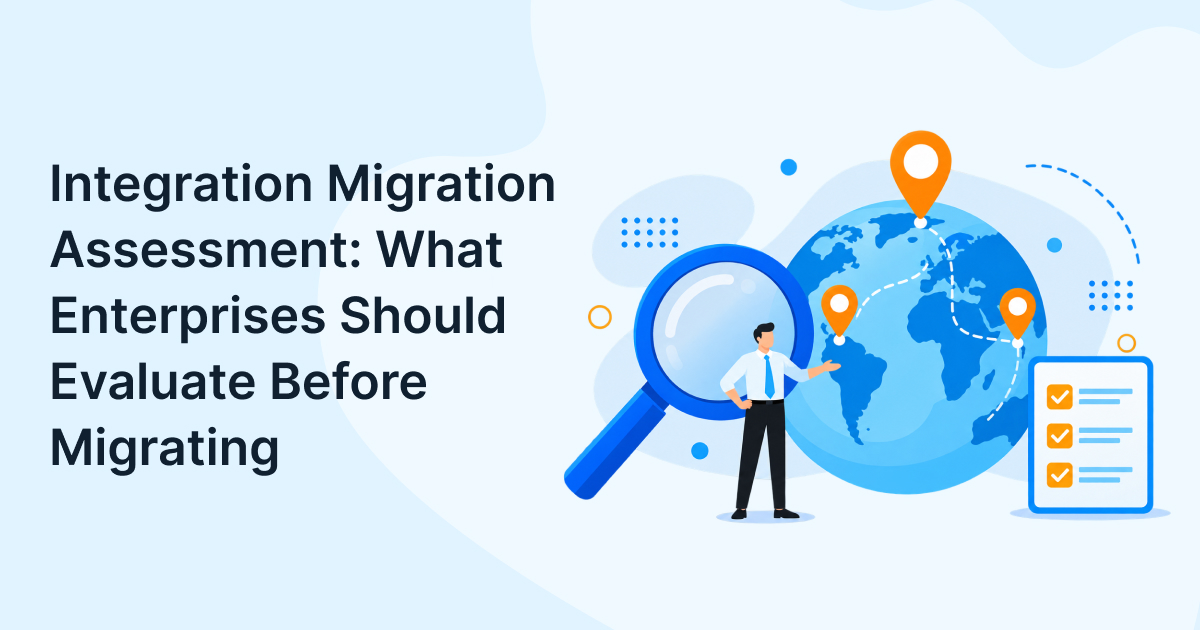
An integration migration assessment evaluates an enterprise’s interfaces, APIs, middleware, data flows, dependencies, security controls, performance, and business criticality before migration. The assessment helps determine which integrations should be migrated as-is, modernized, replaced, consolidated, or retired, while identifying dependencies, risks, effort, and migration sequencing requirements.
An integration migration assessment helps enterprises understand how systems interact, where dependencies exist & what changes may be needed before migration begins. By evaluating integrations early, organisations can reduce risk, improve planning accuracy, and identify opportunities to modernise their technology landscape.
Companies investing in modern integration solutions often begin with a structured assessment process because integrations increasingly sit at the centre of digital transformation, cloud adoption, and AI initiatives.
What Is an Integration Migration Assessment?
An integration migration assessment is a structured evaluation of an organisation’s integrations, data flows, middleware, APIs & system dependencies before a migration project begins. Its purpose is to identify migration risks, understand business impact, estimate effort, and determine whether existing integrations should be migrated, modernised, replaced, or retired.
Unlike a traditional migration assessment that focuses only on applications or infrastructure, an integration-focused approach examines how information moves across the enterprise and which business processes depend on those connections.
A typical integration assessment includes –
- Integration inventory analysis
- Dependency mapping
- API and middleware evaluation
- Security and compliance reviews
- Performance benchmarking
- Scalability assessment
- Modernization opportunities
The outcome is a clearer migration strategy and a stronger foundation for future growth.

Why Do Enterprises Need a Migration Readiness Assessment Before Migrating?
A migration readiness assessment gives organisations visibility into technical dependencies, operational risks, and integration challenges before systems are moved. This early understanding helps teams make informed decisions, allocate resources effectively, and avoid discovering critical issues halfway through a migration project.
Enterprise environments rarely consist of isolated systems. Business applications exchange information continuously across –
- ERP platforms
- CRM systems
- Data lakes and warehouses
- E-commerce platforms
- Financial systems
- Partner ecosystems
When one integration fails, downstream processes can quickly be affected. A readiness assessment helps organisations –
- Reduce migration uncertainty
- Prioritise business-critical integrations
- Identify technical debt
- Estimate migration complexity
- Strengthen governance
- Improve stakeholder alignment
Many enterprises discover during this phase that migration alone may not address their long-term objectives. Understanding the difference between migration and modernization can help teams choose the right path. Our guide on migration versus modernization approaches explores this in greater detail.
Which Systems and Dependencies Should Be Evaluated First?
The systems that support core business operations should be evaluated first because they typically carry the highest number of dependencies and pose the greatest migration risk. Evaluating these systems early helps prevent disruptions that could impact multiple business functions simultaneously.
ERP Platforms
ERP systems often form the operational backbone of an enterprise. Finance, procurement, supply chain, and inventory processes frequently rely on ERP integrations. Any migration involving ERP systems requires careful dependency analysis.
CRM Systems
Customer-facing operations depend heavily on CRM integrations. Marketing automation, customer support, sales reporting, and analytics platforms often connect directly to CRM ecosystems.
Data Warehouses and Analytics Platforms
Reporting environments depend on accurate and uninterrupted data movement. Organisations should document data pipelines, transformation processes, and reporting workflows before migration.
Third-Party Services
External APIs, payment processors, supplier platforms, and SaaS applications frequently introduce hidden dependencies. These integrations should be validated early to avoid unexpected compatibility issues.
Middleware Environments
Middleware often contains years of accumulated business logic and undocumented workflows. A thorough review helps uncover integration complexity that may not be immediately visible.
This evaluation phase also supports the development of a scalable enterprise integration architecture, ensuring future integrations remain manageable as the business grows.
How Should Organisations Perform a Legacy Integration Assessment?
A legacy integration assessment begins with documenting existing integrations and understanding how business processes depend on them. Once visibility is established, organisations can determine which integrations still provide value and which have become obstacles to transformation.
Many enterprises continue to rely on –
- Point-to-point integrations
- Legacy ESBs
- Batch processing systems
- Custom scripts
- Outdated middleware platforms
While these solutions may still function, they often create challenges around scalability, supportability, and maintenance.
A strong assessment evaluates four key areas –
Technical Viability
Can the integration operate effectively within the target environment?
Business Importance
Does the integration support a critical business function today?
Cost Of Ownership
What resources are required to maintain, troubleshoot, and upgrade it?
Modernization Potential
Could the integration be redesigned using APIs, microservices, or event-driven approaches?
Enterprises frequently use migration projects as an opportunity to modernise older technologies rather than simply moving existing problems into a new environment. Organisations exploring broader transformation strategies may find value in this guide on modernising integrations during migration.
What Security and Compliance Risks Should Be Evaluated?
Security and compliance reviews should focus on sensitive data movement, access controls, regulatory obligations, and third-party integration risks. Addressing these areas before migration significantly reduces the likelihood of security vulnerabilities being transferred into the target environment.
Security assessments should examine –
Data Protection
Identify sensitive customer, employee & operational data moving between systems.
Identity And Access Management
Review authentication mechanisms, permissions, service accounts & integration credentials.
Regulatory Complianc
Consider requirements related to –
- GDPR
- PCI DSS
- HIPAA
- ISO 27001
- SOC 2
External Integration Risks
Third-party systems often represent a significant share of an organisation’s attack surface. Their security posture should be assessed alongside internal systems.
Security requirements should influence migration planning from the beginning rather than being treated as a final-stage activity.
How Can Enterprises Assess Integration Performance and Scalability?
Performance and scalability assessments help organisations determine whether existing integrations can support future business growth and technology demands. This evaluation highlights bottlenecks, reliability concerns & modernization opportunities before migration takes place.
Several factors should be reviewed –
1. Transaction Volumes
Current and projected transaction loads provide insight into future capacity requirements.
2. Latency Performance
Migration can introduce changes in network topology, application hosting models, and data movement patterns that affect response times.
3. Monitoring And Observability
Monitoring capabilities should provide visibility into integration health, failures, and performance trends.
4. Scalability Requirements
The assessment should determine whether integrations can support growth in users, applications, data volumes, and real-time processing demands.
Many organisations discover that migration creates the ideal opportunity to move towards API-led and event-driven integration approaches.
Should Enterprises Modernise Integrations During Migration?
In many situations, migration offers one of the best opportunities to modernise integrations because systems are already being reviewed, redesigned & revalidated. Modernisation during migration helps reduce technical debt and positions organisations for future innovation.
Benefits of combining migration and modernisation include –
- Lower long-term maintenance costs
- Improved scalability
- Better integration governance
- Enhanced security
- Faster development cycles
- Greater agility
API-led connectivity, event streaming architectures, and cloud-native integration platforms continue to gain momentum across enterprise environments.
Many organisations are also exploring AI-Powered Integration Migration: How Enterprises Can Modernize Legacy ESBs when evaluating how automation and intelligent orchestration can accelerate complex migration initiatives.
Integration Migration Assessment Checklist
| Assessment Area | Key Question | Priority |
| Integration Inventory | Have all integrations been documented? | High |
| Dependency Mapping | Are all upstream and downstream systems identified? | High |
| Migration Readiness Assessment | Are operational risks understood? | High |
| Legacy Integration Assessment | Which integrations should be modernised? | High |
| Security Review | Are compliance obligations addressed? | High |
| API Readiness | Can integrations support modern architectures? | Medium |
| Performance Assessment | Are scalability risks understood? | Medium |
| Monitoring Capability | Is integration visibility sufficient? | Medium |
| Business Continuity Planning | Is a rollback strategy available? | High |
| Future Architecture | Does the migration support long-term goals? | High |
What Common Mistakes Should Enterprises Avoid During An Integration Assessment?
Most assessment challenges occur because organisations lack visibility into their integration landscape. Incomplete documentation and limited stakeholder involvement often lead to unexpected migration issues later in the project.
Common mistakes include –
- Ignoring undocumented integrations
- Overlooking third-party dependencies
- Treating migration as a simple lift-and-shift exercise
- Delaying security reviews
- Focusing only on technology rather than business processes
- Underestimating legacy integration complexity
A successful integration assessment combines technical analysis with a clear understanding of operational requirements and business objectives.

Conclusion
Enterprise migration projects succeed when organisations understand what sits beneath the applications and infrastructure being moved. Integrations connect business processes, data, users, and technologies, making them one of the most important components of any migration initiative.
A well-executed integration migration assessment helps organisations uncover risks, improve planning, evaluate modernization opportunities, and build a more resilient technology environment. By combining a structured migration assessment, detailed integration assessment, robust legacy integration assessment & comprehensive migration readiness assessment, enterprises can move forward with confidence.
If you’re planning a migration initiative and want expert guidance on integration strategy, architecture assessment, or modernization planning, connect with the Ledgesure team to discuss your objectives.
Key Takeaways
- Integrations are often the hidden factor behind migration complexity.
- Migration readiness assessments help uncover risks before execution begins.
- Legacy integration assessments reveal modernization opportunities.
- Security, compliance, scalability, and dependency mapping should be evaluated early.
- API-driven and event-driven architectures are becoming key migration considerations.
- Strong enterprise integration architecture supports long-term business agility.
FAQs
Q. What is an integration migration assessment?
A. An integration migration assessment is a structured review of integrations, APIs, middleware platforms, dependencies, and data flows before a migration project begins. It helps organisations identify risks, understand system relationships, estimate migration effort, and uncover opportunities to modernise outdated integrations.
Q. Why is a migration readiness assessment important?
A. A migration readiness assessment provides visibility into technical, operational, and business challenges before migration starts. Understanding these challenges early helps organisations prioritise work, reduce disruption, control costs, and improve the chances of a successful migration outcome.
Q. What does a legacy integration assessment include?
A. A legacy integration assessment evaluates older integration technologies, middleware platforms, point-to-point connections, custom interfaces, and unsupported systems. The goal is to determine whether those integrations should be retained, modernised, replaced, or retired.
Q. Which systems should be evaluated first during migration?
A. Business-critical systems such as ERP platforms, CRM systems, core applications, analytics environments, middleware platforms, and third-party integrations should be assessed first because they often have the highest dependency levels.
Q. Should enterprises modernise integrations during migration?
A. Many organisations choose to modernise integrations during migration because it reduces technical debt and improves long-term scalability. Migration creates an ideal opportunity to review integration architecture and implement modern approaches such as APIs and event-driven systems.
Q. How long does an integration assessment typically take?
A. The timeline varies based on the number of applications, integrations, and dependencies involved. More complex enterprise environments generally require deeper assessment efforts to achieve complete visibility and accurate migration planning.