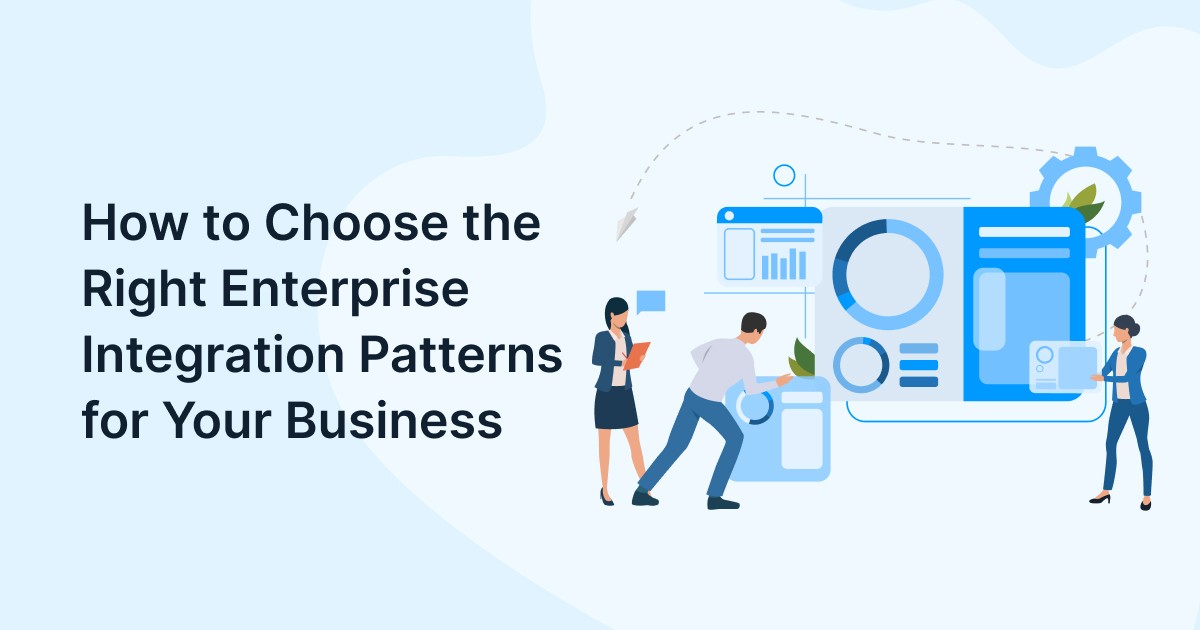
Enterprise Integration Patterns help organisations determine how applications, databases, cloud platforms & business processes should communicate. The right pattern improves scalability, data visibility, system reliability, and operational efficiency, while the wrong choice can create performance bottlenecks, higher maintenance costs, and long-term technical debt.
As businesses expand their technology ecosystems, integration stops being a technical consideration and becomes a business decision. Customer data may live in a CRM, finance data in an ERP, operational information in cloud applications, and reporting data in a warehouse. The challenge is not simply connecting these systems. The challenge is choosing a connection method that continues to work as the organisation grows.
This is where Enterprise Integration Patterns become essential. Rather than designing every integration from scratch, businesses use proven architectural approaches that define how data should move, how applications should communicate, and how systems should remain scalable over time.
Organisations that are evaluating modern integration services often discover that success depends less on the tools themselves and more on selecting an integration pattern that aligns with business goals, system complexity, and future growth plans. This is why choosing an integration approach should be part of a broader technology strategy rather than a standalone IT initiative.
Summary
- Enterprise Integration Patterns provide proven ways to connect enterprise systems.
- There is no universally “best” integration pattern.
- Your ideal pattern depends on business complexity, scalability requirements, real-time needs & existing technology investments.
- API-led and event-driven approaches are widely used in modern integration architectures, particularly where organizations need reusable services, asynchronous communication, or near-real-time responses.
- Most successful organisations combine multiple patterns rather than relying on one architecture.
What Are Enterprise Integration Patterns and How Do They Differ from Integration Architectures?
Enterprise Integration Patterns are important because they provide a structured way to connect systems without creating unnecessary complexity. They reduce development effort, improve reliability & make future integrations easier to manage.
Many organisations start with isolated integrations. A CRM is connected to an ERP. An ERP is connected to a reporting platform. A reporting platform is connected to a data warehouse.
Initially, these connections appear manageable. Over time, however, each new application requires additional integrations. The architecture quickly becomes difficult to monitor, expensive to maintain, and vulnerable to failures.
This challenge is commonly known as the “integration spaghetti” problem. Enterprise Integration Patterns solve this by introducing standardised approaches for communication, routing, transformation & data exchange.

Which Enterprise Integration Pattern Is Best for Your Business?
The best Enterprise Integration Pattern depends on four factors: the number of systems involved, how frequently data moves, how quickly information must be shared, and the expected growth of the organisation.
Many businesses search for a single “correct” pattern. In reality, selecting an integration pattern is like selecting a vehicle. A compact car, delivery truck, and construction vehicle all serve different purposes.
The same principle applies to integration architecture.
| Architecture approach | Best suited for | Key strength | Main trade-off |
| Point-to-point | Small or relatively stable system landscapes | Simplicity | Becomes harder to manage as connections multiply |
| Hub-and-spoke | Centralized integration environments | Centralized connectivity and control | Central hub can become a dependency |
| ESB | Complex enterprise integration with centralized mediation/governance | Routing, transformation and mediation | Platform complexity and centralized operational overhead |
| API-led | Reusable application/service connectivity | Reusability and controlled access | Requires API lifecycle and governance discipline |
| Event-driven | Asynchronous, reactive and high-volume workflows | Loose coupling and independent consumers | Eventual consistency, observability and operational complexity |
The objective is not selecting the most advanced architecture. The objective is selecting the architecture that solves today’s challenges without limiting tomorrow’s opportunities.
What Is the Difference Between Point-to-Point, ESB, and API-Led Integration?
The primary difference is how systems communicate and how easily the architecture can expand when new applications are introduced.
Point-to-Point Integration
Each application communicates directly with another application. A business with five systems may maintain these connections successfully.
A business with fifty systems usually cannot. While point-to-point integrations offer quick implementation, they often become difficult to maintain as application ecosystems grow.
Enterprise Service Bus (ESB)
ESB introduces a central integration layer. Instead of creating individual connections, applications communicate through a shared service bus.
This approach improves governance, transformation capabilities, and visibility across the enterprise. For readers trying to understand how middleware supports these architectures, our guide on enterprise integration middleware provides useful context on the role middleware plays in message routing and orchestration.
API-Led Integration
API-led integration exposes system functionality through reusable APIs. Rather than building custom integrations repeatedly, applications rely on standardised interfaces.
This improves agility, accelerates development, and supports cloud-first transformation strategies. According to Postman State of the API Report 2025, 82% of surveyed organizations have adopted some level of an API-first approach, while 25% describe themselves as fully API-first.
How Should Businesses Evaluate Their Integration Strategy?
Businesses should evaluate their integration strategy by assessing scalability, data movement requirements, governance needs, and future technology plans rather than focusing only on current integration challenges.
A common mistake is designing integrations purely around current requirements. For example, a company with ten applications may optimise for today’s environment and ignore future expansion plans.
Two years later, after cloud migrations, acquisitions, and SaaS adoption, the architecture requires complete redesign. An effective integration strategy should answer the following questions:
How Many Systems Need to Be Connected?
The larger the application ecosystem, the more important architectural standardisation becomes.
How Fast Must Data Move?
Not every system requires real-time communication. Customer order processing may require immediate updates, while financial reporting can operate effectively through scheduled synchronisation.
Are Legacy Systems Involved?
Older enterprise systems frequently influence pattern selection. Many organisations adopt hybrid architectures because replacing legacy systems immediately is not practical.
How Quickly Will the Business Scale?
Integration decisions should account for the organization’s expected technology and business changes over the medium term, including cloud adoption, SaaS expansion, acquisitions and new digital channels.
This growing application landscape is one of the main reasons Enterprise Integration Patterns have become increasingly important for modern businesses.
How Does EAI Architecture Influence Long-Term Success?
A strong EAI architecture creates a framework that allows systems, applications, and data sources to work together consistently as the business evolves.
Enterprise Application Integration is no longer limited to on-premises environments. Modern EAI architecture includes –
- SaaS applications
- Cloud platforms
- Data warehouses
- Customer platforms
- AI models
- External partner systems
This broader scope means integration decisions affect nearly every business function. Organisations developing an connected data ecosystem often benefit from understanding how enterprise data integration contributes to data consistency, reporting accuracy, and operational visibility across the enterprise.
For a broader overview of integration technologies, governance, middleware and implementation approaches, see our guide to enterprise integration services.

What Integration Best Practices Help Avoid Costly Mistakes?
The most effective integration best practices focus on governance, scalability, reusability, security & observability rather than simply getting systems connected quickly.
Short-term integrations often become long-term liabilities. To avoid this outcome –
- Standardise API Design – Consistent API standards improve maintainability and developer productivity.
- Avoid Hardcoded Dependencies – Tightly coupled systems become expensive to update.
- Design for Monitoring – Visibility should be built into integrations from the beginning.
- Prioritise Reusability – Reusable services reduce implementation effort for future integrations.
- Think Beyond Technology – Every integration project should be connected to a measurable business objective.
For organisations building enterprise-grade architectures, understanding broader integration architecture patterns and implementation approaches can help align technical decisions with strategic business goals.
Conclusion
Choosing the right Enterprise Integration Patterns is not about selecting the most sophisticated architecture available. It is about selecting the approach that best aligns with your business objectives, operational complexity, technology landscape, and future growth plans.
A successful integration strategy balances immediate requirements with long-term scalability. Whether your organisation relies on traditional EAI integration, API-led connectivity, event-driven systems, or hybrid architectures, the goal remains the same: create a connected ecosystem that can adapt as the business evolves.
If you’re evaluating enterprise-wide integration initiatives and need guidance on architecture, implementation, or modernisation, explore how LedgeSure’s integration experts can help design a scalable integration framework tailored to your business needs.
Frequently Asked Questions:
Q: What areEnterprise Integration Patterns?
A: Enterprise Integration Patterns are proven design approaches that help organisations connect applications, databases, services & processes efficiently. They provide reusable solutions for common integration challenges and improve scalability, reliability, and maintainability.
Q: Why is an integration strategy important?
A: An integration strategy ensures that technology investments align with business goals. It helps organisations reduce operational inefficiencies, improve data consistency, enable automation, and support future digital transformation initiatives.
Q: What is EAI architecture?
A: EAI architecture, or Enterprise Application Integration architecture, defines how systems, applications, and data sources communicate across an enterprise. It includes integration technologies, governance standards, communication protocols & operational processes.
Q: Which integration pattern is best for cloud environments?
A: API-led integration is often a strong fit for cloud environments because APIs provide reusable interfaces between applications and services. However, cloud architectures may also require event-driven messaging, asynchronous workflows, data integration or hybrid approaches depending on the workload.
Q: How does event-driven integration work?
A: Event-driven integration enables applications to respond to events asynchronously, often with near-real-time processing depending on the event broker, network, processing pipeline and application design.
Q: What are the biggest integration challenges?
A: Common challenges include legacy systems, data silos, security requirements, scalability limitations, performance bottlenecks & lack of governance across multiple applications and platforms.
Q: When should a business upgrade its integration architecture?
A: Businesses should consider upgrading their integration architecture when they experience scalability issues, increasing maintenance costs, poor system performance, growing application ecosystems, or digital transformation requirements.