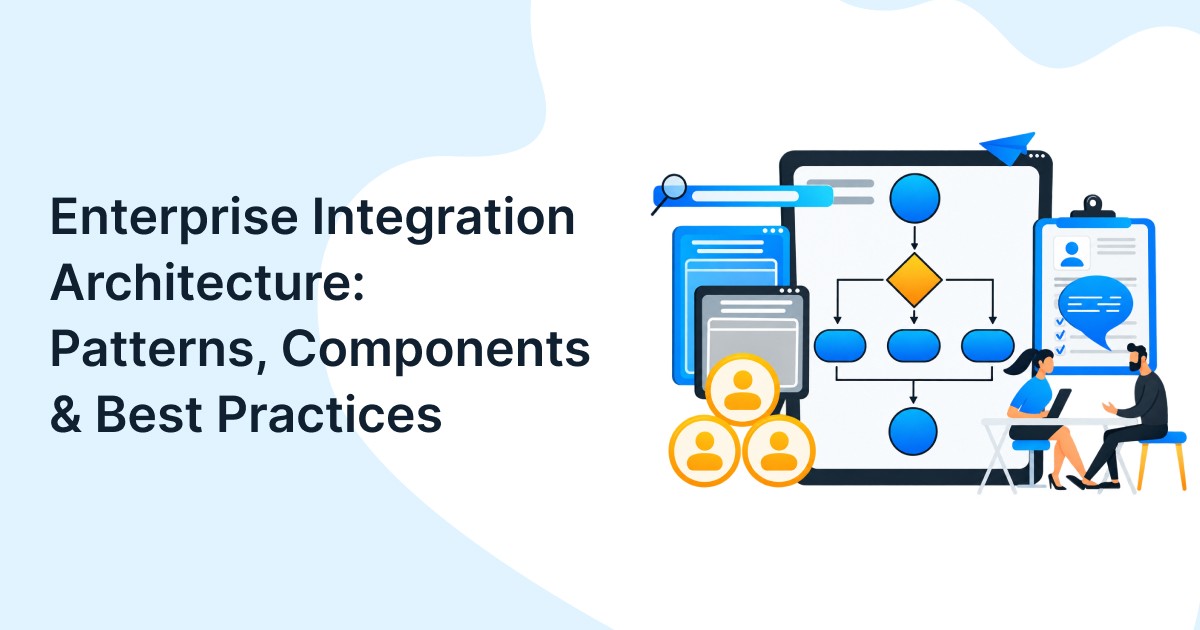
Enterprise Integration Architecture is a structured framework that connects applications, data sources, cloud platforms, APIs & business processes across an organisation. It enables seamless data exchange, real-time decision-making, improved operational efficiency, and scalable digital transformation through standardised integration patterns, governance & security.
Modern enterprises operate hundreds of interconnected technologies, from ERP platforms and CRM systems to SaaS applications, analytics tools, AI solutions, and cloud infrastructure. While these systems drive business operations, they often create fragmented data, inconsistent processes, and operational silos when they are not designed to work together.
This is where enterprise integration architecture becomes critical. A well-designed architecture goes beyond connectivity. It creates a scalable, governed, and secure framework for how systems communicate, share information, and support business outcomes.
Organisations investing in modern enterprise integration solutions often achieve faster automation, improved visibility, and greater business agility.
Key Takeaways
- Enterprise integration connects applications, systems, data, and business processes across the organisation.
- Modern enterprise integration architecture relies heavily on APIs, event-driven systems, middleware & governance.
- Common enterprise integration patterns include API-led, ESB, point-to-point, hub-and-spoke, and event-driven models.
- SaaS integration architectures require specialised approaches to manage cloud application ecosystems.
- Enterprise data integration patterns ensure consistent and reliable data flow across systems.
- AI is increasingly enhancing integration monitoring, mapping, security, and workflow optimisation.
- Effective governance and reusable integration assets are essential for long-term scalability.

Enterprise integration is the process of connecting applications, data, business processes & technology platforms so information can move seamlessly across an organisation.
Most businesses use numerous systems that serve different functions. Finance teams may rely on ERP platforms, sales teams use CRMs, customer service teams operate through support applications, and operations teams depend on specialised tools.
Without enterprise integration, these systems become isolated environments that limit visibility and slow decision-making.
Enterprise integration helps organisations –
- Eliminate data silos
- Automate business processes
- Improve reporting accuracy
- Enhance customer experiences
- Accelerate digital transformation initiatives
- Improve operational efficiency
At its core, enterprise architecture integration ensures technology ecosystems operate as a connected environment rather than a collection of disconnected applications.
Why Is Enterprise Integration Architecture Important?
Enterprise integration architecture provides a standardised framework that enables systems, applications, and data to communicate efficiently while supporting future business growth.
Many integration projects begin as one-off initiatives. Over time, these point solutions create complexity, technical debt, and maintenance challenges. A formal enterprise integration architecture prevents this by establishing governance, standards, and reusable connectivity frameworks.
Key Business Benefits
-
Improved Operational Efficiency
Integrated systems eliminate manual data transfers and reduce duplicate work across teams.
-
Enhanced Business Agility
New applications and technologies can be integrated faster without rebuilding infrastructure from scratch.
-
Better Customer Experiences
Connected systems create a unified customer view and support faster service delivery.
-
Real-Time Decision-Making
Integrated data supports live reporting and more informed business decisions.
-
Reduced Technology Complexity
Standardised integration approaches simplify maintenance and improve scalability.
Businesses evaluating the strategic role of connectivity can also explore how integration solutions support business growth.
Industry Insight
According to MuleSoft’s Connectivity Benchmark Blog, organisations use an average of more than 957 applications, with only 27% connected, yet only a fraction are fully integrated, creating significant operational complexity and data silos.
What Are the Core Components of Enterprise Integration Architecture?
Successful enterprise integration architecture depends on multiple interconnected components that support communication, transformation, governance, security, and orchestration.
API Layer and API Management
Modern architecture relies heavily on API integration capabilities. Key functions include:
- API gateways
- Authentication and authorisation
- Traffic management
- Version control
- API lifecycle management
APIs make business capabilities reusable while accelerating innovation.
Middleware and Integration Platforms
Middleware acts as the bridge between applications that use different protocols, formats, and technologies. Common capabilities include –
- Routing
- Transformation
- Orchestration
- Application connectivity
- Monitoring
Data Integration Layer
Data often exists in multiple formats and locations across the enterprise. The data layer enables –
- Data synchronisation
- Data cleansing
- ETL processing
- ELT processing
- Master Data Management
Event Processing Systems
Modern enterprises increasingly operate in real-time environments. Technologies such as Apache Kafka, Azure Service Bus, and AWS EventBridge support –
- Event-driven communication
- Real-time notifications
- High-volume transactions
- Asynchronous processing
Security and Governance
Security should be embedded throughout the integration lifecycle through –
- Identity management
- SSO
- Access controls
- Encryption
- Compliance monitoring
What Are the Most Common Enterprise Integration Patterns?
Different enterprise integration patterns solve different connectivity challenges. The best pattern depends on business goals, application landscape, scalability requirements, operational maturity, and future growth plans.
| Integration Pattern | Best Use Case | Relative Scalability | Relative Complexity | When to Use | Key Trade-Off |
| Point-to-Point | Small environments with limited integrations | Lower | Lower | When connecting a few applications quickly | Becomes difficult to manage as systems increase |
| Hub-and-Spoke | Organisations seeking centralised integration management | Moderate | Moderate | When multiple systems require central governance | Creates dependency on the central hub |
| Enterprise Service Bus (ESB) | Large enterprises with complex workflows | High | Moderate to High | When routing, orchestration, and transformation are business critical | Can become difficult to modernise over time |
| API-Led Integration | Cloud-first and digital transformation initiatives | High | Moderate | When building reusable services and scalable connectivity | Requires strong API governance |
| Event-Driven Architecture | Real-time business processes and customer experiences | Very High | High | When applications must react immediately to events | Monitoring and troubleshooting can be more complex |
Point-to-Point Integration
Applications connect directly with each other. While fast to implement, this model becomes difficult to manage as additional systems are added.
Hub-and-Spoke Architecture
A central hub manages communication between applications, reducing direct dependencies across systems.
Enterprise Service Bus (ESB)
ESB-based EAI architecture centralises message routing, transformation, and orchestration for large-scale enterprise environments.
API-Led Integration
API-led integration exposes reusable business services through APIs and has become one of the most widely adopted enterprise integration design patterns.
Event-Driven Architecture
Event-driven integration architecture patterns allow systems to react immediately to business events, enabling real-time operations.
What Are the Main SaaS Integration Architecture Patterns?
The main SaaS integration architecture patterns include point-to-point, hub-and-spoke, API-led, iPaaS-based, and event-driven integration models. Each supports different levels of scalability and operational complexity.
As businesses increasingly adopt cloud technologies, SaaS integration has become a major enterprise requirement.
-
Point-to-Point SaaS Integration
Suitable for connecting a small number of cloud applications.
-
Hub-and-Spoke SaaS Integration
A central integration layer manages multiple SaaS applications through a single connectivity framework.
-
API-Led SaaS Integration
Supports flexibility, reusability, and scalable cloud ecosystems.
-
iPaaS-Based Integration
Integration Platform as a Service (iPaaS) solutions simplify connectivity between cloud and on-premise systems.
-
Event-Driven SaaS Integration
Ideal for real-time updates across business-critical cloud applications.
What Are Enterprise Data Integration Patterns?
Enterprise data integration patterns define how information is collected, transformed, synchronised, and delivered across systems while maintaining accuracy and consistency.
Common enterprise data integration patterns include –
- ETL (Extract, Transform, Load)
Data is transformed before entering the destination system.
- ELT (Extract, Load, Transform)
Transformation occurs after loading, commonly used in cloud analytics environments.
- Change Data Capture (CDC)
Tracks and synchronises only the data that has changed.
- Data Virtualisation
Provides access to data without physically moving it.
- Master Data Management (MDM)
Creates a single trusted source of business-critical information.
What Are Embedded Integration Architecture Patterns?
Embedded integration architecture patterns enable software providers and enterprises to build integrations directly into products rather than relying on standalone integration projects.
As digital ecosystems expand, embedded integrations are becoming increasingly important. Examples include –
- Native product integrations
- Embedded iPaaS solutions
- White-label integration experiences
- Customer-facing integration marketplaces
These embedded integration architecture patterns are particularly valuable for SaaS providers seeking faster customer onboarding and stronger product adoption.
Which Enterprise Integration Approach Is Right for Your Organisation?
To choose the right enterprise integration approach, organisations should evaluate their existing technology landscape, integration requirements, scalability goals, operational maturity, and long-term digital transformation strategy. Most enterprises combine multiple integration approaches rather than relying on a single model.
Understanding Integration Approaches vs Integration Platforms
Before selecting an integration strategy, it is important to distinguish between integration architectures, integration patterns & integration platforms.
| Category | Definition | Examples |
| Architectural Approach | High-level integration strategy that defines how systems interact | API-Led Integration, Event-Driven Architecture |
| Integration Pattern | Design approach used to connect applications and services | Hub-and-Spoke, Point-to-Point, Publish-Subscribe |
| Integration Platform | Technology used to implement integrations | MuleSoft, Boomi, Informatica, Azure Integration Services |
| Enterprise Integration Framework | Governance model, standards, policies and operating practices that guide integration initiatives | Enterprise integration governance, API standards, lifecycle management |
Common Enterprise Integration Approaches Compared
| Approach | Best Suited For | Key Strength | Typical Challenge | Recommended When |
| API-Led Integration | Cloud-first and digitally transforming organisations | Reusable services and scalability | Requires strong API governance | Building modern, reusable enterprise integrations |
| Event-Driven Architecture | Real-time operational environments | Immediate response to business events | Event monitoring complexity | Supporting real-time customer and business processes |
| ESB-Based Integration | Enterprises with complex legacy ecosystems | Centralised orchestration and transformation | Can become difficult to modernise | Integrating large numbers of existing enterprise applications |
| Hybrid Integration | Organisations operating across cloud and on-premises environments | Flexibility across diverse systems | Additional architectural planning | Supporting gradual modernisation strategies |
Many enterprises today use a combination of frameworks rather than relying on a single approach. For additional insights, explore composable enterprise architecture approaches.
How Does iPaaS Support Enterprise Integration?
Integration Platform as a Service (iPaaS) is a cloud-based technology platform that helps organisations implement and manage integrations more efficiently. It is not an integration architecture itself, but a platform that can support API-led, event-driven, and hybrid integration strategies.
Common use cases include:
- SaaS integration
- Cloud-to-cloud connectivity
- Hybrid cloud integration
- Workflow automation
- Data synchronisation
Examples include MuleSoft, Boomi, Informatica Intelligent Cloud Services, and Azure Integration Services.
How Is AI Reshaping Enterprise Integration Architecture?
AI is transforming enterprise integration architecture by automating mapping, improving monitoring, optimising workflows, and strengthening security across integration ecosystems.
- AI-Powered Data Mapping
AI can automatically identify relationships between data fields and suggest transformation logic.
- Predictive Integration Monitoring
AI systems analyse historical trends to identify failures before they impact operations.
- Intelligent Workflow Optimisation
Machine learning algorithms detect bottlenecks and recommend performance improvements.
- Enhanced Security Monitoring
AI can identify unusual behaviour patterns and accelerate threat detection.
- Agentic AI Integration
One of the newest trends in enterprise architecture integration involves AI agents interacting directly with enterprise systems through secure APIs and event-driven architectures.
How Should Enterprises Approach Hybrid and Multi-Cloud Integration?
Successful hybrid and multi-cloud integration requires a flexible architecture capable of connecting on-premises infrastructure, public clouds, SaaS applications, and external services.
Scalable integration architecture supports connectivity across all environments while maintaining visibility, governance, and security. For practical implementation approaches, read integration engineering for modern enterprises.
What Are Enterprise Integration Best Practices?
Enterprise integration best practices focus on scalability, governance, standardisation, security, and long-term maintainability.
- Adopt API-First Design
Build reusable services that support future integrations.
- Standardise Integration Methods
Use consistent protocols, naming conventions, and documentation practices.
- Establish Governance Early
Define ownership, lifecycle management, and compliance requirements.
- Focus on Data Quality
Poor data quality undermines even the best-designed integrations.
- Build for Reusability
Reusable assets reduce implementation time and operational costs.
- Prioritise Real-Time Integration
Event-driven architectures support faster business responsiveness.
- Monitor Continuously
Observability and proactive monitoring help identify issues before they impact operations.

What Challenges Affect Enterprise Integration Initiatives?
Most enterprise integration projects struggle because of legacy technology constraints, governance gaps, inconsistent data & growing system complexity.
| Challenge | Impact | Recommended Solution |
| Legacy Systems | Limited connectivity | API enablement |
| Data Quality Issues | Poor reporting | Data governance |
| Security Risks | Compliance concerns | Security-by-design |
| Integration Sprawl | Higher costs | Governance frameworks |
| Skills Gaps | Slower execution | Specialist integration expertise |
Addressing these challenges early significantly improves implementation success rates.
Enterprise Integration Trends for 2026
Several trends are shaping the future of enterprise integration architecture –
- Agentic AI integrations
- Event mesh architectures
- Embedded integrations
- Integration observability
- Low-code integration platforms
- Composable enterprises
- Real-time data ecosystems
- Multi-cloud orchestration
Organisations investing in these capabilities today will be better positioned to support future digital transformation initiatives.
Conclusion
Enterprise integration is no longer simply an IT initiative. It is a strategic capability that determines how effectively an organisation connects systems, data, applications, and processes.
By combining proven enterprise integration patterns, scalable enterprise integration frameworks, modern EAI architecture, robust governance, and emerging AI-driven capabilities, organisations can create connected ecosystems that support growth, innovation, and resilience.
Whether you’re building a new enterprise integration architecture, modernising legacy environments, or implementing advanced integration solutions across cloud and SaaS ecosystems, the right strategy can significantly improve business agility and long-term scalability.
Ready to modernise your integration landscape? Contact the LedgeSure team today.
Frequently Asked Questions
Q: What is enterprise integration architecture?
A: Enterprise integration architecture is a framework that connects applications, systems, data, and business processes across an organisation. It provides governance, security, integration standards, and communication methods that enable reliable information sharing between platforms.
Q: What are the most common enterprise integration patterns?
A: The most common enterprise integration patterns are point-to-point, hub-and-spoke, enterprise service bus (ESB), API-led integration, and event-driven architecture. Each pattern is designed to address different operational and scalability requirements.
Q: What are the main SaaS integration architecture patterns?
A: The main SaaS integration architecture patterns include point-to-point integration, API-led integration, iPaaS-based integration, event-driven integration, and hub-and-spoke architectures. These approaches help organisations connect cloud applications efficiently.
Q: What is EAI architecture?
A: EAI architecture, or Enterprise Application Integration Architecture, is a structured approach for connecting enterprise applications through standardised integration frameworks, governance controls, and communication protocols.
Q: What are enterprise data integration patterns?
A: Enterprise data integration patterns include ETL, ELT, Master Data Management, Change Data Capture, and data virtualisation. These approaches ensure accurate and consistent data flow across enterprise systems.
What are embedded integration architecture patterns?
A: Embedded integration architecture patterns involve building integrations directly into software products or platforms. Examples include embedded iPaaS solutions, native integrations, and customer-facing integration marketplaces.
Q: Which enterprise integration framework is best?
A: There is no single best enterprise integration framework. API-led frameworks are often ideal for cloud-first organisations, while ESB frameworks suit complex legacy environments. Many enterprises adopt hybrid approaches for maximum flexibility.
Q: How does AI support enterprise integration?
A: AI supports enterprise integration by automating data mapping, predicting failures, monitoring performance, identifying security threats, and optimising workflows. It helps reduce manual effort while improving integration reliability.
Q: What are enterprise integration best practices?
A: Key enterprise integration best practices include API-first design, strong governance, security-by-design, reusable assets, continuous monitoring, data quality management, and standardised integration processes.