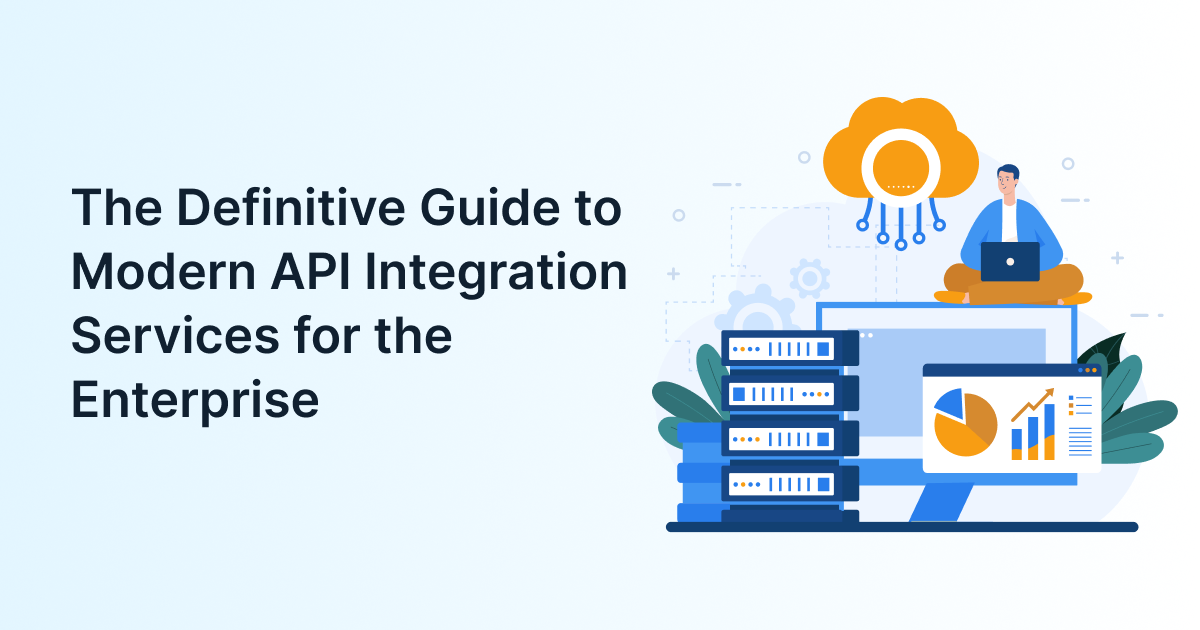
Modern enterprises often rely on a growing mix of applications, cloud platforms, data sources and business systems. Without a well-defined API integration strategy, these systems operate in silos, creating delays, inefficiencies & fragmented customer experiences. Modern API integration services help enterprises connect applications, automate workflows, improve data accessibility, and build a scalable foundation for digital transformation, AI adoption, and API monetization.
As organisations continue expanding their digital ecosystems, API integration has evolved far beyond system connectivity. Today, it plays a critical role in enterprise integration architecture, real-time analytics, automation, governance, and customer experience delivery.
For enterprises with complex application ecosystems, API integration has become a core architectural capability rather than a one-off connectivity project.
Looking to accelerate enterprise connectivity initiatives? Explore LedgeSure’s Integration Engineering Services to discover how modern integration solutions can streamline operations across your business ecosystem.
What Are Modern API Integration Services?
Modern API integration services enable enterprises to connect applications, systems, and data sources through APIs, allowing secure and real-time information exchange across the organisation.
Modern API integration typically emphasizes reusable interfaces, clear contracts, security, observability, lifecycle management and loose coupling, while using direct integrations where they remain appropriate.
An API (Application Programming Interface) acts as a bridge that allows software applications to communicate with each other. API integration services help businesses connect CRM platforms, ERP systems, customer applications, payment solutions, cloud infrastructure, analytics platforms, and third-party services without rebuilding existing systems.
Examples include –
- Connecting Salesforce with SAP
- Integrating eCommerce platforms with inventory systems
- Synchronising customer data across multiple applications
- Enabling real-time reporting dashboards
- Automating approval workflows between departments
As enterprises adopt hybrid and multi-cloud environments, API integration has become the foundation of modern enterprise integration architecture.

Why Are API Integration Services Essential for Enterprise Digital Transformation?
To achieve digital transformation at scale, enterprises need connected systems that can share data instantly and support automated decision-making. API integration services provide that foundation.
Many organisations still struggle with legacy infrastructure, disconnected applications, and fragmented business processes. API integration removes these barriers by creating a unified ecosystem, where, applications exchange information efficiently.
Key business benefits include –
Operational Efficiency
Manual data entry, duplicate processes, and repetitive tasks slow down operations. API integration automates information exchange and reduces administrative overhead.
Improved Customer Experience
Connected systems provide employees with a complete customer view, leading to faster service and personalised interactions.
Faster Innovation
Development teams can reuse existing APIs and services rather than building functionality from scratch.
Better Data Accessibility
Integrated environments improve visibility across departments and support faster decision-making.
Greater Scalability
Modern integration solutions enable organisations to add new systems and technologies without extensive architectural redesign.
How Does Enterprise API Integration Work?
Enterprise API integration works by creating secure communication channels between applications so that data and functionality can be shared automatically across systems.
A typical integration workflow includes –
- A system initiates a request through an API.
- The API securely transfers data to the target system.
- The receiving application processes the request.
- Relevant information is returned in real time.
- Monitoring and governance tools track performance and security.
For example, when a customer places an order online –
- The eCommerce platform sends data through APIs.
- Inventory systems receive stock requests.
- ERP systems update fulfilment records.
- Payment platforms confirm transactions.
- Customer service tools receive updated order status.
These interactions can be automated and coordinated in near real time, depending on the systems, APIs and workflow design involved.
What Are the Main Types of Enterprise Integration Architectures?
Choosing the right enterprise integration architecture is critical because it determines scalability, maintainability, and future digital readiness.
Point-to-Point Integration
Here, applications connect directly.
Advantages
- Can be simple for a small number of integrations but becomes harder to govern and maintain as the number of connections grows.
- Suitable for small environments
Challenges
- Difficult to scale
- Creates management complexity
Hub-and-Spoke Architecture
A central integration hub manages communication between systems.
Advantages
- Easier control
- Simplified management
Challenges
- A centralized hub can simplify management, but creates concentration of architecture, operational and scaling responsibilities around the hub.
API-Led Connectivity
Applications expose reusable APIs for broader accessibility.
Advantages
- Highly scalable
- Faster development
- Better governance
Event-Driven Architecture
Systems communicate through events rather than direct requests.
Advantages
- Real-time responsiveness
- Supports modern digital ecosystems
API Integration vs Traditional System Integration
| Dimension | Modern API-oriented integration | Traditional/legacy integration patterns |
| Connectivity | APIs, events, connectors | Point-to-point, adapters, middleware |
| Reusability | Typically designed around reusable interfaces | Often varies by implementation |
| Cloud integration | Designed for hybrid/cloud environments | May require adapters or modernization |
| Governance | API lifecycle and policy management | Often distributed across middleware/apps |
| Observability | API/event-level monitoring can be integrated | Depends heavily on tooling |
| Change management | Versioning and contract management can reduce coupling | Changes may require coordinated updates |
| Legacy support | Often uses APIs/adapters around legacy systems | Native to many older environments |
This shift explains why enterprises are actively modernising legacy integration approaches.
How Does API Integration Support AI and Intelligent Automation?
Successful AI initiatives depend on access to reliable, connected, and real-time data. API integration makes that possible by linking systems across the enterprise.
Many organisations focus heavily on AI models while overlooking connectivity. Many enterprise AI use cases require reliable access to current business data and systems. APIs provide one way to expose that data and trigger controlled actions.
APIs can act as controlled tools through which AI agents retrieve enterprise data or initiate approved actions, subject to authentication, authorization and governance controls.
- Retrieve customer information from CRM systems
- Access ERP and inventory data
- Trigger workflow automation
- Connect digital assistants to enterprise applications
- Support agentic AI workflows
This is becoming increasingly important as organisations deploy AI-powered copilots and intelligent process automation solutions.
Without strong API integration foundations, these AI-driven initiatives often struggle to scale effectively.
What Challenges Do Enterprises Face During API Integration?
While API integration offers significant benefits, enterprises often face architectural, security & governance challenges during implementation.
-
Legacy Systems
Many organisations operate applications that were not designed for modern API connectivity.
-
Data Silos
Disconnected departments often maintain separate data structures and standards.
-
Integration Complexity
The growing number of applications increases architecture complexity.
-
Security Risks
Poorly managed APIs can increase exposure to cyber threats.
-
Governance Issues
Without ownership standards, organisations risk API sprawl and inconsistent implementation.
A successful API integration strategy requires addressing technology, process, and governance together.
Why Is API Governance and Security More Important Than Ever?
API governance ensures that APIs are secure, scalable, discoverable, and aligned with organisational standards throughout their lifecycle.
As API usage grows, governance becomes a business necessity rather than an IT function. Important governance areas include –
-
API Lifecycle Management
Track API creation, deployment, maintenance, and retirement.
-
Access Control
Use appropriate authentication and authorization mechanisms, such as OpenID Connect, OAuth-based authorization, mutual TLS and workload identities, depending on the integration context.
-
Monitoring and Observability
Monitor performance, usage patterns, and anomalies.
-
Compliance Management
Ensure adherence to industry regulations and security policies.
Enterprises evaluating API security frameworks should also explore emerging concerns around modern API gateway protection strategies, which continue evolving alongside new threat vectors.
How Does API Integration Create a Foundation for API Monetization?
API monetization becomes possible when organisations establish secure, reusable, and governed APIs that deliver measurable business value.
For many enterprises, monetization is the natural next step after establishing a mature API ecosystem. Once APIs are securely integrated, governed, and managed, organisations can begin building sustainable API monetization strategies that create new revenue streams, strengthen partner ecosystems, and unlock additional value from existing digital assets.
API integration is often the first step in a broader API economy strategy. The progression typically looks like this –
API Integration → API Governance → API Management → API Monetization
Businesses can monetise APIs through –
- Subscription access
- Usage-based pricing
- Partner ecosystem models
- Premium functionality offerings
This aligns directly with broader enterprise goals around innovation, customer engagement, and digital revenue generation.
Which Industries Benefit Most from Enterprise API Integration?
Nearly every industry can benefit from API integration, but certain sectors generate particularly strong business outcomes due to complex technology ecosystems.
- Manufacturing
Connects production systems, ERP platforms, supply chains, and predictive maintenance solutions.
- Financial Services
Facilitates open banking, payment integration, fraud monitoring, and customer onboarding.
- Healthcare
Supports secure information exchange across clinical, operational, and patient systems.
- Retail and eCommerce
Synchronises inventory, customer data, logistics, and marketing platforms.
- SaaS Providers
Accelerates product interoperability and partner ecosystem growth.
What Enterprise API Integration Best Practices Should Organisations Follow?
Organisations achieve better outcomes when API integration is treated as a strategic capability rather than a one-time technology project.
Key best practices include –
- Start with Business Objectives
Define measurable outcomes before selecting technology platforms.
- Design for Reusability
Reusable APIs reduce future development effort.
- Build Governance Early
Governance should be embedded from the start, not added later.
- Prioritise Security by Design
Security controls should be implemented throughout the integration lifecycle.
- Invest in Monitoring
Visibility helps teams detect issues before they impact performance.
- Plan for Future Growth
Architectures should support AI, automation, cloud expansion, and evolving integration requirements.
For organisations evaluating future readiness, understanding the latest API integration trends shaping modern technology ecosystems can help inform long-term architectural decisions.
Similarly, businesses adopting modern connectivity approaches should stay informed about API-first architecture developments and emerging enterprise design practices.
What Is the Future of API Integration Services?
The future of API integration services will be driven by AI, automation, composable architectures, event-driven ecosystems, and greater interoperability across digital platforms.
Emerging trends include –
- AI-powered integration platforms
- Low-code and no-code integration tools
- Event-driven architectures
- Agentic AI systems
- API observability platforms
- Composable enterprise architecture
- Increased API monetization initiatives
The organisations that succeed will be those that view APIs not merely as technical interfaces, but as strategic business assets that enable innovation, agility, and growth.
Key Takeaways
- API integration is a foundational component of modern enterprise integration architecture.
- Successful digital transformation depends on connected systems and real-time data exchange.
- Integration solutions improve efficiency, customer experience, scalability, and innovation.
- API governance and security are essential for long-term sustainability.
- AI initiatives require strong API integration capabilities to access enterprise data.
- API integration is a critical foundation for future API monetization opportunities.

Conclusion
Modern enterprises are operating in increasingly complex digital environments where data, applications, and business processes must work together seamlessly. API integration services provide the connectivity layer that enables operational efficiency, real-time decision-making, automation, AI adoption & sustainable growth.
The most successful organisations no longer view API integration as a technical requirement alone. They recognise it as a strategic capability that strengthens enterprise integration architecture, accelerates digital transformation, and creates new opportunities for innovation and monetization.
If you’re evaluating integration solutions or planning a modernisation initiative, LedgeSure can help you design, implement, and scale enterprise-ready integration ecosystems.
FAQs:
Q: What are API integration services?
A: API integration services connect applications, platforms, and systems through APIs, allowing them to exchange data and functionality automatically. These services eliminate manual processes, improve efficiency, and enable real-time communication across business environments.
Q: Why is API integration important for enterprises?
A: API integration helps enterprises remove data silos, streamline operations, automate workflows, and improve decision-making. It creates a connected technology ecosystem that supports digital transformation and long-term business growth.
Q: What is enterprise integration architecture?
A: Enterprise integration architecture is the framework used to connect applications, data, systems, and business processes across an organisation. It defines how information moves securely and efficiently throughout the enterprise.
Q: How does API integration support AI initiatives?
A: AI systems require access to enterprise data from multiple sources. API integration enables AI platforms to retrieve information, execute actions, automate workflows, and support intelligent decision-making across connected environments.
Q: What challenges are common in API integration projects?
A: Common challenges include legacy systems, security concerns, governance issues, inconsistent data formats, integration complexity, and scaling requirements. Effective planning and governance help mitigate these risks.
Q: What is API-led connectivity?
A: API-led connectivity is an integration strategy that uses reusable APIs to connect applications and data sources. This approach improves flexibility, scalability, and development speed across enterprise ecosystems.
Q: How does API integration improve customer experience?
A: By connecting customer-facing and backend systems, API integration enables faster service delivery, accurate information, personalised experiences, and seamless interactions across channels.
Q: Can API integration support API monetization?
A: Yes. Organisations often begin with internal integration initiatives and later expose selected APIs as products. With proper governance and management, APIs can become revenue-generating digital assets.