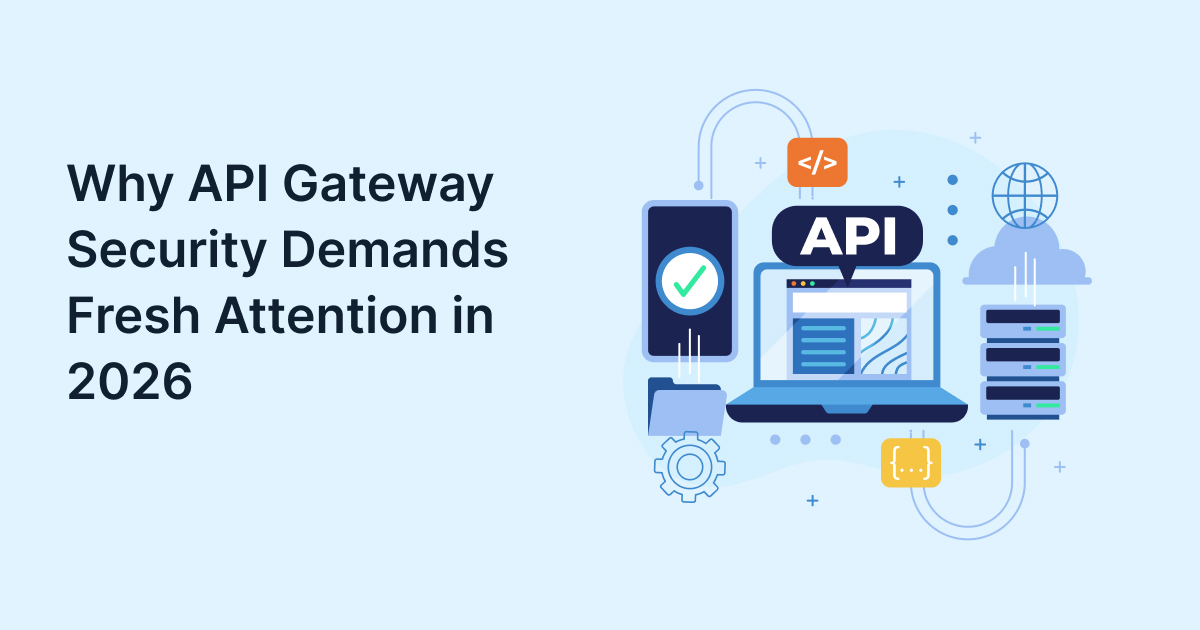
API gateway security deserves more attention in 2026 because the gateway is no longer just a traffic handler. It now sits at the center of access control, service communication & policy enforcement, which makes it one of the most important security layers in modern digital architecture.
As businesses continue to expand their API-driven ecosystems, the gateway has become the place where trust is either protected or exposed. That is why teams cannot afford to treat it as a simple routing tool anymore.
Key Takeaways
- API gateway security is critical in 2026 because gateways now sit at the center of modern access and traffic.
- Misconfiguration, weak policies & poor visibility are the biggest risks.
- Zero trust and least privilege should be standard.
- Monitoring and logging are essential for security and governance.
- Secure gateways help businesses scale safely.
Why does API gateway security matter more in 2026?
API gateway security matters more in 2026 because the gateway sits at the front door of increasingly complex systems. It handles authentication, authorization, routing & request filtering, which means a single weak point can affect many applications at once.
This is especially important for enterprises using microservices, cloud platforms, partner integrations & API-first systems. As the number of connected services grows, the gateway becomes the control point that decides what gets in, what gets blocked & what gets logged.
In simple terms, if the gateway is weak, the whole architecture becomes harder to trust.
Drive Digital Innovation & Transform Your Business
Struggling to find tailored IT solutions that truly accelerate your digital transformation journey? Partner with LedgeSure to unlock the true potential of technology.
What changed in the last few years?
The biggest change is that APIs are now central to how modern businesses operate. They connect customer apps, internal tools, data flows, third-party services & even monetized platforms. That means the gateway is no longer a back-end utility; it is part of the business infrastructure itself.
Another major change is the way attacks look today. Many malicious requests do not appear suspicious at first glance. They may use legitimate tokens, normal-looking patterns, or abused workflows, which makes security harder unless the gateway is configured carefully and monitored continuously.
What risks should teams watch for?
The main risks in 2026 are still familiar, but they are more dangerous because they scale faster in connected environments. Misconfiguration remains one of the most common problems, especially when teams rely on default settings or copy old policies into new environments.
Other risks include weak authentication, poor authorization checks, limited logging & policy drift across teams. These issues can build quietly over time, which is why gateway security needs regular review, not just one-time setup.
| 💡 Did You Know?
“According to Imperva Bad Bot Report 2024, a large share of online traffic is now automated, which makes it harder to tell normal activity from malicious activity.” |
Why is misconfiguration so dangerous?
Misconfiguration is dangerous because it often looks harmless at first. A route that should have been restricted may remain open, or an admin function may be exposed longer than intended. In a distributed system, even one small mistake can create a wider security gap.
That is why gateway policies should be reviewed as carefully as application code. Security teams need to know which routes are public, which are internal & which require stronger controls.
What role does poor visibility play?
Poor visibility makes it hard to detect abuse early. If teams cannot easily see request patterns, authentication failures, policy violations, or unusual traffic spikes, they may only notice a problem after damage has already been done.
A gateway should not only block bad traffic; it should also give teams enough insight to understand what is happening. Without that visibility, response becomes slower and less effective.
Industry insight
“In many enterprises, the real gateway risk is not one major breach but the slow buildup of unnoticed policy drift, where access rules gradually become broader than intended. That is why regular reviews matter just as much as initial setup.”
How should an API gateway be secured?
To secure an API gateway, teams need to combine access control, policy enforcement, logging & regular review. The goal is to make the gateway a trusted enforcement point rather than a passive traffic layer.
This means treating the gateway as part of the security architecture from day one. It should be configured with the same care as identity systems, network controls & application permissions.
What are the most important security controls?
The most important controls are the ones that reduce risk without creating unnecessary friction. A secure gateway should help teams manage traffic safely while still allowing the business to move quickly.
Here are the controls that matter most –
- Strong authentication for all sensitive routes.
- Strict authorization based on least privilege.
- Request validation for schema, payload, and input.
- Rate limiting and throttling to prevent abuse.
- Separate management access from production traffic.
- Detailed logging for access, failures, and policy changes.
- Regular policy audits and configuration reviews.
- Zero trust enforcement across internal and external traffic.
These steps create a stronger baseline and make it easier to spot unusual behavior before it becomes a larger issue.
How does zero trust fit into gateway security?
Zero trust fits naturally into API gateway security because it removes the assumption that internal traffic is automatically safe. In 2026, that assumption is outdated. Every request should be verified, authorized & logged before it is allowed through.
This approach is especially useful in hybrid, cloud-native & microservices environments. When many systems communicate across different platforms, zero trust helps the gateway act as an active security checkpoint instead of a simple pass-through layer.
Why does this matter for modern architecture?
It matters because modern architectures are connected in too many directions to rely on trust by default. Internal services, partner APIs, automation layers & customer-facing apps all interact with one another. If one link is weak, the risk can spread fast.
Zero trust helps reduce that risk by forcing every access decision to be made based on identity, context & policy, not assumptions.
How does gateway security support business growth?
Gateway security supports business growth because it helps companies scale safely. As organizations launch more digital products, connect more partners & expand their API ecosystem, they need a control layer that keeps access manageable and reliable.
A secure gateway also builds confidence across teams and users. When people know traffic is monitored, policies are enforced & sensitive systems are protected, it becomes easier to scale new services without creating unnecessary exposure.
This is why security is not only a defensive function. It is also an enabler of digital growth.
How does this connect to broader business strategy?
This is where the topic connects naturally to broader digital transformation work. Businesses that invest in safer integration and connectivity are better positioned to grow without disruption, which is why related topics like Why integration solutions are critical for business growth are closely connected to this discussion.
The same logic applies to API-led ecosystems. If the architecture is secure, the business can move faster with less risk.
How do API-first systems change the security need?
API-first systems increase the importance of gateway discipline because the gateway often becomes the point where services are exposed, governed & monitored. If that point is not secure, scaling the API strategy becomes riskier.
That is why topics like API-first architecture trends 2026 are closely related to this discussion. The more central APIs become, the more important gateway discipline becomes.
How can API gateways support monetization safely?
API gateways also play a role in monetization because they help control who can access what, how often & under which conditions. That makes them valuable for platforms that package APIs as products or offer tiered access to partners and customers.
A secure gateway helps protect that model. If access controls, logging & throttling are weak, the monetization layer can become a security risk. That is why it also makes sense to connect this topic with API and importance of monetization.
What should teams improve in 2026?
Teams should move beyond basic gateway deployment and focus on governance. That means reviewing policies, tightening access & making sure security settings are consistent across environments. It also means keeping the gateway aligned with current architecture rather than leaving it on an old configuration model.
Another important shift is coordination. Security, integration & platform teams should work from the same standards so that policy decisions are not fragmented across different systems or teams.
Which improvements create the biggest impact?
The biggest improvements usually come from closing the most obvious gaps first. These are the changes that reduce exposure quickly and make the environment easier to manage.
A practical focus list looks like this –
- Remove unnecessary public routes.
- Review and tighten role-based access.
- Turn on detailed logging and alerting.
- Standardize configuration across environments.
- Validate all incoming payloads.
- Limit token scope wherever possible.
- Recheck gateway settings after every major release.
These actions may sound basic, but they are often where the biggest security gains come from.
Gateway security vs weak gateway security
| Area | Weak Gateway Security | Strong Gateway Security |
| Access control | Open or loosely managed routes | Strict least-privilege access |
| Visibility | Limited logs and weak monitoring | Detailed logs and active monitoring |
| Policy management | Inconsistent or outdated policies | Regularly reviewed and standardized policies |
| Attack response | Slow detection and delayed action | Fast detection and clearer incident response |
| Business impact | Higher risk of disruption | Safer scaling and better trust |
This simple comparison shows why gateway security matters beyond the technical layer. It shapes how safely a business can grow and how confidently teams can operate.
Empower Your Workforce with AI & Automated Innovations
Want to boost efficiency and reduce costs? Explore how LedgeSure’s AI-driven solutions simplify workflows and drive real outcomes.
Conclusion
API gateway security in 2026 is about much more than preventing traffic from reaching the wrong place. It is about controlling trust, protecting business operations & giving teams the confidence to scale digital systems safely. When gateway policies are strong, visibility is clear, and access is tightly governed, the entire architecture becomes more resilient.
That is why this topic deserves fresh attention now. The businesses that treat gateway security as a core part of their integration and architecture strategy will be better positioned to grow without exposing themselves to avoidable risk. If you want to strengthen your API layer and build a more secure integration landscape, contact Ledgesure today.