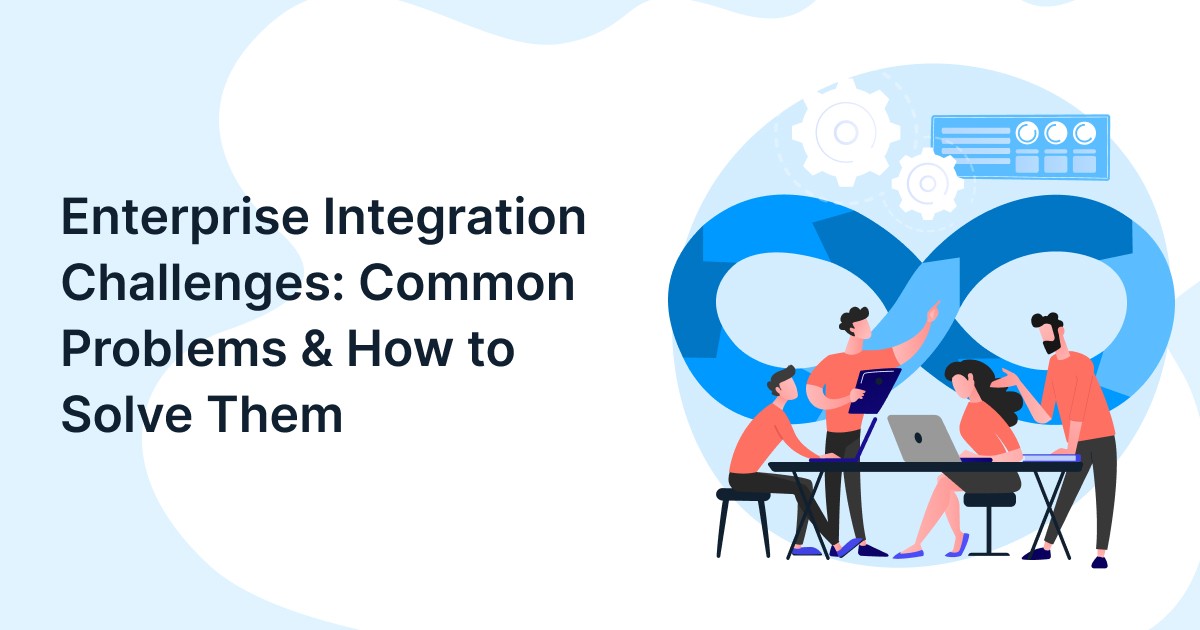
Enterprise integration challenges occur when applications, data, and business processes cannot exchange information reliably across an organisation. Common problems include data silos, legacy systems, poor data quality, security gaps, integration complexity, and scalability limitations.
Digital transformation initiatives have pushed companies to adopt cloud platforms, SaaS applications, customer relationship management systems, ERPs, analytics tools & automation platforms. While these technologies improve operational efficiency, they also create a new problem: disconnected systems.
A sales team may operate from Salesforce, finance may rely on an ERP system, operations may use another platform, while customer support manages interactions through a separate application. When these systems cannot communicate effectively, data becomes fragmented, workflows slow down & business decisions suffer.
This is why modern organisations increasingly invest in professional integration services to create a connected business environment. Whether the objective is application integration, real-time data sharing, cloud migration, or automation, a well-planned integration strategy can significantly improve visibility, efficiency & business agility.
For organisations evaluating enterprise connectivity initiatives, LedgeSure’s integration solutions provide a practical framework for connecting applications, data sources, and business processes through scalable and secure integration architectures.
Key Takeaways
- Enterprise integration projects often fail due to data silos, legacy systems, poor planning, security gaps, and scalability issues.
- Modern integration middleware helps reduce integration complexity and improve connectivity.
- EAI middleware enables multiple business applications to communicate through a central integration layer.
- AI-powered integration tools are improving automation, monitoring, and error resolution.
- Businesses that adopt a structured integration strategy are better positioned to scale and innovate.
Why Do So Many Enterprise Integration Projects Struggle?
Enterprise integration projects often struggle because businesses must connect multiple applications, data sources, and processes that operate across different technologies and environments. Challenges such as data silos, legacy systems, security requirements, inconsistent data, limited governance, and growing integration complexity can quickly increase costs, delay implementation, and make integrations difficult to maintain.
Many companies assume integration simply means connecting one application to another. In reality, enterprise integration involves data structures, security policies, workflows, business rules, APIs, cloud environments, and legacy systems.
When any of these elements are overlooked, projects can face delays, budget overruns, performance issues, and low adoption rates.

Some of the most common enterprise integration challenges include –
- Data silos
- Legacy technology constraints
- Increasing integration complexity
- Security and compliance risks
- Scalability limitations
- Poor data quality
- Lack of governance
- Skills shortages
Let’s look at each challenge in detail and explore practical solutions.
How Do Data Silos Become a Major Enterprise Integration Challenge?
To create a connected enterprise, data must flow seamlessly across departments and applications. Data silos occur when information remains isolated in separate systems, preventing teams from accessing consistent and accurate business data.
Data silos are among the most common causes of failed integration initiatives. For example –
- Customer details exist in CRM software
- Financial information lives in ERP systems
- Marketing data remains in automation platforms
- Support information sits in ticketing systems
Each department works with a different version of reality.
Business Impact:
- Inconsistent reporting
- Duplicate records
- Slower decision-making
- Poor customer experiences
- Increased operational costs
Solution:
A centralised integration layer can synchronise data between systems and help organisations maintain consistent information across applications. Where required, master data management can establish authoritative sources for key business entities such as customers, products, or suppliers.
Businesses should also implement –
- Master data management practices
- Data governance frameworks
- API-led integration strategies
- Real-time synchronisation
This approach is discussed in greater detail in our guide on creating a connected data ecosystem through enterprise data integration, where we examine how organisations can eliminate data fragmentation across departments.
Why Are Legacy Systems Still One of the Biggest Integration Challenges?
Legacy systems create integration challenges because they may use proprietary interfaces, older data structures, limited APIs, or outdated authentication mechanisms. Organisations can often integrate them without immediate replacement by using adapters, APIs, middleware, or hybrid architectures.
To modernise business operations, organisations must connect older systems with modern cloud-based applications. Legacy platforms often lack modern connectivity capabilities, making integration significantly more difficult.
Some legacy systems are extremely stable and secure but difficult to integrate. These platforms typically present challenges such as –
| Legacy System Challenge | Business Impact |
| No API support | Difficult integrations |
| Proprietary technologies | Vendor dependency |
| Outdated database structures | Data mapping issues |
| Poor scalability | Reduced performance |
| Older security mechanisms | Additional security and compliance considerations |
The challenge becomes particularly evident when organisations attempt to connect legacy applications with cloud software, mobile applications, analytics platforms, or AI-driven systems.
Solution
Businesses should avoid replacing all legacy systems at once. Instead –
- Deploy an integration layer
- Use connectors and adapters
- Modernise incrementally
- Implement API gateways
- Introduce hybrid integration architectures
A modern middleware platform can help bridge the gap between legacy infrastructure and modern applications while minimising business disruption.
How Does Growing Integration Complexity Create Operational Problems?
Growing integration complexity creates operational problems when organisations have to manage an increasing number of applications, data flows, and system dependencies. As integration environments expand, teams often face reduced visibility, higher maintenance effort, slower troubleshooting, and a greater risk of failures that can disrupt business operations.
A small environment may be manageable with a limited number of integrations. As organisations add dozens or hundreds of applications, APIs, databases, and SaaS platforms, the number of dependencies becomes much harder to manage without a consistent architecture.
Without a central integration strategy, organisations often end up with –
- Point-to-point integrations
- Duplicate connections
- Difficult maintenance requirements
- Higher technical debt
- Poor visibility into data flows
Solution
This is where integration middleware becomes essential. Rather than creating direct connections between every application, middleware acts as a central integration layer.
Benefits include –
- Simplified architecture
- Easier maintenance
- Improved monitoring
- Faster deployment
- Reduced development effort
If you’re evaluating technologies that reduce integration complexity, our detailed guide to enterprise integration middleware explains how middleware acts as the backbone of scalable enterprise connectivity.
What Security and Compliance Challenges Should Businesses Expect?
Businesses should expect security and compliance challenges whenever data is exchanged between applications, systems, and external platforms. As the number of integrations grows, the risk of unauthorised access, data breaches, inconsistent security controls, and regulatory compliance violations increases, making it essential to secure and monitor every integration point.
Enterprise integrations frequently involve –
- Personal customer information
- Financial records
- Employee data
- Healthcare information
- Intellectual property
If security is not considered from the beginning, integrations can introduce significant risks.
Common Security Challenges
- Unsecured APIs
- Weak authentication controls
- Excessive user permissions
- Limited monitoring
- Compliance violations
Solution
Organisations should –
- Encrypt data in transit and at rest
- Implement role-based access control
- Use secure API gateways
- Conduct regular audits
- Enable continuous monitoring
- Certificate management
- API authentication
- Network segmentation
- Least-privilege access
- Data masking
- Encryption/key management
- Centralized logging
How Can Poor Data Quality Derail Integration Initiatives?
To achieve successful system integration, organisations need consistent, accurate, and standardised data. Poor-quality data can undermine even technically successful integration projects.
Common data quality issues include –
- Duplicate customer records
- Missing information
- Conflicting formats
- Outdated data
- Inconsistent naming conventions
When poor-quality data is transferred between systems, problems spread across the entire organisation.
Solution
Establish processes for –
- Data cleansing
- Data validation
- Data governance
- Master data management
- Automated quality monitoring
Strong integration is not only about connecting systems. It is equally about ensuring trustworthy information flows through those systems.
How Does EAI Middleware Solve Enterprise Application Integration Challenges?
Enterprise Application Integration (EAI) is a broader approach to connecting enterprise applications. EAI middleware can provide the technologies and integration patterns used to implement that connectivity, including message transformation, routing, orchestration, and system adapters.
To reduce integration complexity and improve interoperability, organisations often implement EAI middleware. EAI middleware acts as a central communication framework that allows enterprise applications to exchange data efficiently.
Instead of building separate integrations between every application, EAI middleware creates a structured environment for communication.
Key Benefits of EAI Middleware
- Centralised architecture
- Reduced maintenance costs
- Improved scalability
- Better governance
- Faster deployment
Typical use cases include –
- ERP and CRM integration
- Finance and procurement integration
- Supply chain visibility
- Customer data synchronisation
Organisations designing enterprise-wide integration environments often benefit from understanding proven enterprise integration architecture patterns and best practices, particularly when scalability and long-term maintainability are priorities.
How Does a Lack of Governance Lead to Integration Failures?
A lack of governance leads to integration failures when there are no clear standards for managing systems, data, APIs, and integration processes across the organisation. Without defined ownership, policies, and oversight, integrations can become inconsistent, difficult to maintain, prone to security risks, and increasingly challenging to scale as the technology environment grows.
Many integration projects begin with a specific business need, such as connecting a CRM to an ERP system or integrating cloud applications with on-premise platforms. As more projects are added, different teams may adopt their own tools, standards, and development practices.
Over time, this creates an integration landscape where no one has complete visibility into –
- Data ownership
- API usage
- Security standards
- Integration documentation
- Change management processes
- System dependencies
What starts as a few isolated integrations can quickly evolve into a complex environment that is difficult to troubleshoot or scale.
Business Impact
Without effective governance, organisations often experience –
- Duplicate integrations performing the same functions
- Inconsistent data handling practices
- Increased security and compliance risks
- Higher maintenance costs
- Slower implementation of new projects
- Reduced visibility into integration performance
Solution
Businesses should establish a structured integration governance framework that includes –
- Standardised API design principles
- Defined ownership and accountability
- Integration lifecycle management
- Security and compliance policies
- Centralised monitoring and reporting
- Documentation standards
A robust middleware platform can also support governance efforts by providing centralised visibility into integrations, workflows, APIs & data movement across the enterprise.
The architectural foundations for strong governance often begin with selecting the right integration model.
Why Are Skills Shortages a Growing Enterprise Integration Challenge?
The demand for integration expertise is growing faster than the availability of skilled professionals, making talent shortages a significant challenge for many organisations. As businesses adopt more cloud applications, APIs, and connected systems, limited access to experienced integration specialists can slow project delivery, increase costs, and create operational risks.
Enterprise integration is no longer limited to connecting two applications. Modern projects frequently involve –
- Cloud integration
- API management
- Data transformation
- Event-driven architectures
- Security frameworks
- AI-enabled automation
- Hybrid and multi-cloud environments
As technology ecosystems become more sophisticated, organisations increasingly struggle to find professionals with the specialised knowledge required to design, implement, and manage these integrations effectively.
The challenge becomes even greater when businesses depend on a small number of employees who possess critical integration knowledge. If those individuals leave the organisation, valuable expertise often leaves with them.
Business Impact
A shortage of skilled integration professionals can result in –
- Delayed project delivery
- Increased reliance on external consultants
- Higher operational costs
- Poor integration quality
- Increased system downtime
- Slower digital transformation initiatives
Many organisations also encounter difficulties adopting new technologies such as integration AI because internal teams lack the necessary experience to evaluate and implement emerging integration capabilities.
Solution
Addressing skills shortages requires a combination of workforce development and technology enablement. Organisations can –
- Invest in integration training and certification programmes
- Create internal centres of excellence
- Standardise integration practices and documentation
- Use low-code and no-code integration tools where appropriate
- Partner with experienced integration services providers for complex projects
Modern integration middleware solutions can also reduce technical complexity by providing pre-built connectors, automated workflows, visual development tools, and AI-assisted configuration capabilities. This enables teams to deliver integrations faster without relying exclusively on highly specialised resources.
For organisations looking to scale their integration maturity while reducing dependency on niche skill sets, Enterprise Integration Services: The Complete Guide to Connecting Systems, Data & Applications offers a broader framework for building sustainable, future-ready integration programmes.
Can Integration AI Help Overcome Modern Integration Challenges?
To improve speed, accuracy, and operational efficiency, organisations are increasingly using integration AI within integration platforms and middleware solutions.
Artificial intelligence is transforming enterprise integration in several ways.
Integration AI Applications
- Intelligent Mapping – AI can automatically identify data relationships between systems and reduce manual configuration.
- Predictive Monitoring – AI detects potential failures before they affect business processes.
- Error Resolution – Machine learning models can identify recurring integration issues and recommend corrective actions.
- Workflow Automation – AI helps automate repetitive integration tasks, reducing operational overhead.
As enterprise ecosystems become larger and more complex, integration AI will become an increasingly important part of integration strategies.

What Best Practices Help Organisations Overcome Enterprise Integration Challenges?
To reduce risks and improve project outcomes, organisations should adopt a structured integration approach that balances technology, governance & business objectives.
The most successful integration programmes typically follow these principles:
- Start With Business Outcomes– Focus on the business problem rather than the technology.
- Build an Integration Roadmap– Create a phased implementation strategy aligned with organisational goals.
- Standardise APIs– Reusable APIs simplify future integrations.
- Invest in the Right Middleware Platform– A scalable middleware platform provides flexibility for future growth.
- EstablishData Governance – Good data governance prevents quality issues from spreading.
- Monitor Continuously– Integration performance should be tracked and optimised over time.
- Embrace AI and Automation– Modern integration services increasingly combine automation, analytics, and AI-driven insights to improve efficiency.
For organisations looking to take a broader view of enterprise connectivity, Enterprise Integration Services: The Complete Guide to Connecting Systems, Data & Applications offers valuable insights into integration models, implementation strategies, and long-term governance frameworks.
Conclusion
Enterprise integration has become a business necessity rather than a technical initiative. As organisations adopt more applications, cloud platforms & digital services, the ability to connect systems effectively directly impacts operational efficiency, customer experience & business agility.
The most common enterprise integration challenges, including data silos, legacy systems, security risks, data quality issues, and scalability limitations, can be addressed through a combination of strategy, governance, and technology.
By implementing the right integration middleware, leveraging modern EAI middleware, investing in scalable integration services, and adopting AI-enabled integration practices, businesses can transform fragmented technology environments into connected ecosystems that support growth and innovation.
If your organisation is planning an integration initiative or struggling with disconnected systems, contact the LedgeSure team to explore tailored integration strategies designed for complex enterprise environments.
Frequently Asked Questions
Q: What are the most common enterprise integration challenges?
A: The most common enterprise integration challenges include disconnected systems, data silos, legacy applications, poor data quality, security concerns, scalability issues & growing integration complexity. These challenges often prevent organisations from achieving seamless data sharing and operational efficiency.
Q: What is integration middleware and why is it important?
A: Integration middleware is a software layer that enables communication between applications, databases, cloud platforms & enterprise systems. It simplifies connectivity, reduces integration complexity, and provides centralised management of data flows and business processes.
Q: How does EAI middleware differ from standard integration tools?
A: EAI middleware focuses specifically on connecting enterprise applications through a central integration framework. It provides greater governance, scalability, and interoperability than traditional point-to-point integration approaches.
Q: Why do data silos create business problems?
A: Data silos restrict information sharing across departments and systems. This can lead to duplicate data, inconsistent reporting, delayed decisions, operational inefficiencies & poor customer experiences.
Q: Can legacy systems still be integrated successfully?
A: Yes. Legacy systems can be integrated using API gateways, connectors, adapters, middleware platforms, and hybrid integration architectures without requiring immediate replacement.
Q: How does integration AI improve enterprise integration?
A: Integration AI helps automate data mapping, monitor system performance, detect errors, optimise workflows & improve overall integration efficiency while reducing manual effort.
Q: What should businesses consider when choosing a middleware platform?
A: Organisations should evaluate scalability, API support, security features, cloud compatibility, monitoring capabilities, ease of deployment, and long-term maintenance requirements when selecting a middleware platform.
Q: What are the benefits of professional integration services?
A: Integration services help businesses connect systems, improve data visibility, automate workflows, enhance operational efficiency, reduce manual effort & support digital transformation initiatives.
Q: What is the difference between EAI and API integration?
A: EAI (Enterprise Application Integration) connects multiple enterprise applications through a central integration framework, while API integration enables direct communication between systems using APIs. In most organisations, API integration is one part of a broader EAI strategy that manages application connectivity, data flow, and business processes across the enterprise.
Q: How do you reduce integration complexity in large enterprises?
A: The best way to reduce integration complexity is to use integration middleware, standardise APIs, establish governance policies, and replace point-to-point connections with a central integration architecture. This improves visibility, simplifies maintenance, and makes future integrations easier to scale.