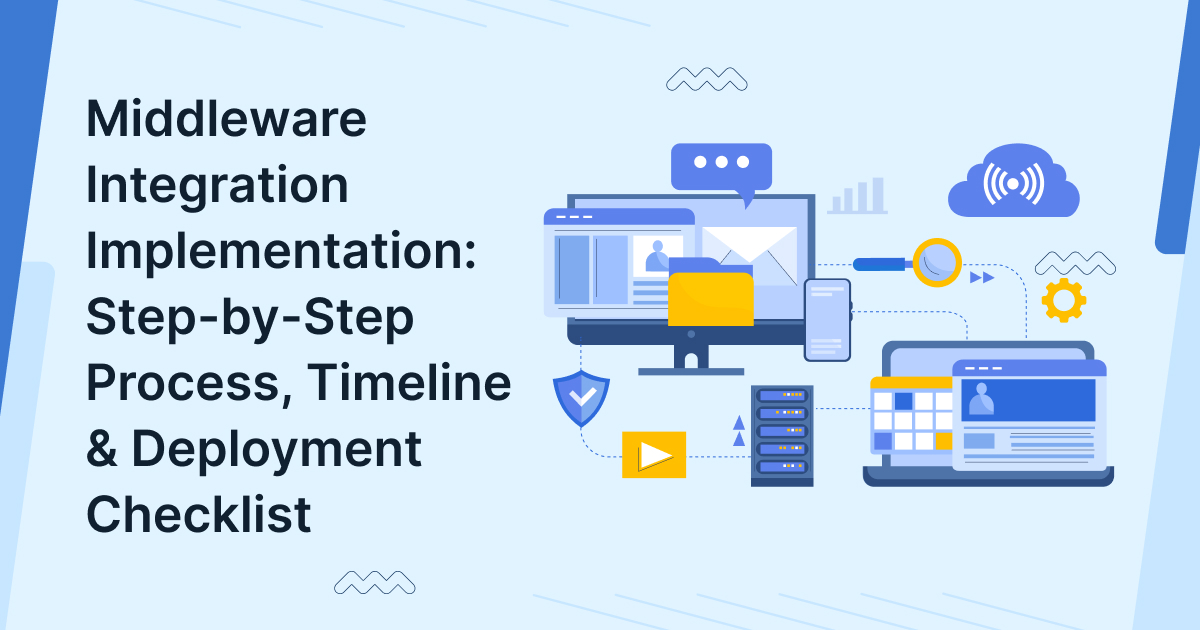
Middleware integration implementation is the process of connecting applications, data sources, APIs, and business systems through a middleware layer that streamlines communication, automates workflows, and improves operational efficiency. A successful implementation requires a clear integration strategy, structured deployment plan, governance framework, and post-deployment monitoring.
As enterprises adopt hybrid cloud platforms, SaaS applications, microservices, and AI-driven workflows, integration complexity continues to rise. ERP systems, CRMs, data warehouses, supply chain platforms, and customer-facing applications must work together in real time.
Organizations that invest in the right integration implementation approach can reduce manual operations, improve data consistency, and accelerate digital transformation initiatives.
Whether you’re planning a new middleware deployment or modernizing an existing integration ecosystem, this guide explains the implementation process, realistic timelines, common pitfalls, and a practical checklist for success.
For organizations evaluating enterprise-grade integration solutions, LedgeSure’s Integration Engineering Services help streamline complex integration environments while reducing implementation risk.
Why Is Middleware Integration Implementation Important?
Businesses implement middleware to create reliable communication between systems, eliminate data silos, and enable scalable digital operations without replacing legacy infrastructure.
Modern enterprises use dozens of applications across departments. Sales teams use CRM platforms, finance relies on ERP systems, operations depend on supply chain applications, and customer support uses service platforms.
When these systems operate independently, organizations face:
- Inconsistent data
- Duplicate processes
- Slow decision making
- Manual data entry
- Increased operational risk
Middleware acts as a centralized communication layer that allows systems to exchange information securely and efficiently.
If you’re new to middleware architecture, our guide on how middleware works across enterprise environments explains its architecture, business benefits, and common use cases in greater detail.

What Are the Key Phases of Middleware Integration Implementation?
A successful middleware integration implementation typically follows six phases: assessment, architecture design, development, testing, deployment, and optimization. Skipping any phase increases project risk and reduces long-term scalability.
Phase 1: Discovery and Assessment
The implementation process begins with understanding the existing technology landscape.
Key activities include:
- Application inventory
- Integration mapping
- Data flow assessment
- Business requirements gathering
- Security and compliance evaluation
The objective is to identify what needs to be integrated, how data moves between systems, and where bottlenecks currently exist.
Phase 2: Integration Strategy and Architecture Design
An effective integration strategy defines how systems will communicate and scale in the future. Architects evaluate:
- Point-to-point integrations
- Middleware platforms
- Event-driven architecture
- API-led integration approaches
- Hybrid cloud requirements
This phase establishes governance standards, security policies, and implementation priorities.
Phase 3: Development and Configuration
This stage focuses on building and configuring integration workflows. Typical tasks include:
- Connector development
- API configuration
- Data mapping
- Workflow creation
- Business rule implementation
Organizations using modern middleware integration services typically prioritize reusable integrations to reduce future development efforts.
Phase 4: Testing and Validation
Testing ensures integrations function correctly before production deployment. Testing should cover:
- Functional testing
- Data validation
- Security testing
- Performance testing
- Failover and recovery testing
Many implementation failures can be traced back to insufficient testing rather than platform limitations.
Phase 5: Middleware Deployment
Middleware deployment should occur in a controlled environment with rollback plans in place. Deployment activities include:
- Production migration
- User acceptance testing
- Performance validation
- Security verification
- Documentation updates
Phase 6: Monitoring and Optimization
Implementation does not end after deployment. Organizations should continuously monitor:
- Transaction volumes
- Latency
- System health
- Error rates
- Security incidents
Platforms such as Genova IQ help organizations improve visibility across integration ecosystems through intelligent monitoring and analytics capabilities.
How Long Does Middleware Integration Implementation Take?
Most middleware integration implementation projects take between 8 and 20 weeks, although timelines vary based on system complexity, integration volume, security requirements, and business objectives.
Typical Middleware Implementation Timeline
| Project Phase | Estimated Duration |
| Discovery & Assessment | 1-2 Weeks |
| Architecture Design | 2-4 Weeks |
| Development & Configuration | 4-8 Weeks |
| Testing & Validation | 2-4 Weeks |
| Deployment | 1-2 Weeks |
| Optimization | Ongoing |
Factors That Influence Timelines
- Number of systems being connected
- Legacy application complexity
- Data transformation requirements
- API availability
- Security requirements
- Regulatory compliance obligations
Large enterprises often require phased implementations to minimize operational disruption.
| 💡 Did You Know?
Gartner predicts that by 2027, more than 65% of application integration activity will involve low-code or no-code integration technologies, helping organizations accelerate deployment timelines and reduce dependency on specialist resources. |
What Should Be Included in a Middleware Deployment Checklist?
An enterprise-ready middleware deployment checklist helps reduce project risks by ensuring technical, operational, and governance requirements are addressed before production rollout.
Middleware Deployment Checklist
Planning
- Define business objectives
- Identify all systems requiring integration
- Document integration requirements
- Establish governance policies
Architecture
- Finalize integration architecture
- Design data flow diagrams
- Validate scalability requirements
- Review API readiness
Security
- Perform security assessment
- Configure access controls
- Encrypt data in transit
- Validate compliance requirements
Testing
- Functional testing completed
- Performance testing completed
- Security testing completed
- User acceptance testing completed
Deployment
- Rollback procedures defined
- Backup strategy validated
- Monitoring configured
- Documentation updated
Post-Deployment
- KPI dashboard established
- Error monitoring enabled
- Training completed
- Optimization roadmap created
What Are the Biggest Middleware Implementation Challenges?
Most middleware implementation challenges stem from data quality issues, legacy system limitations, governance gaps, and scalability concerns rather than the middleware platform itself.
Common obstacles include:
- Legacy System Integration – Older systems often lack modern APIs, requiring custom connectors and transformation of logic.
- Data Quality Issues – Incomplete, inconsistent, or duplicate data can disrupt integration workflows and affect downstream systems.
- Governance Gaps – Without ownership and standardization, integrations become difficult to maintain as environments grow.
- Scalability Challenges – Initial implementations may work effectively but struggle under increasing transaction volumes.
A well-defined integration implementation framework significantly reduces these risks.
How Is AI Transforming Middleware Integration Projects?
AI is making middleware implementation faster, smarter, and more proactive by improving monitoring, anomaly detection, workflow optimization, and integration management.
Emerging AI applications include:
- Intelligent data mapping
- Automated error resolution
- Predictive maintenance
- Workflow recommendations
- Performance optimization
- Security anomaly detection
Rather than replacing integration specialists, AI enhances operational visibility and simplifies management across large-scale environments.
Middleware vs API-Led Integration: Which Approach Is Better?
Neither approach is universally better. Middleware works best for complex enterprise environments, while API-led integration often suits modern, service-oriented architectures.
| Factor | Middleware | API-Led Integration |
| Legacy Integration | Excellent | Moderate |
| Scalability | High | High |
| Complex Data Transformation | Excellent | Moderate |
| Cloud-Native Flexibility | Good | Excellent |
| Governance | Strong | Strong |
| Deployment Complexity | Moderate | Lower |
Organizations evaluating architectural approaches may find our comparison of middleware and API integration approaches useful when planning future initiatives.
Why Do Middleware Integration Projects Fail?
Middleware projects typically fail when organizations underestimate planning requirements, overlook governance, or treat deployment as the finish line rather than the beginning of integration management.
Common reasons include:
- Poor requirements gathering
- Lack of stakeholder involvement
- Weak testing processes
- Inadequate documentation
- Data quality problems
- No post-deployment monitoring strategy
A practical way to reduce risk is partnering with experienced middleware integration services providers that understand enterprise-scale deployments and operational requirements.
Organizations seeking a broader understanding of enterprise integration models often explore Middleware Integration Services: Complete Guide for Enterprises before defining their implementation roadmap.
What KPIs Should You Track After Deployment?
The success of middleware deployment should be measured through business outcomes and operational performance rather than deployment completion alone.
Recommended KPIs include:
- Integration success rate
- System availability
- API response time
- Transaction throughput
- Data synchronization accuracy
- Mean time to resolution (MTTR)
- Operational cost reduction
Monitoring these metrics helps organizations identify optimization opportunities and justify integration investments.
How Can the Right Integration Partner Improve Outcomes?
An experienced integration partner accelerates implementation by bringing proven frameworks, domain expertise, governance models, and deployment best practices to complex projects.
The right partner helps organizations:
- Reduce implementation risk
- Improve deployment speed
- Strengthen security controls
- Optimize architecture decisions
- Enhance long-term scalability
Instead of focusing solely on technology selection, successful integration projects prioritize alignment between business goals, architecture, and operational readiness.
Organizations evaluating budgets, timelines, and deployment complexity may also benefit from understanding middleware integration pricing considerations and implementation costs before launching an initiative.
Conclusion
Middleware integration implementation is no longer just an IT initiative. It is a business-critical capability that enables digital transformation, operational efficiency, and enterprise agility.
Organizations that approach implementation with a structured integration strategy, realistic deployment timelines, governance standards, and continuous optimization practices are far more likely to achieve long-term success.
Whether you’re modernizing legacy environments, integrating cloud applications, or scaling enterprise operations, investing in the right architecture and implementation approach can dramatically improve outcomes.
If you’re planning a middleware deployment or evaluating enterprise integration solutions, connect with the LedgeSure team to discuss your requirements and build an integration strategy tailored to your business goals.

Key Takeaways
- Middleware creates secure communication between enterprise systems.
- A structured implementation approach reduces risk and accelerates deployment.
- Most middleware integration implementation projects take 8-20 weeks.
- Deployment success depends on planning, testing, governance, and monitoring.
- AI is improving visibility, performance optimization, and integration management.
- Long-term success requires continuous monitoring and optimization.
Frequently Asked Questions
Q. What is middleware integration implementation?
A. Middleware integration implementation is the process of configuring middleware platforms to connect applications, systems, databases, and APIs. It enables seamless communication, data exchange, process automation, and operational efficiency across enterprise environments.
Q. How long does middleware implementation usually take?
A. Most projects take between 8 and 20 weeks. Smaller deployments can be completed faster, while large enterprise implementations involving multiple legacy systems may require several months.
Q. What is middleware deployment?
A. Middleware deployment refers to moving integration workflows, configurations, connectors, and supporting infrastructure into a production environment where they can support live business operations.
Q. What are the most common middleware implementation challenges?
A. Organizations commonly face data quality issues, legacy system constraints, scalability requirements, governance gaps, security concerns, and insufficient testing during implementation.
Q. How does AI help middleware integration?
A. AI helps automate data mapping, detect anomalies, monitor transactions, optimize workflows, and improve operational visibility across complex integration environments.
Q. What is the difference between middleware and API integration?
A. Middleware serves as a central integration layer connecting multiple systems, while API integration focuses on direct communication between applications through APIs. Many organizations use both approaches together.
Q. What should be included in a middleware deployment checklist?
A. A deployment checklist should include architecture validation, testing completion, security verification, backup planning, monitoring setup, governance reviews, rollback procedures, and post-deployment optimization plans.
Q. Should enterprises outsource middleware implementation?
A. Many enterprises engage external specialists when dealing with large-scale integration projects. Experienced partners bring technical expertise, implementation frameworks, risk management capabilities, and deployment best practices.