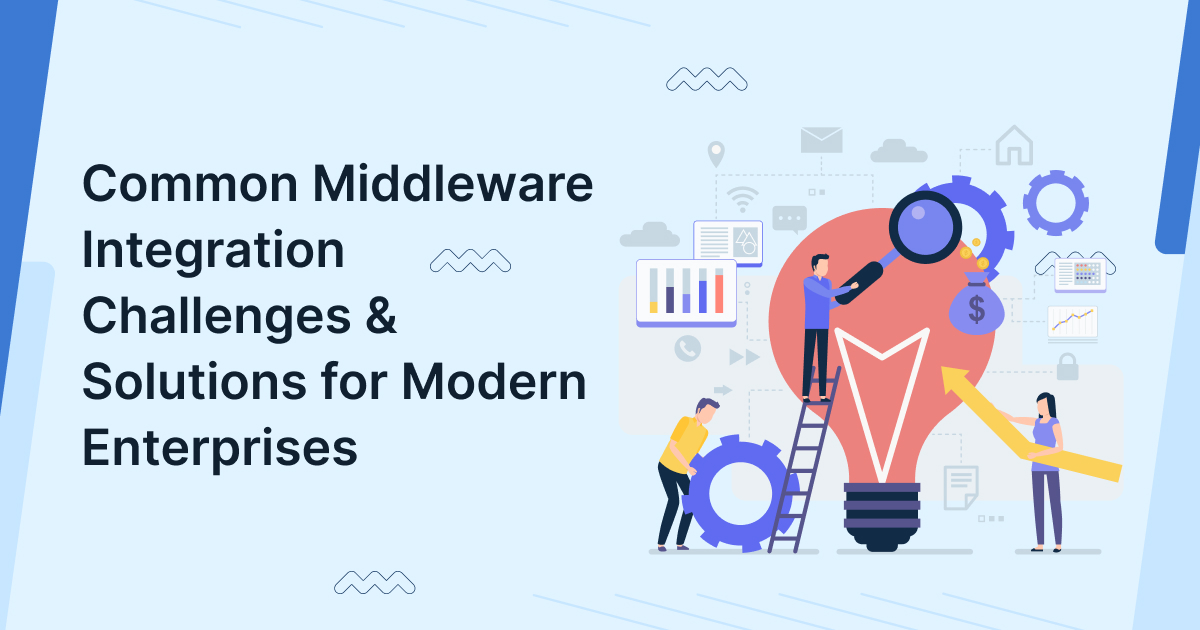
Middleware integration challenges commonly arise from legacy systems, disconnected applications, inconsistent data formats, security vulnerabilities, and growing hybrid cloud complexity. Organizations can address these challenges through scalable integration architecture, governance frameworks, proactive monitoring, and modern integration solutions that improve visibility and system reliability.
As organizations expand their technology ecosystems, connecting applications is no longer the only challenge. Maintaining seamless communication between cloud platforms, enterprise applications, databases, AI systems, and third-party tools has become the real challenge.
Today’s enterprises often operate with dozens or even hundreds of applications. This is where middleware becomes a critical business enabler. Effective middleware helps bridge technology gaps, automate data exchange, and support enterprise-wide workflows. Organizations investing in integration solutions and scalable middleware integration services can significantly improve operational efficiency while reducing long-term maintenance costs.
For businesses planning enterprise-wide integration initiatives, Ledgesure’s Integration Engineering Services provide the expertise needed to build scalable, future-ready integration architectures.
Key Statistics
According to IBM’s Cost of a Data Breach Report, 2026, organizations that extensively use security AI and automation to identify and contain breaches 108 days faster on average than organizations that do not.
What Are Middleware Integration Challenges?
Middleware integration challenges are the technical, operational, and architectural issues that prevent applications, databases, APIs, and business systems from communicating effectively. These obstacles can slow digital transformation initiatives, increase operational costs, and reduce overall business agility.
A typical enterprise may need to connect:
- ERP platforms
- CRM systems
- Data warehouses
- SaaS applications
- Customer portals
- AI-powered applications
- Legacy infrastructure
Each additional connection introduces new opportunities for integration problems. As environments grow more complex, organizations often discover that connectivity alone is not enough. Security, governance, visibility, and scalability become equally important considerations.
Businesses that want a deeper understanding of integration fundamentals can explore how middleware integration works, including its architecture, benefits, and use cases before evaluating modernization strategies.

What Are the 7 Most Common Middleware Integration Challenges Enterprises Face?
The most common middleware integration challenges include legacy system compatibility, inconsistent data formats, security risks, limited visibility, scalability constraints, hybrid cloud complexity, and AI-driven data demands. Each challenge impacts business performance differently and requires its own solution strategy.
1. Legacy System Compatibility
Many organizations continue to depend on decades-old mission-critical applications. While these systems still perform important business functions, they often lack:
- Modern APIs
- Real-time connectivity
- Cloud compatibility
- Standardized integration capabilities
As a result, integration teams must rely on custom development, adapters, or complex middleware configurations.
Solution: Implement integration layers that expose legacy functionality through APIs while preserving existing business processes.
2. Inconsistent Data Formats
Different applications often represent the same data in different ways. For example:
- Customer names may follow different formats.
- Product codes may vary between platforms.
- Regional data standards may differ across systems.
This creates synchronization issues and reporting inaccuracies.
Solution: Establish enterprise-wide data standards and implement automated transformation rules within your middleware architecture.
3. Security and Compliance Risks
As data moves across multiple platforms, the integration layer becomes a critical security control point.
Potential risks include:
- Unauthorized access
- Data leakage
- Weak authentication
- API vulnerabilities
- Regulatory non-compliance
Solution: Use encryption, identity management, role-based access controls, and continuous monitoring throughout the integration lifecycle.
4. Lack of Integration Visibility
Many organizations discover integration failures only after business operations are disrupted.
Without visibility, teams struggle to answer questions such as:
- Where did the transaction fail?
- Which application caused the delay?
- What data was affected?
Solution: Implement observability tools that provide real-time monitoring, transaction tracing, and centralized alerting.
5. Scalability Limitations
An integration strategy that works for ten applications may fail when supporting one hundred.
As transaction volumes increase, middleware bottlenecks become more noticeable. Common symptoms include:
- Delayed processing
- Performance degradation
- Resource constraints
- User experience issues
Solution: Adopt scalable integration architectures that can grow alongside business requirements.
6. Hybrid Cloud Complexity
Most enterprises now operate across:
- On-premises environments
- Public cloud services
- Private cloud platforms
- Third-party SaaS applications
Every environment introduces different security policies, connectivity models, and management requirements.
Solution: Use hybrid-ready integration platforms capable of supporting multiple deployment models.
7. AI and Intelligent Automation Integration
AI initiatives are creating entirely new integration challenges. Enterprise AI applications require:
- Reliable data access
- Real-time information exchange
- Strong governance
- High-quality datasets
Poor integrations often result in inaccurate outputs and reduced trust in AI systems.
Solution: Create centralized data pipelines and intelligent integration architectures designed specifically for AI-driven workloads.
Why Do Enterprise Integration Projects Often Fail?
Enterprise integration projects usually fail because organizations focus on connecting systems instead of managing the broader integration ecosystem.
Several root causes consistently appear across failed implementations.
Poor Planning
Organizations frequently underestimate integration dependencies between systems. What appears to be a simple connection may affect:
- Business workflows
- Compliance processes
- Reporting systems
- Customer experiences
Lack of Governance
Without clear standards, integration environments become difficult to manage. Governance helps establish:
- Data ownership
- Security policies
- API standards
- Change management controls
Technical Debt
Years of custom integrations can create highly complex environments that are difficult to scale or maintain.
Inadequate Monitoring
Many businesses monitor infrastructure but not integration health. This creates blind spots that delay issue detection and resolution.
Why Is Integration Observability Becoming a Business Requirement?
Organizations need integration observability because modern digital ecosystems depend on uninterrupted data movement between multiple systems. Without visibility into those interactions, troubleshooting becomes reactive and costly.
Monitoring tells teams that a system failed. Observability explains:
- Why it failed
- Where it failed
- What impact it had
- How to prevent recurrence
This distinction is becoming increasingly important as enterprises manage larger integration environments
Organizations implementing advanced integration solutions are increasingly prioritizing observability alongside security and scalability.
Is Traditional Middleware Enough in an API-First Enterprise?
Traditional middleware remains important, but most modern enterprises benefit from combining middleware with API-led integration strategies.
The choice is no longer middleware versus APIs. Instead, organizations need both technologies to work together.
| Traditional Middleware | API-Led Integration |
| Centralized architecture | Distributed architecture |
| Strong legacy support | Strong cloud support |
| Complex maintenance | Higher flexibility |
| Internal connectivity focus | Internal and external connectivity |
| System-centric approach | Service-centric approach |
For organizations evaluating architectural approaches, the guide on middleware vs API integration and their key differences provides a deeper comparison of both models.
How Does AI Change Middleware Requirements?
AI adoption requires middleware platforms to support greater data volume, speed, governance, and intelligence.
Unlike traditional integrations, AI systems continuously consume information from multiple business applications.
Common AI-related middleware issues include:
Data Quality Challenges – Inaccurate or outdated data directly impacts AI performance.
Real-Time Processing Requirements – AI applications often require immediate access to enterprise data.
Governance and Compliance – Organizations must maintain complete visibility into how AI systems access and use information.
Cross-System Context Sharing – AI platforms frequently need information from:
- CRMs
- ERPs
- Knowledge bases
- Analytics environments
Solutions like Genova IQ help organizations derive actionable intelligence from integrated enterprise environments while maintaining visibility and governance.
How Can Organizations Solve Middleware Integration Challenges?
Organizations can solve middleware integration challenges by combining modernization efforts, governance frameworks, security best practices, and proactive monitoring.
The most successful enterprises follow a structured approach.
Assess the Current Environment
Document:
- Applications
- APIs
- Data flows
- Dependencies
This provides a clear roadmap for improvement.
Standardize Integration Processes
Standardization reduces operational complexity and improves consistency across projects.
Prioritize Security from the Start
Integration security should be embedded into architecture design rather than added later.
Invest in Observability
Real-time visibility helps teams resolve issues before they affect users.
Plan for Future Growth
Integration platforms should support:
- New applications
- Cloud expansion
- Increased transaction volumes
- AI initiatives
Organizations evaluating enterprise-scale modernization programs often begin by understanding middleware implementation costs, pricing factors, and deployment considerations before selecting a long-term strategy.
The Ledgesure CONNECT Framework for Modern Integration Success
Most organizations view integration as a project. High-performing enterprises treat it as a strategic capability.
The Ledgesure CONNECT Framework provides a practical roadmap:
C – Consolidate Systems
Reduce unnecessary complexity across applications.
O – Optimize Data Flows
Eliminate redundant processing and bottlenecks.
N – Normalize Data
Create consistent data standards.
N – Navigate Compliance
Embed governance into integration architecture.
E – Enable Observability
Improve visibility across all integration points.
C – Continuously Monitor
Detect and resolve issues proactively.
T – Transform Architecture
Modernize integration environments for future growth.
For organizations exploring enterprise-wide Middleware Integration Services: Complete Guide for Enterprises, these principles serve as the foundation for scalable modernization efforts.
Middleware Integration Best Practices for 2026
Organizations creating future-ready integration ecosystems should prioritize:
- API-first architecture design
- Hybrid cloud readiness
- Integration observability
- Data governance frameworks
- Security by design
- Scalable infrastructure
- AI-ready data pipelines
- Continuous performance optimization
The enterprises seeing the greatest return on integration investments are those treating integration as an ongoing business capability rather than a one-time implementation effort.
Key Takeaways
- Middleware remains a critical component of enterprise digital transformation.
- Legacy systems, data silos, and scalability limitations continue to drive integration problems.
- Hybrid cloud environments and AI adoption are creating new integration requirements.
- Observability is becoming as important as connectivity itself.
- Organizations achieve better outcomes when they combine governance, security, and modernization strategies.
- A structured framework can significantly reduce middleware issues and improve long-term scalability.
Conclusion
Middleware integration challenges have evolved far beyond simple system connectivity. Today’s enterprises must manage complex ecosystems spanning cloud services, legacy applications, APIs, and AI platforms.
The organizations that succeed are not necessarily those with the most technology. They are the ones with the right integration strategy, strong governance, end-to-end visibility, and scalable architecture.
Whether you’re modernizing legacy infrastructure, enabling hybrid cloud operations, or preparing for AI-driven innovation, investing in the right integration solutions and middleware integration services can create a more resilient and future-ready business.
Ready to simplify complex integrations and unlock greater enterprise agility? Contact the Ledgesure team to discuss your integration goals and build a scalable integration roadmap.

Frequently Asked Questions
Q. What are middleware integration challenges?
A. Middleware integration challenges are obstacles that affect communication between applications, databases, cloud platforms, and enterprise systems. Common examples include legacy system compatibility issues, inconsistent data formats, security vulnerabilities, scalability limitations, and lack of visibility into integration performance.
Q. How can organizations reduce integration problems?
A. Organizations can reduce integration problems by adopting standardized integration practices, implementing governance frameworks, improving data quality, strengthening security controls, and investing in observability tools that provide real-time monitoring and troubleshooting capabilities.
Q. Why do legacy systems create middleware issues?
A. Legacy systems often lack APIs, real-time connectivity options, and modern security capabilities. This makes integration more complex and frequently requires custom development, specialized connectors, or middleware solutions to bridge technology gaps.
Q. What is the difference between middleware and API integration?
A. Middleware serves as an integration layer that helps systems communicate, while APIs define how applications exchange information. Most modern enterprises use both technologies together to support complex business workflows.
Q. Why is observability important in system integration?
A. Observability helps teams understand how data moves across systems and identify the root causes of failures. This improves troubleshooting, reduces downtime, and supports better operational decision-making.
Q. How does AI affect middleware architecture?
A. AI applications require access to accurate, timely, and governed data from multiple business systems. As a result, organizations need more scalable integrations, stronger governance controls, and real-time data delivery capabilities.
Q. What are the most important middleware integration best practices?
A. Best practices include implementing security by design, standardizing data formats, maintaining governance policies, investing in observability, building scalable architectures, and continuously monitoring integration performance.
Q. Are middleware integration services still relevant in cloud-native environments?
A. Yes. Even cloud-native organizations often need middleware to connect applications, orchestrate workflows, manage data flows, and integrate cloud platforms with legacy or third-party systems.