AI-assisted migration can accelerate repeatable activities such as discovery, dependency analysis, mapping and testing, but outcomes depend on the quality of the migration tooling, source environment, and human validation. However, enterprises achieve the best modernization outcomes when AI-driven automation is combined with human expertise, governance, and architecture oversight.
Legacy integrations are becoming one of the biggest obstacles to digital transformation. Many enterprises still rely on aging middleware, tightly coupled systems & complex integration networks that were never designed for today’s cloud-native and API-led environments.
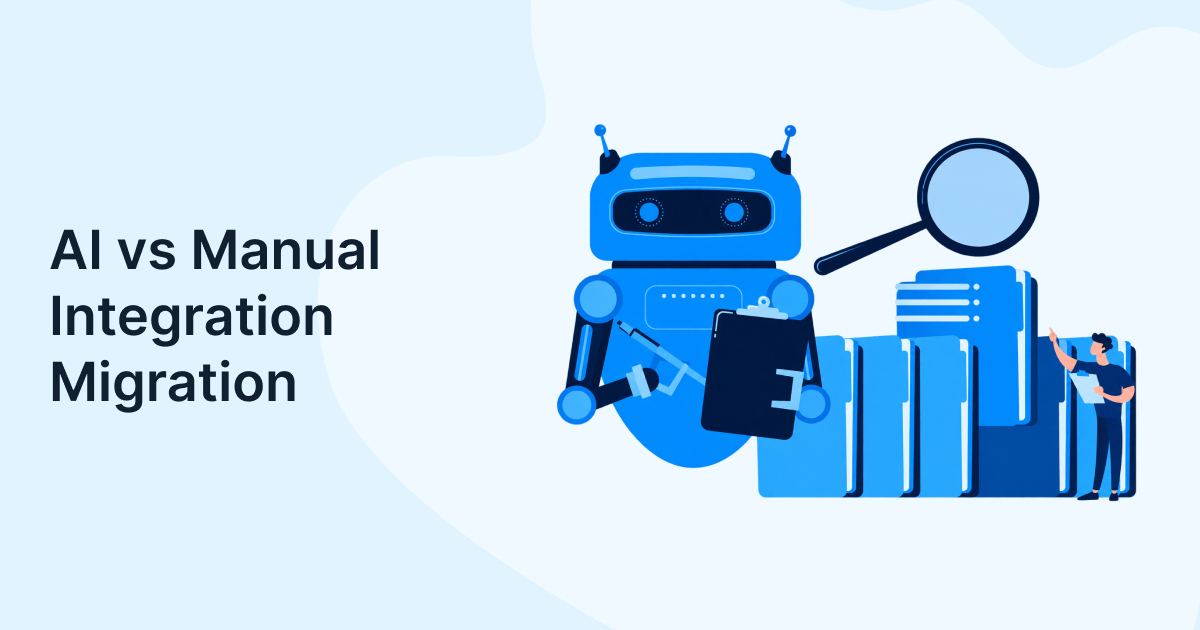
As businesses modernize their technology ecosystems, a common question emerges: AI vs manual integration migration, which approach is better for enterprises?
The answer depends on factors such as integration complexity, project scope, regulatory requirements, and modernization goals. While manual migration offers precise control, advances in AI migration tools and migration automation are changing how organizations approach large-scale transformation initiatives.
Enterprises investing in modern integration solutions often start by evaluating their existing systems, architecture, and future business requirements. Working with experienced integration engineering services teams can help organizations build a roadmap that balances speed, risk management, and long-term scalability.
Summary
- AI migration significantly reduces discovery, mapping, and testing effort.
- Manual migration offers greater control over highly customized integrations.
- AI-driven automation improves speed, consistency, and scalability.
- Human oversight remains essential for governance and compliance.
- Hybrid migration models are becoming the preferred enterprise approach.
- Most large-scale modernization initiatives achieve stronger ROI through AI-assisted migration.
What Is AI-Powered Integration Migration?
AI-powered integration migration uses automation, machine learning, and intelligent analysis to streamline integration modernization projects. Rather than manually reviewing every workflow and connection, AI systems can identify dependencies, generate mappings, recommend transformations, and accelerate testing.
Modern AI migration tools help organizations manage migration projects more efficiently by reducing repetitive tasks and improving visibility into complex integration environments.
Common capabilities include –
- Automated integration discovery
- Dependency mapping
- Workflow analysis
- Intelligent transformation recommendations
- Automated testing support
- Migration documentation generation
For enterprises with hundreds of integrations spread across multiple business systems, AI can dramatically reduce the time required to assess and prepare migration projects.

How Does Manual Integration Migration Work?
Manual integration migration relies on architects, developers & integration specialists to analyze, rebuild, validate, and deploy integrations individually. Every migration decision is reviewed and executed through human expertise.
This approach has been the traditional method for decades because it allows complete control over migration activities.
Typical manual migration activities include –
- Reviewing legacy integrations
- Mapping source and target systems
- Refactoring integration logic
- Rebuilding workflows
- Testing integrations manually
- Validating business processes
Although manual migration provides detailed oversight, it often increases project timelines and resource requirements. Large enterprises managing extensive integration portfolios can find manual approaches costly and difficult to scale.
AI vs Manual Integration Migration: What Are the Key Differences?
The primary difference between AI and manual migration is the level of automation involved. AI-powered approaches automate repetitive and time-consuming tasks, while manual migration depends heavily on human effort throughout the project lifecycle.
| Factor | AI-assisted migration | Manual-led migration |
| Discovery | Strong fit for automated inventory and dependency analysis | Detailed but resource-intensive |
| Mapping | Can accelerate repetitive mappings | Greater manual control |
| Complex business logic | Requires expert validation | Strong human interpretation |
| Testing | Can automate test generation/execution | Greater manual effort |
| Governance | Requires defined human controls | Direct human review |
| Scale | Well suited to large portfolios | Resource-intensive at scale |
| Highly customized integrations | May require significant intervention | Can provide closer control |
| Regulatory validation | Automation can assist evidence gathering/testing | Human review remains central |
| Architecture decisions | Decision support | Human-led |
| Best fit | Large, repeatable migration tasks | Complex/high-touch integrations |
The larger the migration project, the more advantages AI-driven automated integration migration tends to deliver. However, manual migration still has a place when business logic is extremely specialized, or regulatory requirements demand extensive validation.
Which Approach Delivers Better ROI for Enterprises?
For most large-scale modernization initiatives, AI-assisted migration delivers stronger long-term ROI. Faster project execution, reduced manual effort, and lower operational costs contribute directly to business value.
Manual migration may appear less expensive initially because it avoids investment in automation platforms. However, as project complexity increases, labor costs and resource demands often outweigh those savings.
ROI improvements from AI commonly come from –
- Faster migration timelines
- Reduced manual rework
- Improved testing accuracy
- Better documentation quality
- Lower operational disruption
- Increased scalability
Industry Insight
According to McKinsey’s State of AI research, organizations implementing AI continue to report measurable improvements in operational efficiency and business performance.
For enterprises pursuing integration modernization, these efficiency gains can significantly impact project economics and transformation outcomes.
How Do AI Migration Tools Accelerate Integration Modernization?
AI migration tools accelerate modernization by automating several of the most time-consuming phases of migration projects. Instead of spending weeks manually documenting integrations and dependencies, teams can generate insights in a fraction of the time.
Several capabilities drive this acceleration.
Automated Discovery
AI can identify integrations, endpoints, dependencies, and workflow relationships across enterprise environments. This reduces assessment effort and uncovers hidden connections that may otherwise be missed.
Intelligent Mapping
Migration tools help organizations match legacy integrations with modern cloud, API, and middleware architectures more efficiently.
Faster Testing
Automated testing capabilities improve validation processes and help teams identify issues earlier in the migration lifecycle.
Documentation Generation
Many enterprises struggle with missing or outdated integration documentation. AI can generate architecture inventories, dependency reports, and migration artifacts automatically.
Organizations planning an integration migration and modernization roadmap often discover that automation reduces project complexity while improving migration confidence.
What Are the Risks and Limitations of Automated Integration Migration?
Automation improves migration efficiency, but it does not eliminate every challenge. Enterprise migrations often involve unique business processes, compliance requirements, and undocumented dependencies that require human judgment.
Key limitations include –
- Complex Business Rules
AI can analyze patterns, but business-specific exceptions may still require expert validation.
- Regulatory Requirements
Industries such as healthcare, banking, and insurance often require extensive governance and compliance reviews.
- Legacy Technology Constraints
Older systems may contain undocumented integrations that automation tools cannot fully interpret.
- Architectural Decisions
Migration success depends on future-state architecture planning, an area where human expertise remains critical.
These limitations explain why enterprises increasingly favor human-guided automation instead of fully autonomous migration.
Why Are Hybrid Migration Models Becoming the Enterprise Standard?
Hybrid migration models combine the speed of automation with the governance and oversight provided by experienced integration professionals. This balance allows organizations to modernize efficiently without sacrificing control.
Rather than treating migration as an AI-versus-human decision, leading enterprises use each approach where it delivers the greatest value.
AI excels at –
- Discovery
- Dependency analysis
- Mapping
- Testing
- Documentation
Human experts excel at –
- Governance
- Compliance
- Architecture design
- Business process validation
- Risk management
This balance is becoming a defining characteristic of successful enterprise integration architecture strategies.
Organizations exploring AI-powered integration migration initiatives for legacy middleware and ESB environments often find that automation delivers the strongest results when paired with expert oversight.
How Should Enterprises Choose the Right Migration Strategy?
The right migration strategy depends on business goals, technical complexity, compliance obligations, and modernization priorities. There is no universal answer that applies to every organization.
AI-Led Migration May Be Best When
- Hundreds of integrations need assessment
- Project timelines are aggressive
- Documentation gaps exist
- Costs need to be minimized
- Cloud modernization is a priority
Manual Migration May Be Best When
- Workflows are highly customized
- Compliance requirements are extensive
- Significant redesign is required
- Migration scope is relatively small
Hybrid Migration Is Often Best When
- Enterprise-wide modernization is planned
- Governance requirements are high
- Multiple business systems are involved
- Scalability is a long-term objective
Organizations evaluating a broader migration versus modernization strategy should align migration decisions with future business requirements rather than focusing solely on short-term technical goals.
This growing adoption highlights why enterprises are increasingly exploring AI-enabled approaches to migration automation and digital transformation.
Expert Perspective: The Future of Integration Modernization
The future of migration is not defined by AI replacing people. It is defined by AI making integration teams more effective.
As integration environments become larger and more complex, automation helps organizations manage scale without dramatically increasing resource requirements. At the same time, business context, governance & strategic planning remain in human responsibilities.
The strongest modernization programs focus on building scalable enterprise integration architecture, reducing technical debt, and establishing future-ready integration solutions rather than simply moving workloads from one platform to another.

Conclusion
The debate around AI vs manual integration migration is ultimately about choosing the right approach for your modernization goals.
AI delivers significant advantages in speed, scalability, and efficiency, making it a powerful tool for enterprise transformation. Manual expertise, however, remains essential for governance, compliance, and architectural decision-making.
For most organizations, the strongest outcomes come from combining both approaches. By using AI for discovery, mapping, and testing while relying on experts for validation and strategy, enterprises can modernize faster without increasing risk.
If your organization is evaluating integration modernization initiatives, contact our integration experts to build a migration strategy aligned with your business and technology goals.
FAQs
Q. Is AI better than manual integration migration?
A. It depends on the migration estate. AI-assisted approaches can accelerate repetitive discovery, mapping, testing and documentation, while manual expertise remains important for complex business logic, architecture, governance and validation. Many enterprise programs therefore use a hybrid model.
Q. What is automated integration migration?
A. Automated integration migration uses software and AI-powered technologies to discover, analyze, map, and transform integrations with minimal manual intervention. It helps reduce migration timelines while improving consistency and documentation quality.
Q. Can AI migration tools replace integration architects?
A. No. AI migration tools can automate technical tasks, but architecture planning, governance, compliance oversight & strategic decision-making still require experienced professionals.
Q. How does migration automation reduce risk?
A. Migration automation improves consistency, identifies dependencies earlier, automates testing, and reduces manual errors. These capabilities help organizations detect potential issues before production deployment.
Q. When should enterprises choose manual migration?
A. Manual migration is often a better choice when integrations contain extensive customization, complex business logic, or regulatory requirements that require detailed human review.
Q. What is integration modernization?
A. Integration modernization involves upgrading integration platforms, architectures, and workflows to improve scalability, agility, and operational performance while supporting cloud, API, and digital transformation initiatives.
Q. How do AI migration tools support enterprise integration architecture?
A. AI migration tools provide visibility into dependencies, workflows, and architecture patterns. This helps organizations make better modernization decisions and reduce technical debt.
Q. Are AI migration tools secure?
A. Enterprise-grade AI migration platforms typically include governance, access controls, encryption, and compliance features. Organizations should still evaluate security requirements carefully before implementation.