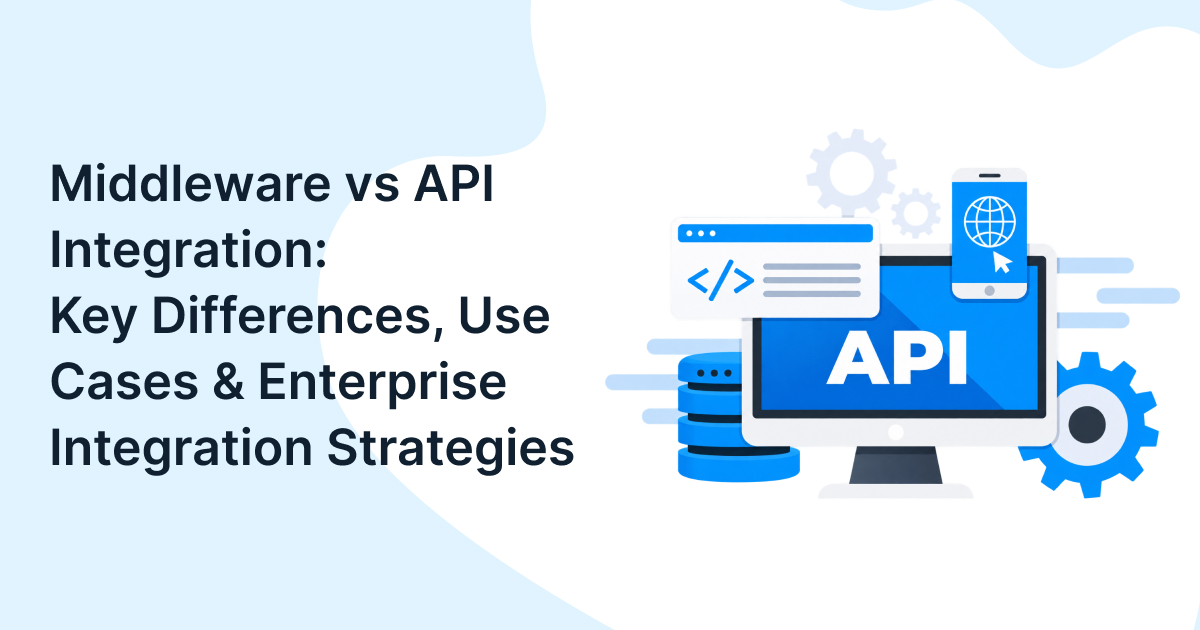
When evaluating middleware vs API integration, the right choice depends on the complexity of your systems, the number of applications involved & your long-term integration goals. API integration enables direct communication between applications, while middleware provides a centralized layer for orchestration, data transformation, governance, and enterprise-wide connectivity.
As organizations adopt more cloud applications, modern data platforms, AI solutions, and legacy systems, integration decisions have become strategic business decisions. A direct API connection may work well for a few applications, but growing enterprises often require broader integration solutions that support scalability, visibility, and governance.
Businesses modernizing their integration landscape frequently combine APIs, middleware, automation, and AI-powered tools to build resilient digital ecosystems. Organizations looking to accelerate enterprise connectivity can leverage Ledgesure’s Integration Engineering Services to simplify complex integration challenges across cloud, on-premises, and hybrid environments.
Middleware vs API Integration at a Glance
| Factor | API Integration | Middleware |
| Primary Purpose | Connect applications directly | Manage enterprise-wide integration |
| Complexity | Low to Moderate | Moderate to High |
| Real-Time Communication | Excellent | Excellent |
| Legacy System Support | Limited | Strong |
| Data Transformation | Basic | Advanced |
| Workflow Orchestration | Limited | Extensive |
| Governance | Distributed | Centralized |
| Best For | SaaS and cloud apps | Large enterprise ecosystems |
What Is the Difference Between Middleware and API Integration?
The primary difference is that APIs enable communication between applications, while middleware manages and coordinates communication across multiple systems. APIs focus on connectivity. Middleware focuses on orchestration, transformation, governance, and scalability.
Think of API integration as building individual roads between locations. Middleware acts more like a transportation network that manages traffic, routes vehicles, and ensures every connection works together efficiently.
This difference becomes increasingly important as organizations grow. Connecting three applications may be manageable with APIs alone. Connecting dozens of enterprise systems often requires middleware architecture to avoid integration complexity and maintenance challenges.

What Is Middleware and How Does It Work?
Middleware acts as a communication layer between applications, systems, and data sources, helping them exchange information efficiently while enforcing governance and business rules.
A middleware platform typically handles –
- Data transformation
- Message routing
- Workflow orchestration
- Authentication and security
- Monitoring and reporting
- Governance and compliance
For example, a manufacturing company may need to connect:
- SAP ERP
- Salesforce CRM
- Warehouse systems
- Supply chain applications
- Customer portals
Instead of managing separate integrations between every platform, middleware provides a centralized integration layer.
This approach improves maintainability and reduces integration sprawl.
What Is API Integration and How Does It Work?
API integration allows applications to communicate directly through defined interfaces that expose data or services to other systems.
An Application Programming Interface (API) defines how applications request and exchange information.
Common API integration examples include –
- CRM and marketing platform synchronization
- Ecommerce payment processing
- Customer portal integrations
- Mobile application backends
- Cloud application connectivity
According to the Postman State of the API Report, APIs are considered mission-critical by more than 70% of organizations, highlighting their growing role in digital transformation initiatives.
Because APIs are lightweight and flexible, they are often the preferred choice for cloud-native environments and real-time user experiences.
When Should Businesses Choose API Integration?
Businesses should choose API integration when they need fast, direct communication between a limited number of systems without requiring extensive orchestration or governance.
API integration is typically ideal when –
- Connecting SaaS Applications – Many modern platforms such as Salesforce, HubSpot, Shopify, and ServiceNow provide mature APIs that simplify connectivity.
- Building Cloud-Native Architectures – Cloud applications are often designed around APIs, making direct integration straightforward.
- Supporting Real-Time User Experiences – APIs excel when applications need instant responses, such as mobile apps, ecommerce platforms, and customer portals.
- Accelerating Time to Value – API implementations can often be deployed faster than large-scale middleware projects.
When Is Middleware the Better Choice?
Middleware becomes the preferred option when multiple systems, complex workflows, or enterprise-wide governance requirements make direct integrations difficult to manage.
Organizations often need middleware architecture when –
Integrating Legacy Systems
Older ERP platforms and proprietary applications frequently lack modern API capabilities.
Companies assessing modernization readiness often begin with an enterprise integration migration assessment to understand dependencies, integration risks, and migration complexity.
Managing Enterprise Workflows
Business processes rarely operate within a single application. Middleware can coordinate:
- Order fulfillment
- Procurement
- Customer onboarding
- Financial processing
- Inventory management
Supporting Hybrid Environments
Most enterprises now operate across –
- On-premises systems
- Public cloud platforms
- SaaS applications
- AI platforms
- Data warehouses
Middleware integration services simplify communication across these fragmented environments.
Can API Integration Replace Middleware?
In most enterprise environments, API integration cannot completely replace middleware because connectivity alone does not solve governance, orchestration, transformation, and monitoring challenges.
This is one of the most common questions technology leaders ask. The answer depends on complexity.
If an organization only needs to connect to a few cloud applications, APIs may be sufficient. However, enterprises often require –
- Centralized monitoring
- Workflow orchestration
- Data transformation
- Security policy enforcement
- Integration governance
These capabilities are traditionally handled by middleware. The most successful enterprises rarely choose one approach exclusively. Instead, they combine both technologies.
How Do APIs and Middleware Work Together?
Modern enterprises achieve the best results by using APIs and middleware together as complementary technologies.
In a typical architecture –
- APIs expose services and data
- Middleware manages orchestration
- Middleware handles transformations
- Middleware enforces governance
- APIs deliver application access
This combination creates an integration ecosystem that is both flexible and scalable.
Rather than viewing middleware vs API integration as competing approaches, organizations should see them as different layers within the same integration strategy.
Middleware vs API Integration vs iPaaS: What’s the Difference?
API integration, middleware, and iPaaS all support connectivity, but they serve different integration needs.
| Technology | Best Use Case | Complexity |
| API Integration | Direct application connectivity | Low |
| Middleware | Enterprise orchestration | Medium to High |
| iPaaS | Cloud-centric integrations | Medium |
An Integration Platform as a Service (iPaaS) often combines middleware and API management capabilities in a cloud-based model.
As enterprises modernize legacy ecosystems, many are evaluating whether traditional middleware, iPaaS platforms, or API-led approaches best align with their future architecture.
Is Middleware Still Relevant in 2026?
Yes. Middleware remains highly relevant because most enterprises still operate across hybrid environments that require centralized integration management.
The misconception that APIs have replaced middleware comes from cloud-native use cases. Enterprise environments still contain –
- Legacy ERP systems
- Mainframe applications
- Custom software
- Third-party platforms
- Regulatory requirements
These challenges continue to drive demand for middleware architecture.
How AI Is Transforming Middleware and API Integration
AI is helping organizations discover, analyze, modernize, and govern integrations faster than traditional manual approaches.
Historically, integration modernization involved extensive manual effort. Teams had to –
- Analyze dependencies
- Review documentation
- Map interfaces
- Assess workflows
- Plan migrations
Today, AI is automating many of these tasks.
AI-Powered Interface Discovery
AI can identify integration relationships and dependencies across large environments. Businesses exploring this approach can learn more about AI-driven interface mapping for integration modernization.
Accelerated Migration Assessments
AI significantly reduces the effort required to analyze legacy integration landscapes.
Smarter Modernization Strategies
Enterprises moving away from legacy ESB environments increasingly adopt AI-Powered Integration Migration: How Enterprises Can Modernize Legacy ESBs as part of broader modernization efforts.
AI-Assisted Integration Intelligence
Platforms such as Genova IQ help organizations analyze integration assets, identify migration opportunities, and uncover modernization risks earlier in the planning process.
How Agentic AI and Intelligent Automation Are Reshaping Enterprise Integration
AI agents require reliable access to systems, applications, and data, making integration architecture more important than ever.
As organizations deploy AI copilots and intelligent workflows, integration becomes the foundation that determines whether AI delivers business value.
AI agents depend on –
- APIs for data access
- Middleware for orchestration
- Secure integration layers
- Reliable governance controls
This evolution is creating a new generation of intelligent integration solutions that combine APIs, middleware, automation, and AI into a unified architecture.
Organizations planning long-term modernization initiatives can benefit from understanding how AI-powered integration migration tools support these emerging requirements.
The Ledgesure Integration Decision Framework
The right integration strategy depends on business complexity rather than technology trends.
Before selecting an approach, ask these five questions –
- How many systems need to be integrated?
- Are legacy applications involved?
- Do workflows span multiple business functions?
- Is centralized governance required?
- Will integration requirements grow significantly over the next three years?
If most answers are “yes,” middleware architecture will likely be necessary.
If most answers are “no,” API integration may adequately support current requirements.
For modernization initiatives, organizations should also evaluate the potential cost savings achieved through AI-assisted migration automation.
Key Takeaways
- API integration enables direct connectivity between applications.
- Middleware architecture manages enterprise-wide orchestration and governance.
- APIs and middleware often work together rather than compete.
- Hybrid environments typically benefit from middleware integration services.
- AI is reshaping integration modernization, migration, and governance.
- The best integration strategy depends on business complexity, scalability requirements, and future digital transformation goals.

Conclusion
The conversation around middleware vs API integration is no longer about choosing one technology over another. Modern enterprises require integration strategies that balance agility, governance, scalability, and modernization readiness.
API integration delivers fast and efficient connectivity, while middleware provides the orchestration and control required for enterprise-scale system integration. Together, they create a stronger foundation for digital transformation, AI adoption, and long-term business growth.
Whether you’re modernizing legacy ESBs, evaluating integration solutions, or planning your next integration initiative, Ledgesure can help you design a future-ready integration strategy.
FAQs
Q: What is middleware in system integration?
A: Middleware is software that acts as an intermediary layer between applications and systems. It manages communication, workflow orchestration, data transformation, governance, and monitoring within enterprise integration environments.
Q: What is API integration?
A: API integration enables applications to exchange data and functionality through predefined interfaces. It is commonly used for SaaS connectivity, cloud applications, customer portals, and mobile experiences.
Q: Which is better: middleware or API integration?
A: Neither is universally better. API integration works well for direct connectivity, while middleware is better suited for complex enterprise environments requiring orchestration and governance.
Q: Can APIs completely replace middleware?
A: In simple environments, APIs may replace some middleware functions. Enterprise ecosystems, however, often require middleware for workflow management, monitoring, security, and data transformation.
Q: Is middleware necessary in cloud environments?
A: Not always. Small cloud environments may rely solely on APIs. Larger hybrid environments often benefit from middleware to manage complexity and governance.
Q: What role does AI play in integration modernization?
A: AI helps automate dependency discovery, interface analysis, migration planning, governance monitoring, and modernization assessments, reducing manual effort while improving accuracy.
Q: What is middleware architecture?
A: Middleware architecture refers to the design and structure of middleware platforms that facilitate communication, orchestration, governance, and integration between systems.
Q: How do APIs and middleware support AI applications?
A: APIs provide access to systems and data. Middleware coordinates workflows, transformations, and governance, enabling AI applications to operate across multiple business systems securely.