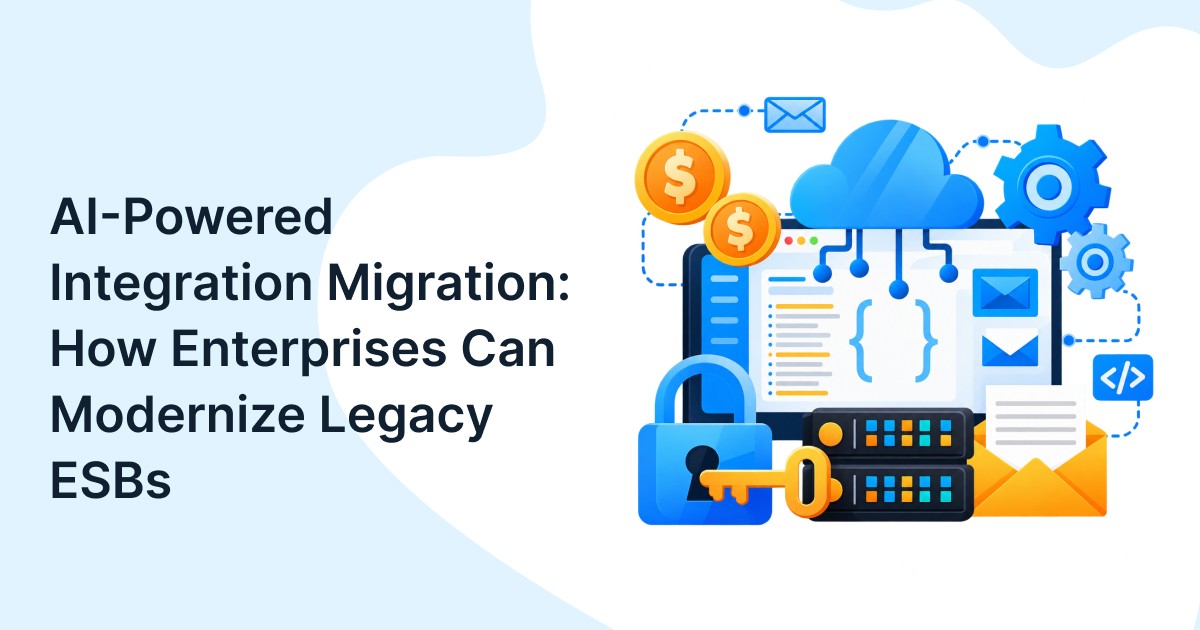
AI-powered integration migration enables enterprises to modernize legacy ESBs by using artificial intelligence to automate discovery, dependency analysis, interface mapping, code transformation, testing, and deployment. Compared to manual approaches, AI integration migration helps reduce project timelines, lower migration costs, improve accuracy, and accelerate cloud-native transformation initiatives.
For many enterprises, integration is the invisible backbone that powers critical business operations. Customer data flows between CRM systems and ERPs. Orders move across supply chains. Applications communicate through a complex network of APIs, interfaces, middleware, and Enterprise Service Buses (ESBs).
The challenge is that many of these integration environments were built years ago.
Legacy ESBs that once enabled enterprise connectivity are now becoming barriers to innovation. They are expensive to maintain, difficult to scale, and often incompatible with modern cloud-native architectures.
As organizations pursue digital transformation, modernization programs, and AI adoption initiatives, traditional integration infrastructures can no longer keep pace with business demands.
This is where AI powered integration migration is changing the game.
By combining automation, machine learning, intelligent analysis, and advanced migration tooling, organizations can accelerate integration modernization while reducing risks traditionally associated with large-scale migration projects.
Organizations seeking support with complex modernization initiatives often begin by evaluating advanced integration engineering services that combine domain expertise, automation frameworks, and AI-enabled migration methodologies.
What Is AI-Powered Integration Migration?
AI-powered integration migration refers to the use of artificial intelligence and automation technologies to assess, transform, validate, and migrate enterprise integrations from legacy platforms to modern architectures. Rather than relying entirely on manual analysis and development, AI accelerates migration activities across the entire lifecycle.
Traditional integration migration projects involve significant manual effort.
Teams often spend months:
- Discovering integrations
- Documenting dependencies
- Understanding interface mappings
- Rewriting code
- Testing migrated environments
In large enterprises, thousands of integrations may exist across applications, databases, APIs, and middleware platforms.
AI integration migration introduces intelligence into these activities. Instead of manually reviewing hundreds of workflows, AI can:
- Identify integration assets
- Analyze message flows
- Detect dependencies
- Recommend migration patterns
- Map interfaces automatically
- Support testing validation
The result is faster, safer, and more predictable modernization.

Why Are Legacy ESBs Becoming a Modernization Challenge?
Legacy ESBs are becoming a modernization challenge because they can limit scalability, increase maintenance costs, slow innovation, and make it harder to support cloud-native, API-first, and real-time integration requirements. As enterprises modernize their technology ecosystems, many legacy ESBs struggle to provide the flexibility and agility needed for modern business operations.
ESBs were designed to centralize enterprise integration. For many years, they successfully connected applications and simplified communication.
However, enterprise integration requirements have evolved dramatically. Today organizations require:
- Hybrid-cloud connectivity
- Real-time data processing
- Event-driven architecture
- API-based integration
- Microservices support
- AI-enabled workflows
Legacy ESBs frequently introduce limitations such as:
- Increased Technical Debt
Years of modifications create highly complex integration landscapes that are difficult to understand and maintain.
- Limited Scalability
Older middleware infrastructures may struggle with rapidly growing integration demands.
- High Maintenance Costs
Specialized talent becomes difficult and expensive to find as technologies age.
- Slower Innovation
Rigid middleware architectures often delay modernization initiatives.
- Security and Compliance Risks
Legacy environments may lack modern security controls required for evolving regulatory requirements.
What Challenges Do Enterprises Face During Legacy ESB Migration?
Successful legacy ESB migration requires organizations to overcome documentation gaps, dependency complexity, testing inefficiencies, migration risks, and resource constraints. These challenges often make migration projects longer and more expensive than expected.
Before organizations can modernize, they must understand existing integration environments. Unfortunately, that is often easier said than done.
- Limited Documentation
Many legacy environments contain integrations developed years ago.
Documentation may be:
- Incomplete
- Outdated
- Missing entirely
Teams often rely on institutional knowledge rather than documented architecture.
- Complex Dependencies
Applications rarely operate independently. A single integration change may impact:
- ERP systems
- CRM platforms
- Data warehouses
- Customer portals
- Supply chain applications
Understanding these dependencies is crucial.
- Interface Mapping Challenges
Organizations must map legacy integrations to modern architecture while preserving business logic.
This becomes especially difficult when dealing with large integration inventories.
For a deeper look at how automation simplifies interface transformation, enterprises can explore AI Interface Mapping: A Smarter Approach to Integration Modernization.
- Migration Risk
Migration errors can disrupt critical business processes. Even minor mistakes may impact:
- Data accuracy
- Customer experiences
- Operational continuity
- Resource Constraints
Enterprise architects and integration specialists are often heavily committed to business priorities, limiting available migration capacity.
How Does AI Transform the Integration Migration Process?
AI transforms integration migration by automating discovery, dependency analysis, migration planning, interface mapping, testing, and validation. This reduces manual effort while improving visibility, consistency, and migration outcomes.
Traditional migration projects rely heavily on human review. AI introduces a more scalable approach.
Intelligent Discovery
AI can scan integration ecosystems and identify:
- APIs
- Services
- Message queues
- Middleware dependencies
- Data flows
Instead of spending months documenting environments manually, teams gain visibility much faster.
Dependency Analysis
Machine learning algorithms can identify hidden relationships across applications. This helps teams:
- Understand impacts
- Prioritize migrations
- Reduce disruption risks
Automated Mapping
AI-powered platforms can analyze source and target systems and recommend mappings automatically.
This significantly reduces manual effort.
Code Transformation Assistance
Some migration platforms can recommend transformation patterns and accelerate migration development activities.
Intelligent Testing
AI can help:
- Identify edge cases
- Generate test scenarios
- Validate outcomes
- Detect anomalies
Testing becomes more comprehensive without requiring large teams.
What Is the LedgeSure A.I.M. Framework for AI-Powered Integration Migration?
The LedgeSure A.I.M. Framework is a structured approach to AI-powered integration migration that helps enterprises modernize legacy ESBs through three phases: Assess, Identify, and Modernize. By combining migration assessment, dependency analysis, and AI-driven modernization, the framework provides a repeatable path for reducing migration risk and accelerating transformation outcomes.
This framework establishes a repeatable methodology that aligns with enterprise transformation goals.
Phase 1: Assess
Organizations must first understand what exists. Key activities include:
- Integration inventory analysis
- Application dependency mapping
- Technical risk evaluation
- Migration readiness assessment
Before planning modernization initiatives, enterprises should conduct a comprehensive integration migration assessment to understand migration complexity and establish modernization priorities.
Key Questions
- What integrations exist?
- Which systems are business-critical?
- What technical debt exists?
- Which risks require mitigation?
Phase 2: Identify
Once the current environment is understood, organizations identify modernization opportunities. Key activities include:
- Dependency Analysis
Understanding system interconnections.
- Interface Mapping
Defining migration paths and target architectures.
- Modernization Prioritization
Identifying high-value migration candidates.
- Automation Opportunities
Determining where AI can maximize migration efficiency.
Phase 3: Modernize
This phase executes the migration strategy. Activities include:
- Platform modernization
- API transformation
- Cloud integration deployment
- Testing and validation
- Governance implementation
Modernization should be viewed as a business transformation initiative rather than simply a technology migration project.
What Does a Step-by-Step AI Integration Migration Process Look Like?
A successful AI integration migration process typically includes assessment, dependency analysis, interface mapping, migration planning, AI-assisted transformation, testing, and deployment. Following these stages helps organizations modernize legacy integrations systematically while improving visibility, reducing risks, and accelerating migration timelines.
AI-powered integration migration is most effective when approached as a structured transformation program rather than a one-time technology upgrade. While every organization’s environment is different, most successful migration projects follow the same core stages.
-
Assess the Current Integration Environment
The first step is understanding the existing integration landscape. Organizations need visibility into their applications, interfaces, workflows, dependencies, and integration assets before creating a migration strategy.
This assessment helps answer questions such as:
- Which integrations are business-critical?
- What technical debt exists?
- Which systems should be modernized first?
- What risks could impact migration?
For a deeper assessment framework, read our guide to Enterprise Integration Migration Assessment.
-
Discover and Analyze Dependencies
Most enterprise integrations are connected to multiple applications, databases, and business processes.
AI can help organizations identify dependencies faster, providing greater visibility into how systems interact and reduce the risk of unexpected disruptions during migration.
A clear understanding of dependencies helps teams prioritize migration activities and create realistic implementation plans.
-
Map Legacy Interfaces to Modern Architectures
Once the environment has been analyzed, organizations must determine how existing integrations will translate into the target architecture.
AI-assisted interface mapping can simplify this process by identifying relationships between source and target systems, reducing manual effort, and improving consistency.
Teams looking to streamline this phase can explore our article on AI Interface Mapping for Integration Modernization.
-
Modernize and Transform Integrations
With mapping completed, organizations can begin transforming legacy integrations into modern equivalents.
Depending on business requirements, this may involve:
- API modernization
- Cloud migration
- Workflow transformation
- Middleware replacement
- Hybrid integration deployment
AI-powered tools can automate portions of this process, helping teams deliver modernization initiatives faster.
-
Test and Validate Migrations
Before deployment, migrated integrations must be validated to ensure they perform as expected. Testing should confirm:
- Functional accuracy
- Data integrity
- Performance requirements
- Security compliance
AI-assisted testing can accelerate validation activities and help identify issues earlier in the migration lifecycle.
-
Deploy and Continuously Optimize
Migration does not end with deployment. Organizations should continuously monitor integration performance, governance, security, and scalability after implementation.
Ongoing optimization ensures that the modernized environment continues to support business growth and evolving technology requirements.
AI vs Manual Migration: Which Approach Delivers Better Results?
AI-powered migration generally delivers better results for large-scale enterprise modernization because it automates discovery, dependency analysis, interface mapping, and testing activities. While manual migration may be suitable for smaller environments, AI-powered integration migration offers greater speed, consistency, scalability, and operational efficiency.
For years, integration migration projects relied almost entirely on manual effort. Architects documented interfaces, developers recreated integration logic, and testing teams validated outcomes for one integration at a time.
The approach worked, but it was slow, expensive, and susceptible to human error.
Today, advances in AI integration platforms and migration automation are transforming how enterprises approach modernization.
Organizations evaluating migration strategies should understand the strengths and limitations of both approaches.
AI-Powered vs Manual Migration Comparison
| Criteria | AI-Powered Migration | Manual Migration |
| Discovery & Assessment | Automated | Manual |
| Dependency Analysis | AI-Assisted | Time-Consuming |
| Interface Mapping | Automated Recommendations | Fully Manual |
| Migration Speed | Faster | Slower |
| Scalability | High | Limited |
| Cost Efficiency | Higher | Lower |
| Testing Support | Automated Validation | Manual Testing |
| Error Reduction | Improved Accuracy | Human-Dependent |
| Enterprise Readiness | Excellent | Moderate |
Where AI Delivers the Greatest Value
AI is particularly effective in:
- Integration discovery
- Dependency analysis
- Interface mapping
- Code transformation recommendations
- Test generation
- Risk identification
Where Human Expertise Remains Critical
Successful migration still requires experienced integration architects to:
- Define target architectures
- Establish governance frameworks
- Review transformation logic
- Manage business risks
- Handle complex exceptions
For enterprises comparing both approaches in detail, explore AI vs Manual Integration Migration for Enterprise Modernization.
How Does AI Reduce Integration Migration Costs?
AI reduces integration migration costs by automating time-intensive activities such as system discovery, dependency analysis, interface mapping, documentation, testing, and validation. This enables enterprises to complete modernization initiatives more efficiently while reducing the overall project effort.
One of the biggest reasons legacy ESB environments remain in production is cost.
Many organizations assume modernization requires a massive investment of time and resources.
However, AI-powered integration migration changes the economics of modernization.
Areas Where AI Creates Cost Savings
- Faster Environment Discovery
Instead of manually documenting hundreds of integrations, AI can analyze environments and generate inventories automatically.
- Reduced Mapping Effort
AI recommendations significantly reduce the effort required to map interfaces between source and target platforms.
- Shorter Development Cycles
Migration teams spend less time recreating workflows manually.
- Improved Testing Efficiency
Automated testing and validation reduce both effort and risk.
- Lower Operational Disruption
Better planning and visibility help prevent costly outages.
Why Are Enterprises Moving from Legacy ESBs to Cloud-Native Integration?
Enterprises are moving from legacy ESBs to cloud-native integration platforms to improve scalability, agility, flexibility, and support for modern technologies such as APIs, microservices, and event-driven architectures. Cloud-native integration environments enable faster innovation and better alignment with digital transformation initiatives.
Enterprise Service Buses were built to solve integration challenges in an era dominated by on-premises applications.
Today’s environment looks very different. Organizations now work with:
- SaaS platforms
- Hybrid-cloud infrastructure
- APIs
- Microservices
- Real-time analytics
- AI-powered applications
Traditional ESB architectures often struggle to support these requirements efficiently.
Characteristics of Cloud-Native Integration
- API-First Connectivity
Modern integrations rely heavily on reusable APIs rather than tightly coupled application connections.
- Event-Driven Processing
Applications can respond to business events in real time.
- Elastic Scalability
Infrastructure scales based on actual demand.
- Faster Deployment
Teams can deploy and update integrations more quickly.
- Improved Resilience
Cloud-native architectures typically provide stronger fault tolerance and recovery capabilities.
For a deeper examination of modernization strategies, read Moving From Legacy ESB to Cloud-Native Integration.
What Features Should Enterprises Look for in AI-Powered Migration Tools?
Organizations should look for AI-powered migration tools that support automated discovery, dependency analysis, interface mapping, testing, governance, and monitoring. The most effective platforms help reduce manual effort, improve migration visibility, and accelerate integration modernization initiatives.
Not all migration tools provide the same level of intelligence or automation. The best solutions assist organizations throughout the complete migration lifecycle.
Essential Capabilities
- Automated Discovery
The platform should identify integration assets automatically.
- Dependency Mapping
Visual visibility into interconnected systems reduces migration risks.
- AI-Assisted Interface Mapping
Automation should simplify transformation between source and target environments.
- Code and Workflow Analysis
The platform should support migration planning and modernization recommendations.
- Automated Testing
Testing automation reduces validation effort and improves quality.
- Governance and Security
Enterprise-grade controls remain essential throughout modernization.
- Monitoring and Observability
Organizations need visibility after deployment to ensure long-term success.
Enterprises assessing solutions can review Enterprise Integration Migration Tools: What to Look for in an AI-Powered Platform.
What Does a Modern AI-Powered Integration Architecture Look Like?
A modern AI-powered integration architecture combines discovery, dependency analysis, automation, governance, and modern integration patterns to support large-scale modernization initiatives. While architectures vary by organization, AI helps accelerate migration planning, improve visibility, and support a range of target integration models such as iPaaS, APIs, hybrid integration, and event-driven architectures.
A typical AI-powered integration migration architecture includes several interconnected components:
Existing Integration Environment (Legacy ESB, APIs, Middleware, Custom Integrations)
↓
AI Discovery & Assessment
↕
Dependency Analysis
↕
Interface Mapping
↓
Migration Planning & Automation Tools
↓
Target Integration Model (iPaaS, APIs, Event Streaming, Hybrid Integration, etc.)
↓
Governance, Monitoring, Security and Observability
Existing Integration Environment
Migration programs typically begin by assessing the current integration ecosystem, including middleware platforms, APIs, applications, workflows, and business processes.
AI Discovery and Assessment
AI helps identify integration assets, analyze configurations, and accelerate documentation activities.
Dependency Analysis and Interface Mapping
These activities help organizations understand system relationships, application dependencies, and migration impacts. In practice, teams may revisit these activities multiple times throughout the migration journey.
Migration Planning and Automation
AI-powered tools can support migration planning, transformation, testing, and validation activities to improve efficiency and reduce manual effort.
Target Integration Model
The target environment varies based on business and technical requirements. Organizations may adopt:
- Integration Platform as a Service (iPaaS)
- API-first architectures
- Event-driven integration
- Hybrid integration platforms
- Cloud-native middleware
- Combinations of multiple integration patterns
Governance and Observability
Regardless of the target architecture, ongoing governance, monitoring, security, and observability remain critical to maintaining integration performance and compliance.
Is Your Organization Ready for Integration Migration?
Before launching an integration modernization initiative, enterprises should evaluate their readiness across technology, governance, business alignment, and migration planning. Organizations with a clear migration strategy are more likely to achieve successful outcomes while minimizing project risks.
Use the checklist below to assess migration readiness:
Integration Migration Readiness Checklist
- Existing integrations have been inventoried
- Critical business processes are documented
- Application dependencies are understood
- Migration priorities have been established
- Legacy technical debt has been assessed
- Target architecture has been defined
- Governance and security requirements are documented
- Testing and validation strategies are in place
- Business stakeholders are aligned
- Migration tools and platforms have been evaluated
The more boxes an organization can check before migration begins, the more predictable and efficient the modernization journey becomes.
What Business Benefits Does Integration Modernization Deliver?
Integration modernization helps enterprises improve operational agility, reduce technical debt, lower maintenance costs, and create a foundation for future digital transformation initiatives.
Beyond technology upgrades, modernization delivers measurable business value.
- Increased Agility
Organizations can launch new services and integrations faster.
- Reduced Technical Debt
Older customizations and legacy dependencies can be eliminated.
- Lower Maintenance Costs
Modern platforms require less operational overhead.
- Better Scalability
Organizations can support evolving business requirements without extensive rework.
- Improved Security and Compliance
Modern platforms generally provide stronger governance capabilities.
- Faster Innovation
Teams can focus on delivering business value rather than maintaining legacy infrastructure.
Which Industries Benefit Most from AI-Powered Integration Migration?
Organizations across industries are modernizing legacy integration environments to improve agility, enable digital transformation, and support cloud-native operations. While the drivers may differ, the modernization objectives are often similar.
Manufacturing
Manufacturers use integration modernization to connect ERP systems, production platforms, supply chain applications, and analytics environments more effectively.
Financial Services
Banks and financial institutions modernize integrations to improve regulatory compliance, accelerate product innovation, and reduce legacy technology dependencies.
Healthcare
Healthcare organizations rely on integration modernization to improve interoperability, data exchange, and patient information management.
Retail and E-Commerce
Retailers use AI-powered integration migration to support omnichannel experiences, real-time inventory management, and personalized customer interactions.
Logistics and Supply Chain
Modern integrations enable real-time visibility, automated workflows, and improved coordination across suppliers, warehouses, and transportation networks.
Why Do Integration Modernization Projects Fail?
Integration modernization projects typically fail because of inadequate assessment, undocumented dependencies, insufficient testing, poor planning, or a lack of alignment between business and technology objectives. Addressing these challenges early helps organizations reduce risk and improve migration outcomes.
- Poor Discovery and Assessment
Organizations often underestimate the size and complexity of their integration environments.
- Undocumented Dependencies
Unknown system relationships frequently cause unexpected delays and disruptions.
- Insufficient Testing
Projects sometimes focus heavily on migration activities while underinvesting in validation and testing.
- Lack of Business Alignment
Modernization efforts should support broader business outcomes rather than existing purely as technology initiatives.
- Underestimating Technical Debt
Legacy integrations often contain hidden customizations, undocumented processes, and outdated dependencies that require careful evaluation.

What Is the Future of AI-Powered Integration Modernization?
The future of integration modernization will be increasingly defined by AI-driven discovery, intelligent automation, self-optimizing integrations, and cloud-native architectures that enable enterprises to adapt faster to changing business needs.
Over the next several years, enterprises can expect AI to support:
- Autonomous dependency mapping
- Automated architecture recommendations
- Intelligent integration monitoring
- Predictive issue detection
- Self-healing integration workflows
- AI-assisted governance
Organizations that modernize early will be better positioned to leverage emerging technologies while maintaining operational resilience.
Key Takeaways
- AI-powered integration migration helps accelerate legacy ESB modernization.
- AI improves discovery, dependency analysis, interface mapping, testing, and migration planning.
- Legacy ESBs often struggle to support modern cloud-native requirements.
- Integration migration automation can reduce both project effort and migration risk.
- Cloud-native integration architectures provide greater agility, scalability, and resilience.
- Successful modernization requires both AI capabilities and experienced integration expertise.
- Enterprises should view migration as a strategic transformation initiative, not simply a technology upgrade.
Conclusion
AI-powered integration migration is rapidly becoming the preferred approach for enterprises seeking to modernize complex integration environments. As organizations move away from legacy ESB architectures toward cloud-native, API-driven ecosystems, the ability to automate discovery, mapping, transformation, and validation becomes a significant competitive advantage.
Rather than treating migration as an isolated IT initiative, enterprises should view integration modernization as a foundational investment in future agility, scalability, and innovation. By combining AI-driven automation with proven integration engineering expertise, organizations can reduce migration risks, accelerate delivery timelines, and build a more resilient digital foundation.
Ready to modernize your integration landscape? Talk to our integration modernization experts.
Frequently Asked Questions
Q: What is AI-powered integration migration?
A: AI-powered integration migration uses artificial intelligence and automation to discover, analyze, transform, test, and migrate integrations from legacy environments to modern platforms. It helps organizations modernize more efficiently while reducing manual effort and migration risks.
Q: How does AI help modernize legacy ESBs?
A: AI assists by automating discovery, analyzing dependencies, recommending interface mappings, supporting transformation activities, and improving testing processes. This enables enterprises to migrate legacy ESBs more quickly and accurately.
Q: What is integration modernization?
A: Integration modernization is the process of updating legacy integration architectures, technologies, and workflows to support modern business needs through APIs, cloud-native systems, automation, and scalable integration platforms.
Q: What is legacy ESB migration?
Legacy ESB migration involves moving integrations, workflows, and middleware capabilities from older Enterprise Service Bus environments to modern integration platforms that better support cloud, API, and hybrid architectures.
Q: What are integration migration tools?
A: Integration migration tools help organizations assess, map, transform, test, and migrate integration assets. Modern platforms increasingly incorporate AI capabilities to automate many of these tasks.
Q: Can AI automate interface mapping?
A: AI can significantly accelerate interface mapping by analyzing source and target systems, identifying relationships, recommending mappings, and highlighting potential issues that require review.
Q: How long does enterprise integration migration take?
A: Migration timelines vary depending on the complexity of the integration ecosystem, number of interfaces, dependencies, migration approach, and target architecture. Large enterprise initiatives often follow phased implementation strategies.
Q: How can organizations reduce integration migration costs?
A: Organizations can reduce costs through automation, phased migration planning, AI-assisted discovery, automated testing, improved dependency visibility, and standardized migration frameworks.
Q: Why are enterprises moving away from legacy ESBs?
A: Legacy ESBs can create scalability, flexibility, maintenance, and innovation challenges. Modern cloud-native integration platforms better support API-driven architectures, digital transformation initiatives, and evolving business requirements.
Q: What is the difference between ESB and iPaaS?
A: An ESB is typically a centralized middleware architecture used to connect enterprise applications. An iPaaS (Integration Platform as a Service) is a cloud-based integration solution designed to support APIs, cloud applications, hybrid environments, and modern integration use cases.