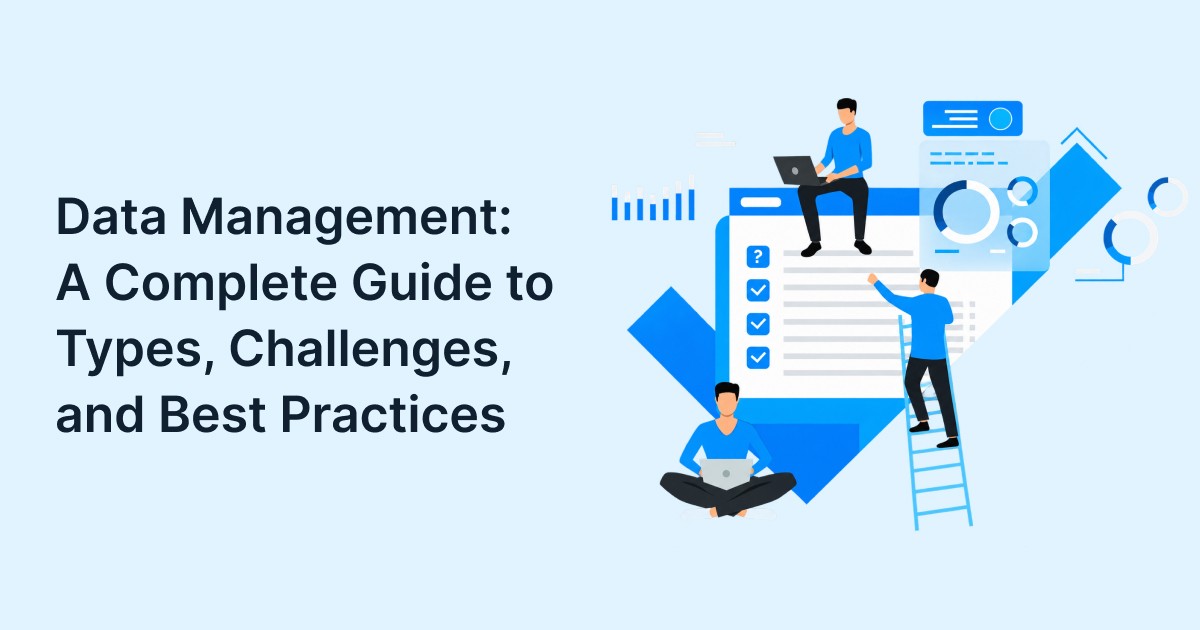
Effective data management is the practice of collecting, organising, storing, protecting, integrating, and using data so it remains accurate, accessible, secure, and valuable for business decisions. Strong data management helps organisations reduce operational inefficiencies, improve compliance, support analytics, and create a trusted foundation for digital transformation.
Modern businesses generate data from applications, APIs, cloud platforms, customer interactions, IoT devices, and external sources. However, data only creates value when it is well governed, integrated, and accessible across the organisation. Without a clear data management strategy, enterprises often face silos, inconsistent reporting, data quality issues, and compliance risks.
As organisations invest in AI, automation, analytics, and cloud technologies, digital data management has become a strategic business priority rather than an IT function alone.
For enterprises looking to improve connected data ecosystems, reliable integration engineering services play a critical role in ensuring systems and data workflows operate as a unified environment.
Summary
- Data management ensures data remains accurate, secure, accessible, and useful.
- Common types of data management include master data, metadata, database, data governance, data integration, and data quality management.
- The biggest data management challenges include data silos, poor data quality, governance gaps, compliance risks, and scaling complexity.
- Enterprise integration architecture and API integration are becoming essential components of modern data management solutions.
- Organisations that combine governance, integration, automation, and quality controls achieve better business outcomes and analytics performance.
Why Is Data Management Important for Modern Enterprises?
Data Management is important in modern enterprises in making reliable business decisions, organisations need trusted, accessible, and consistent data. Data management provides the policies, technologies, and processes needed to transform raw information into a business asset.
Poorly managed data affects nearly every department. Sales teams work with duplicate customer records, operations rely on inconsistent reporting, and executives make decisions based on conflicting information.
Strong data management helps organisations:
- Improve decision-making accuracy
- Reduce data duplication
- Enhance regulatory compliance
- Strengthen cybersecurity readiness
- Support AI and analytics initiatives
- Increase operational efficiency
- Enable faster digital transformation
Industry Insight
According to IBM, poor data quality costs organisations trillions of dollars annually through inefficiencies, errors, and lost opportunities.

What Are the Types of Data Management?
The main types of data management focus on governing, storing, maintaining, securing, and integrating organisational information. Most enterprises require several forms of data management working together rather than relying on a single approach.
| Type of Data Management | Primary Purpose | Example Use Case |
| Data Governance | Define policies and accountability | Compliance and stewardship |
| Data Quality Management | Ensure accuracy and consistency | Customer data validation |
| Master Data Management (MDM) | Create a single source of truth | Unified customer records |
| Metadata Management | Manage data definitions and lineage | Data catalogues |
| Database Management | Store and retrieve data efficiently | Transaction systems |
| Data Integration Management | Connect systems and data flows | ERP and CRM integration |
| Data Security Management | Protect sensitive information | Access controls and encryption |
| Data Lifecycle Management | Manage data from creation to deletion | Retention policies |
Master Data Management
Master Data Management (MDM) creates a trusted version of critical business data such as customers, suppliers, employees, and products.
For organisations struggling with duplicate records and data inconsistency, understanding the role of master data is essential. Learn more about creating a trusted source of enterprise information through effective master data strategies.
Data Integration Management
As enterprises adopt more cloud and SaaS applications, integration becomes increasingly important. Data integration management ensures information moves accurately across systems through APIs, middleware, ETL pipelines, and event-driven architectures.
This is where enterprise integration architecture plays a central role by defining how systems communicate, share information, and support scalable growth.
Data Governance
Data governance establishes ownership, policies, standards, and accountability structures that keep organisational data trustworthy and compliant.
What Are the Biggest Data Management Challenges?
The most common data management challenges include fragmented systems, poor data quality, governance gaps, security risks, compliance requirements, and increasing data volume.
Many companies recognise the value of data but struggle to manage it effectively as technology ecosystems become more complex.
-
Data Silos
Different departments often maintain separate applications and databases that do not communicate effectively.
This fragmented environment creates duplicate records, conflicting reports, and limited visibility.
-
Poor Data Quality
Incomplete, inaccurate, outdated, or duplicated data can undermine decision-making and analytics initiatives.
Common causes include:
- Manual data entry
- Lack of validation rules
- Multiple data sources
- Inconsistent standards
-
Integration Complexity
Modern organisations operate hundreds of applications across cloud and on-premises environments.
Without robust integration solutions and API integration capabilities, maintaining data consistency becomes difficult.
-
Regulatory Compliance
Organisations must comply with regulations such as GDPR, CCPA, HIPAA, and industry-specific requirements.
Compliance becomes increasingly challenging when data is scattered across multiple environments.
-
Data Security Risks
Cybersecurity threats continue to increase, making data protection a board-level concern.
Businesses must implement encryption, identity management, monitoring, and access controls throughout the data lifecycle.
-
Growing Data Volumes
Data creation continues to accelerate through customer interactions, IoT devices, applications, and digital channels.
Scaling storage, governance, and analytics capabilities can become expensive and operationally complex.
Did You Know?
As per IBM, Data scientists often spend more time preparing and cleaning data than analysing it. Strong data management practices can significantly reduce this effort and improve analytical outcomes.
How Can Organisations Solve Common Data Management Problems?
Overcoming data management issues, organisations should combine governance, integration, quality controls, automation, and clear ownership structures.
A technology-first approach rarely works without process and accountability improvements.
Establish Data Ownership
Every critical data domain should have a designated owner responsible for quality, standards, and governance.
Standardise Data Definitions
Teams must align on common business definitions to eliminate reporting discrepancies.
Implement Automated Quality Monitoring
Automated validation, enrichment, and monitoring processes help identify issues before they impact operations.
Invest in Scalable Integration Solutions
Modern integration platforms support API-driven connectivity, event streaming, and real-time data sharing.
Strong API integration capabilities help reduce management overhead while ensuring systems remain synchronised.
Create Governance Frameworks
Policies covering security, retention, privacy, compliance, and access management ensure long-term consistency.
What Are the Best Data Management Practices?
The most effective data management practices balance governance, usability, security, and scalability. Organisations should focus on sustainable operational processes rather than one-time projects.
Create a Data Strategy Aligned with Business Goals
Every initiative should connect directly to measurable business outcomes.
For example:
- Better customer experiences
- Faster reporting
- Regulatory compliance
- Improved operational efficiency
Focus on Data Quality Early
Fixing poor-quality data after migration or analytics projects is significantly more expensive than addressing it at the source.
Build for Integration
Data ecosystems continue to expand. A well-designed enterprise integration architecture helps organisations scale without creating new silos.
Use Metadata Effectively
Metadata provides critical context about data sources, definitions, ownership, and lineage.
Implement Continuous Monitoring
Ongoing monitoring helps detect:
- Quality degradation
- Compliance violations
- Security issues
- Performance bottlenecks
How Does Data Fabric Support Modern Data Management?
A data fabric approach creates a unified layer that connects distributed data environments, making information easier to access, govern, and analyse.
Instead of centralising all data into a single repository, data fabric technologies provide intelligent access across hybrid and multi-cloud ecosystems.
For organisations exploring modern data architectures, understanding how data fabrics enhance enterprise-wide visibility and governance is increasingly important.
Data Management Maturity Framework (Original Value Add)
Many organisations know they have data challenges but struggle to identify their current maturity level.
| Maturity Level | Characteristics | Priority Focus |
| Level 1: Reactive | Frequent data issues, limited governance | Basic quality controls |
| Level 2: Managed | Some standards and ownership | Governance programmes |
| Level 3: Integrated | Connected systems and shared standards | Scalable integration solutions |
| Level 4: Optimised | Automated quality monitoring | Advanced analytics |
| Level 5: Intelligent | AI-driven governance and automation | Continuous optimisation |
How to Use This Framework
Ask three questions:
- Is data trusted across departments?
- Can systems share information reliably?
- Are governance and quality processes automated?
If the answer is “no” to two or more questions, the organisation likely has significant maturity gaps that require attention.
How Do Enterprise Integration Architecture and API Integration Support Data Management?
Enterprise integration architecture provides the framework for connecting business applications, data repositories, cloud platforms, and external services.
Without integration, data management becomes fragmented because information remains trapped inside individual systems.
Benefits include:
- Real-time data access
- Reduced duplication
- Improved operational visibility
- Faster analytics delivery
- Better governance enforcement
- Scalable digital transformation
Modern integration solutions increasingly rely on APIs, event-driven architectures, and cloud-native connectivity to support growing data ecosystems.
As enterprises modernise their technology stacks, integration becomes a foundational component of successful digital data management strategies.

Conclusion
Data management is no longer just about storing information. It is about creating a trusted, connected, and governed information ecosystem that supports decision-making, analytics, compliance, and innovation.
Organisations that combine strong governance, quality processes, modern integration solutions, API integration capabilities, and scalable enterprise integration architecture are better positioned to turn data into a competitive advantage.
If you’re evaluating ways to improve data quality, reduce silos, or modernise enterprise data flows, consider speaking with the team at Ledgesure.
Frequently Asked Questions About Data Management
Q: What is data management in simple terms?
A: Data management is the process of collecting, organising, storing, securing, integrating, and maintaining data throughout its lifecycle. Its goal is to ensure information remains accurate, accessible, and useful for business operations, analytics, and decision-making.
Q: What are the types of data management?
A: The main types of data management include data governance, master data management, metadata management, data quality management, database management, data integration management, security management, and data lifecycle management. Most organisations use multiple approaches together to support business goals.
Q: What are the biggest challenges in data management?
A: The biggest challenges include data silos, poor quality data, integration complexity, regulatory compliance, cybersecurity risks, and rapidly increasing data volumes. Organisations often address these challenges through governance frameworks, automation, and integration technologies.
Q: Why is digital data management important?
A: Digital data management helps organisations maintain control over growing volumes of information across applications, cloud platforms, and connected devices. It supports compliance, improves decision-making, and enables advanced technologies such as analytics and artificial intelligence.
Q: What are master data management challenges?
A: Common master data management challenges include duplicate records, inconsistent standards, unclear ownership, integration complexity, and governance gaps. Successful MDM programmes require both process improvements and supporting technology.
Q: How do API integration and data management work together?
A: API integration enables applications and systems to exchange data automatically. This improves accuracy, reduces manual effort, eliminates redundancy, and supports consistent information across business processes and reporting environments.
Q: What is the best data management solution?
A: The best data management solution depends on organisational requirements, data volume, compliance needs, integration complexity, and business goals. Most enterprises combine governance, quality management, integration platforms, automation, and security controls rather than relying on a single tool.