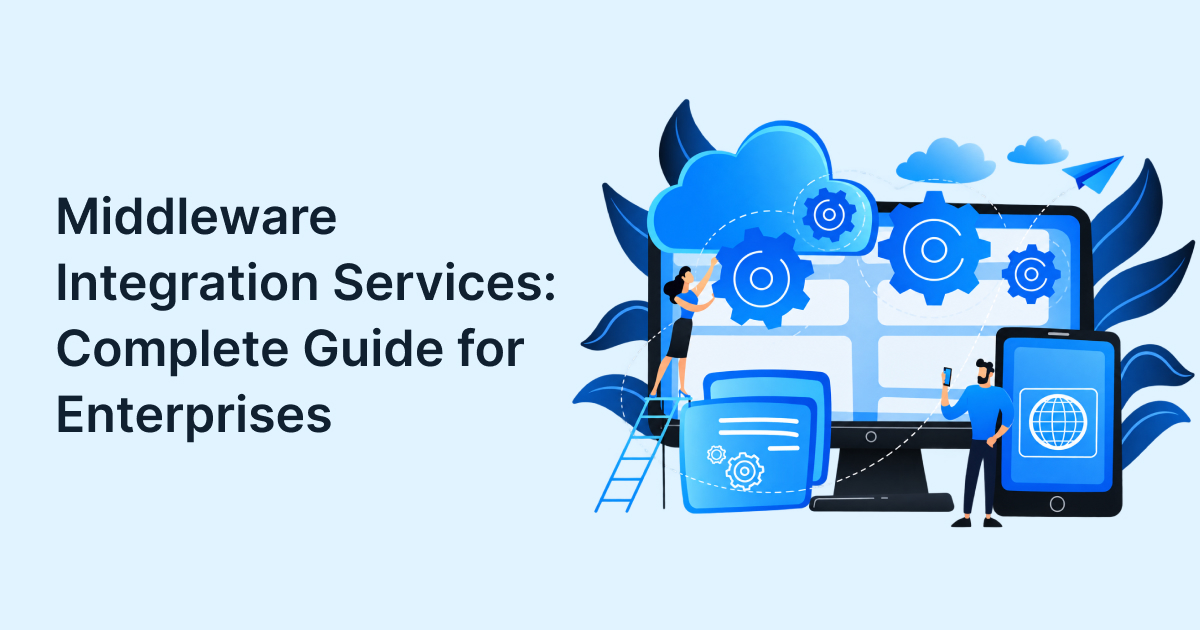
Middleware integration services help enterprises connect applications, data sources and business processes through a controlled integration layer instead of building a separate connection between every pair of systems. They cover architecture, implementation, data mapping, API and event design, migration, testing, security, monitoring and ongoing support.
Middleware integration services are the engineering discipline behind enterprise integration. They turn a fragmented collection of ERP, CRM, finance, supply-chain, SaaS, cloud and legacy applications into a coordinated operating environment.
For a CIO or integration lead, the practical question is rarely “which middleware product should we buy?” It is broader: how do we move orders, customer records, invoices, inventory, payments and operational events between systems reliably, securely and at a sustainable cost?
That is where middleware integration services differ from buying a licence. A capable provider brings architecture, delivery and operations together: assessing the current estate, defining reusable patterns, building interfaces, migrating legacy middleware, establishing governance and supporting the platform in production.
Ledgesure’s Integration Engineering services are structured around this full lifecycle: strategy and platform selection, delivery, modernisation, migration and managed operations. The company works across SAP, TIBCO, MuleSoft, Boomi and cloud-native stacks, with a vendor-neutral architecture approach rather than a single-platform bias.
Summary
- Middleware integration services design, build, modernise and operate the layer that lets ERP, CRM, finance, supply-chain, cloud and legacy systems exchange data reliably.
- Middleware is not a single product. Enterprises typically combine APIs, message brokers, ESBs, iPaaS, event streaming and API gateways in a governed hybrid architecture.
- The main business case is fewer brittle point-to-point connections, faster change, better data consistency and lower operational risk.
- Legacy ESB modernisation should not simply copy old interfaces to a new platform; it should improve architecture, observability and maintainability at the same time.
- Security must cover every integration path, not only externally exposed APIs. NIST’s 2025 API guidance recommends encryption, authentication, authorisation, validation and consumption controls across the API lifecycle.
- Choose a provider for engineering depth, governance, migration experience and operating support, not only for familiarity with one integration tool.

What an integration middleware layer does
Integration middleware sits between applications and handles work that applications should not each solve independently:
- Connectivity: connects systems that use different protocols, data formats and authentication methods.
- Transformation: converts fields, units, codes and structures so both systems understand the message.
- Routing: sends data to the correct destination based on business rules.
- Orchestration: coordinates multi-step processes across systems.
- Reliability: handles retry, error handling, ordering and delivery guarantees.
- Governance: applies security, logging, monitoring and change control.
For example, when a customer places an order in a commerce platform, middleware can validate the order, create it in ERP, check inventory, notify the warehouse system, trigger invoicing and update the CRM, without each application needing a custom connection to every other application.
What is included in a service engagement?
A mature middleware integration engagement usually includes:
- Integration architecture and reference patterns.
- Platform evaluation and selection.
- Interface design, data mapping and API specification.
- Build, test and deployment.
- Legacy ESB or middleware migration.
- API management, event design and observability.
- Security, compliance and access controls.
- Production monitoring, incident response and continuous improvement.
The scope should be defined by business outcomes and integration risk, not by the number of licences purchased.
How Does Middleware Integration Work?
Middleware integration works by placing a shared integration layer between producing and consuming systems. A source system publishes or sends data; middleware validates, transforms, routes and delivers it; the target system consumes it through an API, message queue, event stream, file transfer or database interface.
The value comes from separating business applications from the mechanics of communication. A sales system does not need to know how SAP receives an order. A warehouse system does not need to understand Salesforce data structures. Middleware absorbs much of that variation.
The four planes of an integration architecture
A useful way to evaluate middleware is to separate four responsibilities:
| Plane | What it does | Typical components |
| Connectivity plane | Moves data between systems | Connectors, adapters, file transfer, messaging |
| Processing plane | Transforms, validates and orchestrates data | Integration flows, mappings, rules, orchestration |
| API and event plane | Exposes and distributes capabilities | API gateway, API management, event broker, streaming |
| Operations plane | Runs, observes and governs integrations | Monitoring, logging, alerting, CI/CD, access control |
This model prevents a common mistake: treating an API gateway as a complete integration platform. A gateway controls access and traffic, but it does not by itself solve data mapping, process orchestration, legacy connectivity or operational support.
A practical example: order-to-cash
Consider an enterprise with Salesforce, SAP, a warehouse management system and a finance platform.
- A sales order is created in Salesforce.
- Middleware validates customer, product and pricing data.
- It transforms the order into the structure SAP expects.
- SAP creates the sales order and returns a confirmation.
- Middleware updates Salesforce and notifies the warehouse system.
- Finance receives billing triggers without a direct Salesforce-to-finance connection.
The integration layer becomes the controlled path for the process. When SAP changes a field or a business rule changes, the team updates a governed integration component rather than rewriting code in several applications.
For a deeper walkthrough of middleware architecture, benefits and common use cases, see Ledgesure’s guide to how middleware integration works.
Which Middleware Patterns Fit Your Enterprise?
There is no single correct middleware pattern. Most mid-to-large enterprises use several patterns at once: APIs for reusable services, messaging for reliable asynchronous work, events for real-time distribution, batch integration for high-volume data movement, and B2B integration for partner transactions.
Common integration patterns
| Pattern | Best for | Main advantage | Main limitation |
| Point-to-point | One-off, low-risk connection | Fast to implement | Becomes difficult to maintain as connections grow |
| API-led integration | Reusable services and partner access | Reuse, clear contracts, governance | Requires API design discipline |
| Message-oriented middleware | Reliable asynchronous processing | Decouples systems and absorbs load spikes | Needs operational expertise |
| Event-driven integration | Real-time visibility and reactive processes | Systems respond immediately to business events | Requires event design and observability |
| Batch / ETL integration | Large scheduled data movement | Efficient for high volumes | Not suitable for time-critical processes |
| B2B integration | Suppliers, customers and logistics partners | Standardised external transactions | Requires partner onboarding and protocol support |
How to choose between them
Use these practical rules:
- Choose point-to-point only when the connection is temporary, low-risk and unlikely to be reused.
- Choose API-led integration when multiple consumers need the same capability, such as customer lookup or credit checking.
- Choose messaging when the receiving system must continue working even if another system is temporarily unavailable.
- Choose events when many systems need to react to the same business occurrence, such as “order shipped” or “invoice approved.”
- Choose batch when latency is acceptable and data volume is high, such as nightly master-data synchronisation.
- Choose B2B integration when external partners require EDI, AS2, SFTP or industry-specific message standards.
A large manufacturer, for instance, may use SAP IDoc or BAPI-based integration for core transactional processes, APIs for customer-facing services, an event stream for inventory visibility, and B2B messaging for supplier and logistics partners. The middleware strategy is therefore a portfolio, not a single technology decision.
What Business Problems Do Middleware Integration Services Solve?
Middleware integration services solve the operational problems created by disconnected systems: duplicate data, delayed processes, manual rekeying, poor visibility, fragile interfaces and slow change delivery.
The most common enterprise problem is not the absence of integration. It is too much unmanaged integration: custom scripts, undocumented APIs, old ESB interfaces, SaaS connectors and file-based jobs that nobody fully owns.
Typical enterprise use cases
- ERP and CRM alignment: synchronise accounts, orders, pricing, invoices and service cases between SAP, Oracle, Microsoft Dynamics, Salesforce or other platforms.
- Finance integration: connect billing, procurement, payments, tax and reporting systems while preserving audit trails.
- Supply-chain integration: connect planning, warehouse, logistics, supplier and manufacturing systems.
- Customer experience: expose product, inventory, order-status and account services through APIs to web and mobile channels.
- Mergers and acquisitions: consolidate data and processes across acquired businesses without forcing an immediate system replacement.
- Legacy modernisation: move workloads from ageing ESBs to cloud-native or hybrid platforms while maintaining business continuity.
- AI enablement: provide governed, reliable access to operational data and events for analytics and AI agents.
Why middleware improves change speed
Without middleware, a change in one system often requires changes in every connected system. With middleware, the integration layer can absorb many of those differences.
For example, if a company replaces its warehouse system, a well-designed middleware layer can keep ERP, e-commerce and customer-service systems working while the warehouse integration is re-pointed and tested. The business process remains stable even though an underlying application changes.
Ledgesure positions this as an engineering-led approach: designing integration solutions across architecture, cloud platforms and AI-driven automation, rather than simply implementing connectors.
How Do Middleware and API Integration Differ?
Middleware and API integration are not opposites. APIs define how systems request or exchange capabilities; middleware provides the broader connective, transformation, orchestration and operational layer that often uses APIs to do so.
An API is a contract: it says what can be requested, what data is required and what response to expect. Middleware is the infrastructure and engineering layer that can call APIs, transform data, coordinate processes, queue messages, handle failures and monitor outcomes.
Practical distinction
| Dimension | API integration | Middleware integration |
| Core purpose | Expose or consume a defined capability | Connect, coordinate and operate systems |
| Scope | Usually one service-to-service interaction | Often many systems, formats and processes |
| Data transformation | Usually handled by the consumer or producer | Commonly centralised or governed |
| Process orchestration | Limited unless separately built | Often a core capability |
| Failure handling | Depends on application design | Retries, dead-letter handling and monitoring are common |
| Legacy connectivity | May require custom development | Often includes adapters and protocol support |
| Best use | Reusable, well-defined services | Complex, cross-system enterprise processes |
When each approach wins
Use API integration when two modern systems need a clear, reusable interaction, for example, a mobile app retrieving customer order status through an API.
Use middleware when the process spans systems with different protocols, data models, timing requirements and ownership. Connecting SAP, a legacy warehouse system, a payment provider and a customer portal usually needs more than direct API calls.
The strongest enterprise architectures use both. APIs provide clean contracts; middleware provides controlled execution, transformation and operations. For a detailed comparison, read Ledgesure’s explanation of middleware versus API integration.
Middleware, ESB, iPaaS and API Gateway
Middleware is the broad category. ESBs, iPaaS platforms, message brokers and API gateways are specific technologies or architectural components within it.
Comparison matrix
| Capability | Traditional ESB | iPaaS | Message broker / event streaming | API gateway |
| Primary role | Central routing, transformation and orchestration | Cloud-based integration build and management | Reliable asynchronous messaging and event distribution | Secure API exposure and traffic control |
| Typical deployment | On-premises or private cloud | Cloud, hybrid or vendor-managed | On-premises, cloud or hybrid | Edge, cloud or in-cluster |
| Strength | Deep legacy and protocol support | Faster SaaS and cloud connectivity | Decoupling, resilience, real-time distribution | Security, throttling, analytics and access control |
| Weakness | Can become a central bottleneck | May struggle with specialised legacy protocols | Does not solve every transformation or orchestration need | Not a full integration platform |
| Best fit | Established estates with complex legacy interfaces | SaaS-heavy, hybrid or cloud-first enterprises | High-volume, real-time or event-driven processes | API consumption, partner access and microservices |
Gartner defines iPaaS as a vendor-managed cloud service that enables integrations between applications, services and data sources, including a customer control plane and a managed runtime data plane. That makes iPaaS attractive for SaaS-heavy estates, but it does not automatically remove the need for messaging, API management or legacy adapters.
Why hybrid is normal
Most enterprises do not replace everything at once. They retain an ESB for critical legacy interfaces, adopt iPaaS for new SaaS and cloud integrations, introduce event streaming for real-time processes, and use API gateways to control external and internal API traffic.
The architecture question is not “ESB or iPaaS?” It is: “Which responsibility belongs in which layer, and who owns it?”
When Should You Modernise Legacy Middleware?
Modernise legacy middleware when the platform limits business change, creates operational risk, lacks observability, depends on scarce skills or prevents cloud and AI initiatives. Do not modernise merely because a platform is old.
Many enterprises still run critical processes through ESBs and older integration middleware. These systems often work, but the surrounding estate becomes expensive: undocumented interfaces, manual deployment, limited monitoring, inconsistent patterns and dependency on a small group of specialists.
Signals that modernisation is justified
- Integration changes take weeks because every interface is custom.
- No reliable inventory exists of interfaces, dependencies and data flows.
- Production issues are discovered by business users rather than monitoring.
- The platform cannot support APIs, events, cloud connectivity or modern security controls.
- Specialist skills are scarce or concentrated in one team.
- Licence, infrastructure and support costs rise while business value stays flat.
- A major ERP, CRM or cloud migration is planned.
Modernise, do not lift and shift
A lift-and-shift migration copies existing interfaces to a new platform. It reduces immediate platform risk but often preserves brittle logic, poor documentation and inconsistent architecture.
A better approach treats migration as modernisation:
- Discover and inventory interfaces, dependencies and business rules.
- Classify interfaces by business criticality, complexity and change frequency.
- Define target patterns for APIs, events, batch processing and B2B transactions.
- Redesign high-value interfaces rather than reproducing legacy defects.
- Migrate in controlled waves with rollback plans.
- Establish observability and operational ownership before cutover.
Ledgesure’s GenovaIQ is designed for this problem: it scans and maps interfaces into a canonical model, redesigns them against modern patterns, generates integration artefacts, validates them and supports deployment to target environments. It supports migration from platforms including TIBCO, SAP PI/PO, MuleSoft and BizTalk to SAP Integration Suite.
For SAP-specific architecture, migration considerations and best practices, see Ledgesure’s guide to SAP middleware integration.
Illustrative scenario
Global manufacturer –
An enterprise has more than 200 interfaces spread across SAP PI/PO, TIBCO and custom scripts. Documentation is incomplete, and only a few architects understand critical dependencies. Rather than migrating all interfaces simultaneously, the programme inventories the estate, identifies critical order-to-cash and supply-chain flows, redesigns those interfaces around APIs and events, then migrates remaining lower-risk interfaces in waves. The objective is not only to retire the ESB; it is to create an observable, governable integration estate.
What Does Middleware Integration Cost?
Middleware integration cost depends on estate size, interface complexity, platform licensing, data volume, security requirements, migration scope and the operating model after go-live. The largest cost is rarely the initial build; it is the long-term cost of maintaining poorly governed integration.
Avoid treating cost as a single project number. Evaluate total cost of ownership across discovery, build, platform, operations, change and retirement.
Cost drivers
| Cost driver | What increases cost | How to control it |
| Interface count | More systems and more custom logic | Reuse canonical objects and standard patterns |
| Legacy complexity | Proprietary protocols, undocumented logic, tightly coupled systems | Invest in discovery and dependency mapping |
| Data quality | Inconsistent master data and duplicate records | Establish data ownership and validation rules |
| Security and compliance | Regulated data, audit requirements, partner access | Design controls early, not after go-live |
| Platform model | Licence, cloud consumption, infrastructure and support | Model three-year TCO, not Year 1 licence cost |
| Operating model | Fragmented vendors and unclear ownership | Define support tiers, SLAs and escalation paths |
| Testing depth | Complex business processes and regulatory validation | Automate regression and contract testing |
Build versus buy
| Decision | Build internally | Buy platform and services | Hybrid approach |
| Best when | Integration is a strategic internal capability | Speed, specialist skills or migration capacity are needed | Core platform is owned internally; specialist delivery is augmented |
| Advantage | Full control and domain knowledge | Faster access to patterns, tooling and experience | Balances control with delivery capacity |
| Risk | Slow hiring, key-person dependency | Less internal knowledge if poorly structured | Requires clear governance and handover |
| Typical fit | Large enterprises with mature integration teams | Programmes with deadlines or legacy modernisation needs | Most mid-to-large enterprises |
For a detailed breakdown of pricing factors, implementation planning and deployment considerations, read Ledgesure’s guide to middleware integration cost in 2026.
How Do You Choose a Middleware Integration Provider?
Choose a middleware integration provider based on architecture capability, delivery evidence, migration method, governance, security practices and operating support, not on familiarity with one product.
Integration Partner Scorecard
Use this scorecard during procurement. Score each criterion from 1 to 5, where 5 is strongest.
| Criterion | What good looks like | Weight |
| Architecture depth | Can explain target-state patterns, not just tool features | 20% |
| Estate discovery | Has a repeatable method to inventory interfaces and dependencies | 15% |
| Multi-platform experience | Works across SAP, iPaaS, ESB, cloud and legacy technologies | 15% |
| Migration method | Uses phased cutover, testing, rollback and modernisation—not lift-and-shift only | 15% |
| Security and compliance | Addresses’ identity, encryption, API controls, audit and data residency | 10% |
| Observability and operations | Provides monitoring, incident response and continuous improvement | 10% |
| Governance | Defines ownership, standards, versioning and change control | 10% |
| Commercial transparency | Separates discovery, build, migration, run and change costs | 5% |
A provider scoring below 3 on architecture depth, migration method or observability creates delivery risk regardless of price.
Questions to ask before signing
- How will you create a reliable inventory of our existing interfaces?
- Which integration patterns will you standardise, and why?
- How will you avoid migrating legacy defects into the new platform?
- How will you prove that migrated interfaces behave correctly?
- What monitoring, alerting and incident-response model do you propose?
- Who owns each interface after go-live?
- How will knowledge transfer happen throughout delivery?
- What happens if the platform vendor changes licensing or roadmap?
- Ledgesure describes an assess-design-deliver-operate engagement model, with platform selection, governance frameworks, reference patterns, API and cloud integration delivery, modernisation, migration and managed support.
How Should You Implement Middleware Integration?
Implement middleware integration in phases: assess the estate, define the target architecture, deliver a controlled first wave, establish operations, then scale through repeatable increments.
Implementation sequence
- Assess. Inventory systems, interfaces, data flows, dependencies, pain points, security gaps and business priorities.
- Design. Define integration principles, reference patterns, canonical data objects, API standards, event taxonomy and governance model.
- Pilot. Select two to four interfaces that are important but manageable. Prove the pattern, tooling, testing approach and operating model.
- Build and migrate. Deliver interfaces in waves, prioritising business value, risk and dependency order.
- Operate. Move each wave into monitoring, incident management, change control and continuous improvement.
- Scale. Reuse patterns, automate testing and deployment, and retire redundant point-to-point interfaces.
Practical implementation checklist
- Confirm business outcomes and measurable success criteria.
- Inventory applications, interfaces, owners, protocols and data flows.
- Identify critical processes and dependency chains.
- Define canonical data objects and naming standards.
- Select target patterns for APIs, events, batch and B2B integration.
- Define security, identity, encryption and audit requirements.
- Establish environments, CI/CD, version control and deployment standards.
- Build a pilot with automated tests and observability.
- Define cutover, rollback and communication plans.
- Assign production ownership, support tiers and escalation paths.
- Review performance, error rates and business outcomes after go-live.
- Retire duplicate or obsolete interfaces deliberately.
For a step-by-step delivery plan, timeline guidance and deployment checklist, see Ledgesure’s middleware implementation guide.
What Challenges Should You Plan For?
The main middleware challenges are unclear ownership, undocumented interfaces, inconsistent standards, weak testing, poor observability, security gaps and underestimating the operating model. Most are organisational and architectural problems before they are tooling problems.
Common mistakes
| Mistake | Why it happens | Consequence | Prevention |
| Starting with a tool | Procurement precedes architecture | Platform does not fit estate or operating model | Define requirements and patterns first |
| Building more point-to-point links | It feels faster initially | Integration sprawl and high maintenance cost | Use reusable services and governed patterns |
| Migrating without discovery | Teams assume interfaces are understood | Missed dependencies and production failures | Map interfaces, data flows and dependencies first |
| Treating migration as copy-paste | Focus is on platform retirement | Legacy defects move to the new platform | Modernise patterns during migration |
| Ignoring observability | Monitoring is treated as an operations afterthought | Issues surface through business complaints | Build logging, tracing and alerting into delivery |
| Weak API governance | APIs multiply without ownership | Security, versioning and reuse problems | Establish API lifecycle standards |
| No production ownership | Delivery ends at go-live | Slow incident response and technical debt | Fund run, support and continuous improvement |
For a fuller discussion of failure modes and remediation approaches, read Ledgesure’s guide to middleware integration challenges and solutions.
How Should You Secure and Govern Integrations?
Secure middleware by applying identity, encryption, authorisation, validation and monitoring controls to every integration path, not only to APIs exposed outside the organisation.
NIST SP 800-228, Guidelines for API Protection for Cloud-Native Systems, updated in March 2026, recommends risk-based security controls across the API lifecycle, including controls for development, deployment and runtime. Its runtime controls include encryption in transit, service authentication and authorisation, end-user authentication and authorisation, request and response validation, and resource-consumption controls such as rate limiting, timeouts and circuit breaking.
Integration security controls
- Use managed service identities for system-to-system communication.
- Encrypt data in transit and protect sensitive data at rest according to classification.
- Apply least-privilege authorisation to APIs, queues, topics and integration flows.
- Validate requests and payloads at the integration boundary and near the service.
- Use secrets management rather than hard-coded credentials.
- Log who or what accessed which interface, when, and with what outcome.
- Monitor throughput, latency, failures, retries and unusual access patterns.
- Define data-retention, residency and cross-border transfer rules for regulated data.
NIST’s zero-trust guidance similarly treats authentication and authorisation as discrete functions and rejects implicit trust based on network location.
Governance that survives delivery pressure
Governance should be lightweight enough to use during delivery:
- Every interface has a named business and technical owner.
- Every API has a version, contract, consumer list and deprecation plan.
- Every production integration has monitoring, alerting and an incident path.
- Every new interface is reviewed against reference patterns.
- Every change is traceable from requirement to deployment.
Is Middleware Still Relevant with APIs and AI?
Yes. Middleware remains relevant because APIs, event streams and AI agents still need a governed layer for connectivity, transformation, orchestration, security and operations. The form of middleware is changing, but its role is not disappearing.
APIs make integration more modular, but they do not eliminate the need to handle legacy protocols, transform data, coordinate multi-step processes, manage failures or observe cross-system transactions. Event-driven architecture adds another requirement: enterprises need a reliable way to publish, consume and govern business events.
AI increases this need. AI agents depend on access to accurate, current and permission-controlled enterprise data. Integration commentary in 2026 increasingly frames event streaming and governed APIs as the foundation for operational AI, while noting that most enterprises will retain hybrid architectures rather than move entirely to one paradigm.
The contrary view: when middleware is not the answer
Middleware is not always the right first move.
- If two systems need one simple, stable connection, direct API integration can be simpler.
- If the organisation lacks data ownership and master-data discipline, middleware will automate bad data.
- If there is no operational ownership, a new platform can become another unmanaged integration estate.
- If the business process itself is unclear, integration will make a broken process faster rather than better.
Middleware should follow process clarity, data ownership and a defined target architecture, not substitute for them.
For guidance on designing API-led integration alongside middleware, see Ledgesure’s article on how middleware supports API-led integration.

Which Approach Fits Your Situation?
Use estate complexity, legacy footprint, compliance needs, change frequency and budget to choose an approach. Most enterprises need a hybrid model rather than one universal platform.
| Your situation | Recommended starting point | Why |
| Fewer than 10 systems, simple SaaS workflows | iPaaS or managed API integration | Fast delivery with lower infrastructure overhead |
| ERP-centric estate, especially SAP | SAP Integration Suite or SAP BTP-aligned architecture | Native SAP connectivity, API management and event capability news.sap |
| Large legacy ESB estate | Phased modernisation with discovery and interface redesign | Reduces risk while improving maintainability |
| High-volume real-time operations | Event streaming plus API-led services | Decouples producers and consumers and supports real-time visibility |
| Strong regulatory or partner requirements | Governed API management, B2B integration and zero-trust controls | Supports audit, access control and secure external exchange |
| Limited internal integration capacity | Integration engineering partner with managed operations | Adds architecture, delivery and operational capability without long hiring cycles |
| AI and agent initiatives planned | Governed APIs, event backbone and data-access controls | Gives AI systems reliable, permissioned access to operational context |
The right answer is rarely “replace all middleware.” It is to make the integration estate intentional: clear patterns, clear ownership, measurable operations and a path to retire what no longer earns its place.

Conclusion
Middleware integration services turn disconnected enterprise systems into a coordinated, secure and operable technology foundation. The best programmes do not simply install a platform; they establish reusable patterns, modernise legacy interfaces, secure every integration path and build an operating model that can support change.
For enterprises facing ERP, CRM, supply-chain, cloud and legacy complexity, middleware integration services are a strategic capability, not plumbing. Ledgesure’s Integration Engineering team supports the full lifecycle, from architecture and delivery to modernisation and managed operations. To discuss your integration estate or migration programme, contact Ledgesure.
Frequently Asked Questions
Q: What are middleware integration services?
A: Middleware integration services are professional services that design, build, secure, modernise and operate the layer connecting enterprise applications. They typically include architecture, API and event design, data mapping, platform implementation, legacy migration, testing, monitoring and managed support.
Q: What is the difference between middleware and an API gateway?
A: Middleware is the broader integration layer that connects, transforms and coordinates systems. An API gateway is a specific component that manages API traffic, authentication, authorisation, rate limiting and analytics. A gateway is often part of a middleware architecture, but it does not replace integration middleware.
Q: Is middleware the same as iPaaS?
A: No. Middleware is the general category of technology that enables systems to communicate. iPaaS is a cloud-based type of integration platform within that category. Gartner defines iPaaS as a vendor-managed cloud service for implementing integrations between applications, services and data sources.
Q: How much does enterprise middleware integration cost?
A: Cost varies widely by number of interfaces, legacy complexity, platform licensing, security requirements and ongoing support. Evaluate total cost of ownership: discovery, design, build, migration, infrastructure or subscription, operations, change delivery and eventual retirement. A low initial build cost can become expensive if interfaces are undocumented and unsupported.
Q: How long does a middleware integration programme take?
A: A small pilot can take weeks. A large enterprise programme involving hundreds of interfaces, legacy ESB migration and organisational change can take several months or longer, usually delivered in phases. Ledgesure notes that smaller environments may take weeks, while large estates with hundreds of interfaces can require several months in a phased programme.
Q: How do I connect SAP to Salesforce without custom point-to-point code?
A: Use a governed integration layer with a canonical customer and order model. Expose or consume SAP capabilities through APIs or supported SAP integration mechanisms, transform data in middleware, and route events or updates to Salesforce through its APIs. This avoids building and maintaining a direct, brittle connection between the two systems.
Q: Should we replace our ESB with an iPaaS?
A: Not automatically. An iPaaS is often a strong choice for SaaS, cloud and hybrid integration, while an ESB may still support critical legacy protocols and high-complexity interfaces. The better approach is to assess interface criticality, dependencies and target patterns, then modernise in waves rather than replacing everything at once.
Q: How do we secure integrations between cloud and on-premises systems?
A: Use encrypted transport, managed service identities, least-privilege authorisation, payload validation, secrets management, monitoring and audit logging. NIST’s 2025 API guidance recommends these controls across the API lifecycle and applies zero-trust principles to internal and external callers alike.
Q: Can middleware help with AI initiatives?
A: Yes. Middleware provides governed APIs, events and data pipelines that give AI systems-controlled access to operational data. It also helps enforce permissions, logging and data-quality rules, which are essential when AI agents trigger or influence business processes.
Q: When should we hire a middleware integration partner?
A: Hire a partner when you need architecture capability, migration experience, additional delivery capacity, multi-platform expertise or managed operations. It is especially useful for legacy ESB modernisation, ERP-led transformation, complex B2B integration or programmes where internal teams cannot maintain pace with demand.