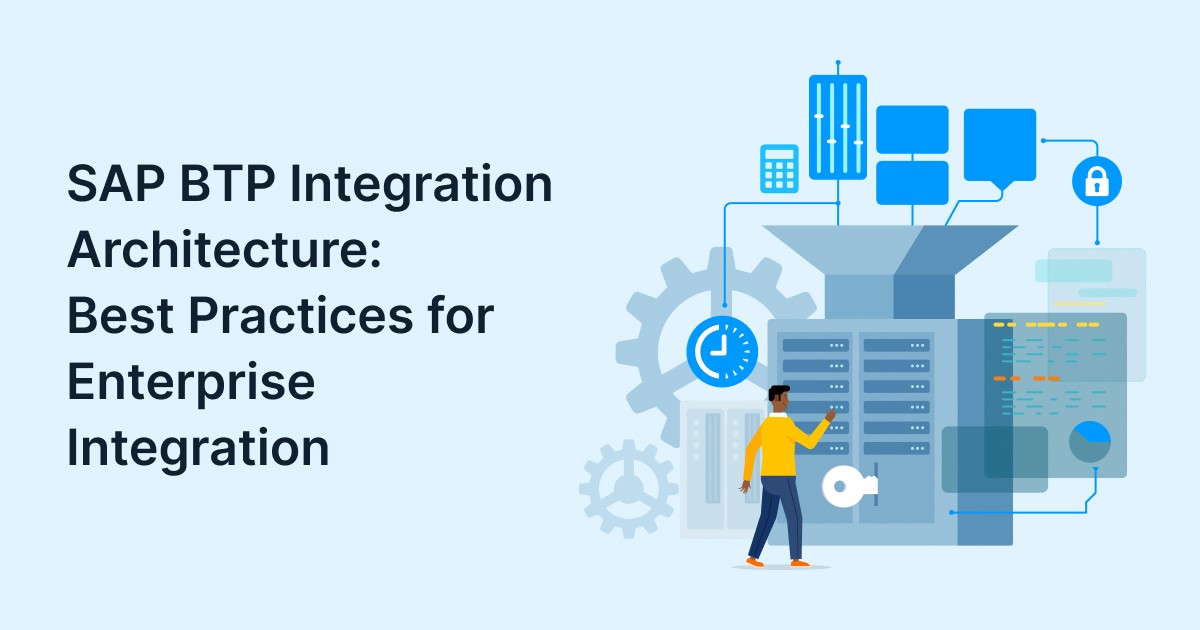
To build scalable and future-ready IT ecosystems, organisations need a well-defined SAP BTP Integration Architecture that connects systems, applications & data seamlessly across hybrid landscapes.
In today’s digital-first environment, businesses operate across multiple platforms, from SAP S/4HANA to SaaS applications and legacy systems. A strong SAP BTP architecture ensures these systems work together efficiently, reducing silos and improving agility. Leveraging robust integration solutions helps enterprises design a scalable and flexible integration framework aligned with their transformation goals.
Summary
- SAP BTP Integration Architecture enables unified enterprise connectivity
- Built on integration suite SAP BTP, it supports API, data & event integration
- API-led and event-driven models are key for scalability
- Essential for modern enterprise integration architecture
Key Statistics
“According to an SAP Report, SAP reports that structured integration strategies can reduce operational costs by up to 30%”
What is SAP BTP Integration Architecture?
To understand SAP BTP Integration Architecture, you need to view it as a structured framework that enables seamless communication between SAP and non-SAP systems using APIs, middleware & event-driven services. It ensures efficient data exchange and supports scalable enterprise operations.
SAP BTP Integration Architecture is built on integration suite SAP BTP, offering tools such as Cloud Integration, API Management, Event Mesh & Open Connectors. These components allow organisations to implement multiple integration styles –
- Application integration for connecting systems
- Data integration, including SAP BTP master data integration
- API-led integration for reusable services
- Event-driven integration for real-time responsiveness
This unified approach is critical for building a robust SAP integration architecture across complex enterprise landscapes.
Drive Digital Innovation & Transform Your Business
Struggling to find tailored IT solutions that truly accelerate your digital transformation journey? Partner with LedgeSure to unlock the true potential of technology.
Why is SAP BTP Integration Architecture Important for Enterprises?
To achieve digital transformation and operational efficiency, enterprises need an enterprise integration architecture that ensures system interoperability, scalability & governance across platforms.
Key advantages –
- Centralised governance – Monitor and manage integration flows in one place
- Improved agility – Rapid deployment of new services and integrations
- Hybrid ecosystem support – Seamlessly connect on-premises and cloud applications
- Data accuracy and consistency – Enabled through SAP BTP master data integration
| 💡 Did You Know?
“Organisations adopting API-led connectivity achieve 3x faster delivery of digital initiatives, according to Mulesoft” |
What are the Core Components of SAP BTP Integration Architecture?
To effectively implement SAP BTP Integration Architecture, you need to leverage its core components strategically within your SAP BTP architecture for seamless connectivity and scalability.
Integration Suite SAP BTP
This is the backbone of SAP BTP integration. It allows organisations to design, manage & monitor integrations through a unified platform.
- Enables reusable integration logic
- Supports multiple integration patterns
- Centralises integration governance
For a deeper technical understanding, explore how integration engineering works in SAP environments in this detailed guide on SAP BTP and Integration Engineering.
API Management
API Management enables organisations to expose, secure & manage APIs effectively.
- Supports API-first architecture
- Enables partner ecosystem integration
- Ensures secure access control
Cloud Integration
Cloud Integration acts as middleware for connecting applications across landscapes.
- Handles message routing and transformation
- Enables process integration
- Simplifies SAP BTP integration
Event Mesh
Event Mesh facilitates event-driven architecture, allowing systems to react instantly to changes.
- Supports real-time integration
- Enables asynchronous communication
- Improves scalability
Open Connectors
Open Connectors provide pre-built integrations for third-party applications.
- Reduces development effort
- Accelerates implementation
- Ensures standardised connectivity
How to Design an Effective SAP Integration Architecture?
To build a scalable SAP integration architecture, you need a design approach that prioritises flexibility, modularity & long-term maintainability.
Best practices for design –
- Adopt API-led design – Create reusable and standardised APIs to avoid duplication
- Use modular architecture – Break integrations into smaller, manageable components
- Enable event-driven processes – Replace batch processes with real-time communication
- Standardise integration patterns – Use predefined templates and frameworks
- Plan for scalability – Ensure your architecture supports evolving business needs
Enterprises transitioning from legacy platforms can benefit from this migration roadmap on MuleSoft to SAP BTP Migration Guide.
What are the Best Practices for SAP BTP Integration Architecture?
To optimise SAP BTP Integration Architecture, organisations need to follow proven best practices that ensure scalability, security & performance across enterprise integration architecture.
Adopt API-led Integration Strategy
- Promote reusability across systems
- Improve development efficiency
- Enable faster innovation cycles
Strengthen Governance and Monitoring
- Establish integration policies
- Monitor performance continuously
- Use centralised dashboards
Leverage SAP Integration Suite Fully
To maximise the capabilities of integration suite SAP BTP, enterprises should utilise all available features including integration flows, APIs & connectors.
- Use pre-built content packages
- Automate workflows
- Ensure standardisation
Ensure Data Consistency with Master Data Integration
- Use SAP BTP master data integration tools
- Eliminate data duplication
- Maintain single source of truth
Prioritise Security and Compliance
- Implement authentication protocols (OAuth, SAML)
- Encrypt data during transmission
- Apply zero-trust architecture
Have a look at the complete SAP Integration Suite: Complete Enterprise Guide to understand this process better.
Traditional vs SAP BTP Integration Architecture
| Feature | Traditional Integration | SAP BTP Integration Architecture |
| Integration Style | Point-to-point | API-led & event-driven |
| Scalability | Limited | Highly scalable |
| Governance | Fragmented | Centralised |
| Speed of Implementation | Slow | Faster deployment |
| Flexibility | Low | High |
| Cloud Compatibility | Limited | Fully cloud-enabled |
How Does SAP BTP Architecture Support Enterprise Integration?
To support a modern enterprise integration architecture, SAP BTP architecture provides a unified platform that connects applications, data & business processes seamlessly across environments.
Key capabilities include –
- Multi-cloud support – Enables deployment across AWS, Azure, and GCP
- Advanced data integration – Supports SAP BTP master data integration
- Embedded analytics and AI – Enables intelligent decision-making
- Seamless connectivity – Integrates SAP and non-SAP systems
Empower Your Workforce with AI & Automated Innovations
Want to boost efficiency and reduce costs? Explore how LedgeSure’s AI-driven solutions simplify workflows and drive real outcomes.
Common Challenges in SAP BTP Integration and How to Overcome Them
To effectively manage SAP BTP Integration Architecture, organisations must address common integration challenges with proactive strategies.
Common issues and solutions –
- Complex landscapes – Use integration suite SAP BTP to centralise processes
- Inconsistent data – Implement SAP BTP master data integration
- Security concerns – Adopt robust encryption and access controls
- Integration bottlenecks – Shift towards event-driven architecture
Conclusion
To stay competitive in a rapidly evolving digital landscape, businesses must invest in a structured SAP BTP Integration Architecture. By leveraging SAP BTP integration, integration suite SAP BTP, and best practices like API-led design and event-driven models, organisations can build a scalable and future-ready enterprise integration architecture.
If you’re looking to design or optimise your SAP integration strategy, Ledgesure offers expert-driven solutions tailored to your business needs. Get in touch today with our experts.