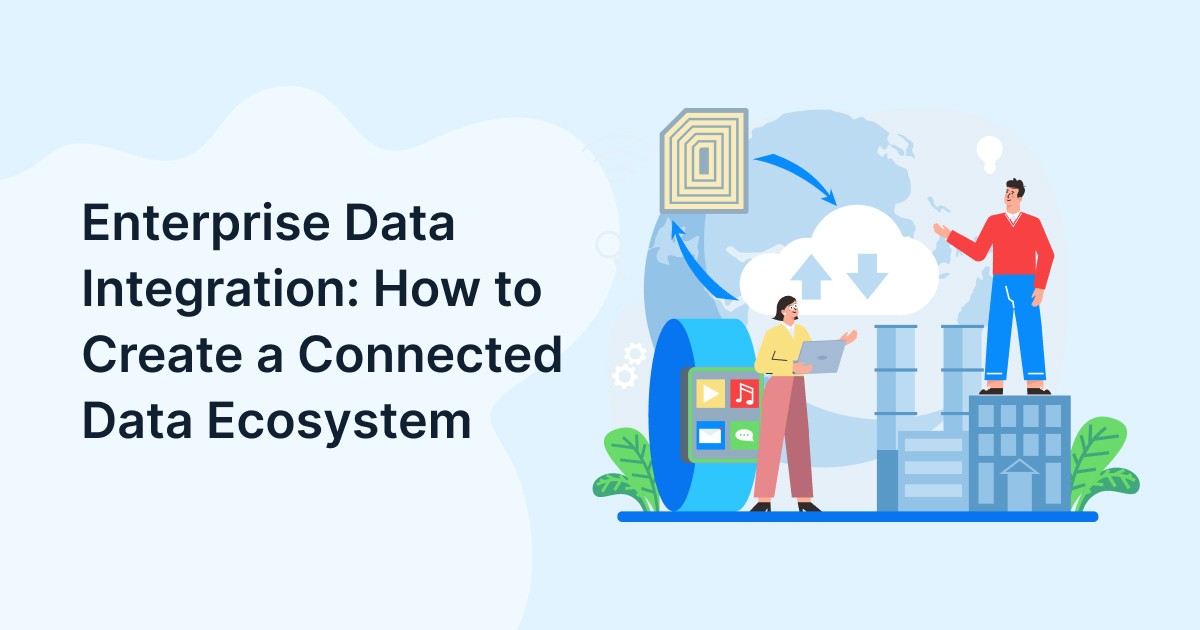
Enterprise data integration enables organisations to connect applications, databases, cloud platforms, and business systems into a unified data ecosystem. By creating seamless data flows across departments and technologies, businesses can improve visibility, accelerate decision-making, and support scalable digital transformation initiatives.
In today’s enterprise environment, data is generated from countless sources, including ERP systems, CRM platforms, cloud applications, analytics tools, customer portals & third-party software. While access to more data should improve decision-making, many organisations struggle with disconnected systems, duplicated information, and inconsistent reporting.
This is where enterprise data integration becomes essential. It helps organisations connect systems, eliminate data silos, and establish reliable data synchronization across the business. Combined with strong enterprise data management practices and modern data integration services, integration creates a foundation for operational efficiency, analytics, automation, and innovation.
Building a connected data ecosystem often requires specialised enterprise integration solutions that can integrate applications, automate workflows, and enable real-time information exchange between systems.
What Is Enterprise Data Integration?
Enterprise data integration is the process of combining and connecting data from various business systems into a unified ecosystem. Instead of information remaining isolated within individual departments or applications, integrated data becomes accessible wherever it is needed.
To create a connected enterprise environment, organisations need a way to unify data that exists across multiple systems. Enterprise data integration brings together information from different applications, platforms & databases so it can be accessed, shared, and analysed efficiently across the organisation.
Common integration sources include –
- ERP systems
- CRM platforms
- Human resources applications
- E-commerce platforms
- Cloud applications
- Data warehouses and data lakes
- IoT devices
- Third-party business applications
Modern data integration services provide the infrastructure required to move, transform, and synchronise information between these systems securely and efficiently.

Why Is a Connected Data Ecosystem Important for Modern Enterprises?
To improve business performance and support data-driven decision-making, organisations need a connected data ecosystem that delivers accurate, consistent, and accessible information across the enterprise. Without integration, data silos often create inefficiencies and limit visibility.
Many organisations operate dozens of standalone systems. While each application serves a specific purpose, disconnected platforms create challenges such as duplicate records, inconsistent reporting, delayed insights & poor collaboration.
A connected data ecosystem helps businesses –
Improve Decision-Making
Integrated data provides leaders with a complete view of business operations, allowing them to make informed decisions faster.
Enhance Customer Experiences
Sales, marketing, and support teams gain access to consistent customer information, improving engagement and service quality.
Increase Operational Efficiency
Automated workflows reduce manual data entry and minimise errors across business processes.
Support Analytics and Innovation
Connected data creates a reliable foundation for business intelligence, predictive analytics, and AI initiatives.
Strengthen Compliance
Centralised and governed information helps organisations meet regulatory and data privacy requirements more effectively.
How Does Enterprise Data Integration Work Across Modern Enterprise Systems?
To create a connected data ecosystem, organisations need a process that enables data to move securely and accurately between multiple applications, databases, cloud platforms & business systems. Enterprise data integration works by extracting, transforming, synchronising, and delivering data so that information remains consistent and accessible across the organisation.
Most enterprises operate multiple applications that generate and consume data independently. Enterprise data integration bridges these systems and ensures information flows seamlessly where it is needed.
A typical enterprise data integration process includes –
- Data Extraction
Data is gathered from business systems such as ERP solutions, CRM platforms, databases, cloud applications, and external services.
- Data Transformation
The extracted information is cleansed, validated, mapped, and standardised into a consistent format.
- Data Synchronization
Reliable data synchronization ensures updates made in one system are automatically reflected in connected systems.
- Data Delivery
Transformed data is delivered to business applications, dashboards, data warehouses, analytics platforms, or cloud environments.
- Monitoring and Governance
Continuous monitoring helps ensure data quality, security, compliance, and system performance.
Modern integration AI capabilities can further automate data mapping, anomaly detection & optimisation processes.
What Are the Key Components Required for a Connected Data Ecosystem?
To establish a scalable and reliable connected data ecosystem, organisations need more than system connectivity. They require architecture, governance, integration technologies, automation & data intelligence working together to support seamless information flow.
A successful connected ecosystem consists of several foundational components –
Unified Data Architecture
A structured data architecture ensures information flows consistently across systems while maintaining scalability.
The architectural foundation of a connected ecosystem plays a critical role in long-term flexibility and business growth. Organisations looking to deepen their understanding can explore Enterprise Integration Architecture: Patterns, Components & Best Practices.
Integration Services Layer
Modern data integration services act as the communication bridge between applications, systems, APIs, and databases.
Data Governance Framework
Governance policies help maintain data ownership, quality standards, compliance controls, and security requirements.
Data Storage and Analytics Platforms
Data lakes, warehouses, and analytics platforms transform integrated data into business insights and reporting capabilities.
Automation and Orchestration
Automated workflows reduce manual processes while improving efficiency and consistency.
AI-Driven Data Intelligence
Increasingly, organisations are using integration AI to improve data quality, automate integrations, and identify optimisation opportunities.
Together, these components create the foundation for effective enterprise data management.
Which Technologies Power Modern Enterprise Data Integration?
To support growing business demands and increasingly complex IT environments, enterprises rely on multiple integration technologies that enable secure, scalable, and real-time connectivity.
Several technologies play a critical role in modern enterprise integration:
| Technology | Primary Purpose | Key Benefit |
| APIs | Connect applications | Real-time communication |
| ETL/ELT Tools | Transform and move data | Improved analytics readiness |
| Cloud Integration Platforms | Connect cloud and on-premises systems | Scalability |
| Event-Driven Architecture | Enable real-time actions | Faster responsiveness |
| Data Warehouses | Centralise information | Unified reporting |
| Integration AI | Automate integration tasks | Increased efficiency |
As integration requirements continue to expand, many organisations are adopting low-code approaches to simplify implementation and reduce development effort. Learn why enterprises increasingly choose low-code integration platforms for modern integration projects.
How Does Integration AI Improve Enterprise Data Integration?
To manage increasingly complex data environments, organisations are using AI-driven integration capabilities that automate repetitive tasks, improve accuracy & accelerate deployment. Integration AI helps businesses build smarter and more scalable integration ecosystems.
Key benefits of integration AI include –
- Automated data mapping
- Intelligent workflow optimisation
- Faster error detection
- Improved data quality monitoring
- Reduced manual intervention
- Better scalability across enterprise systems
As enterprises expand their digital ecosystems, AI-powered integration technologies help reduce complexity while improving operational efficiency.
Did You Know?
“IBM reports that poor data quality costs organisations an average of $12.9 million annually. Data issues such as duplicate records, inconsistent formats, and disconnected systems contribute significantly to these losses. Effective enterprise data integration and data synchronization help organisations improve data accuracy and reduce operational inefficiencies.”
What Challenges Can Organisations Face During Enterprise Data Integration?
To achieve successful integration outcomes, organisations must overcome technical, operational, and governance challenges that often arise when connecting systems, applications, and data sources.
Some of the most common challenges include –
- Legacy Systems – Older applications may lack modern APIs or integration capabilities, making connectivity difficult.
- Data Silos – Departments often maintain isolated systems that prevent information from being shared effectively.
- Data Quality Issues – Duplicate, missing, or inconsistent records can reduce the effectiveness of integration initiatives.
- Security and Compliance Risks – Sensitive information must be protected throughout the integration process.
- Scalability Limitations – As organisations grow, integration architectures must support increasing volumes of data and system complexity.
Addressing these challenges early helps ensure a smoother and more successful integration journey.
How to Build a Connected Data Ecosystem with Enterprise Data Integration: Step-by-Step Approach
To build a connected data ecosystem, organisations should follow a structured strategy that aligns technology, governance, business processes, and long-term business objectives. A phased approach reduces complexity and creates a foundation for future scalability.
Step 1: Assess Existing Systems and Data Sources
Identify applications, databases, cloud platforms, and third-party systems currently operating within the organisation.
Step 2: Define Business Objectives
Determine the outcomes expected from integration, whether improving customer experiences, enabling analytics, increasing efficiency, or supporting compliance.
Step 3: Establish a Data Governance Framework
Develop standards for data ownership, security, compliance, privacy, and quality management.
Step 4: Select the Right Integration Technologies
Choose platforms and data integration services that support API connectivity, automation, scalability, and cloud integration.
Step 5: Implement Data Synchronization Processes
Establish reliable data synchronization mechanisms to maintain accuracy and consistency across connected systems.
Step 6: Leverage Integration AI and Automation
Use integration AI to automate mapping, monitoring, and workflow orchestration while reducing manual effort.
Step 7: Continuously Monitor and Optimise
Track integration performance, data quality, and business outcomes while identifying opportunities for improvement.
Many organisations evaluating integration strategies also explore Enterprise Integration Services: The Complete Guide to Connecting Systems, Data & Applications to better understand how systems, applications, and enterprise data can work together within a unified ecosystem.
Expert Insight: What Defines a Successful Enterprise Integration Strategy?
To maximise the value of enterprise data integration, organisations should focus on business outcomes rather than simply connecting systems. Technology alone cannot create a connected ecosystem without governance, scalability, and continuous optimisation.
Successful integration strategies share several characteristics –
- Strong enterprise data management practices
- Reliable data synchronization processes
- Scalable integration architecture
- Security and compliance controls
- Automated workflows and orchestration
- Continuous monitoring and optimisation
The most successful organisations view integration as an ongoing business capability rather than a one-time technology project.
Conclusion
Enterprise data integration is the foundation of a connected data ecosystem. As organisations continue expanding their digital operations, the ability to connect systems, applications, and data sources becomes critical for maintaining visibility, efficiency, and competitiveness.
By investing in effective enterprise data management, reliable data synchronization, modern data integration services, and emerging integration AI capabilities, businesses can unlock greater operational efficiency, improved analytics, and better customer experiences.
Need to connect legacy systems, cloud applications, and enterprise data without disrupting existing operations? Talk to LedgeSure about your integration requirements.
Key Takeaways
- Enterprise data integration connects systems, applications, and data sources into a unified ecosystem.
- Connected data environments improve visibility, collaboration, and decision-making.
- Data synchronization ensures information remains accurate and consistent across systems.
- Integration AI enhances automation, monitoring, and optimisation.
- Enterprise data management and governance are essential for long-term success.
- A structured implementation approach helps organisations achieve scalable integration outcomes.
Frequently Asked Questions
Q: What is enterprise data integration?
A: Enterprise data integration is the process of connecting data from multiple systems, applications, and databases into a unified environment. It allows organisations to access, share, and analyse information more effectively while reducing data silos and inconsistencies.
Q: Why is enterprise data integration important?
A: It improves operational efficiency, enables better decision-making, enhances customer experiences, and creates a consistent flow of information across business functions. It also supports analytics, automation, and digital transformation initiatives.
Q: What is a connected data ecosystem?
A: A connected data ecosystem is an integrated environment where systems, applications, and data sources work together seamlessly. It allows organisations to maintain accurate information, automate workflows, and support data-driven business decisions.
Q: How does data synchronization support enterprise integration?
A: Data synchronization ensures that information remains consistent across connected systems. When data changes in one application, updates are automatically reflected in others, reducing duplication and improving accuracy.
Q: What are data integration services?
A: Data integration services help organisations connect systems, automate data flows, transform information, and manage integration processes. These services support both cloud and on-premises environments.
Q: How does integration AI improve enterprise data integration?
A: Integration AI automates tasks such as data mapping, anomaly detection, workflow optimisation & system monitoring. This reduces manual effort and improves integration speed and accuracy.
Q: What challenges are commonly associated with enterprise data integration?
A: Common challenges include legacy systems, data silos, poor data quality, security concerns, compliance requirements, and scalability issues. A well-defined integration strategy helps address these challenges effectively.
Q: How can organisations create a connected data ecosystem?
A: Organisations can create a connected data ecosystem by assessing existing systems, implementing data governance, selecting suitable integration technologies, establishing data synchronization processes, and continuously optimising performance.