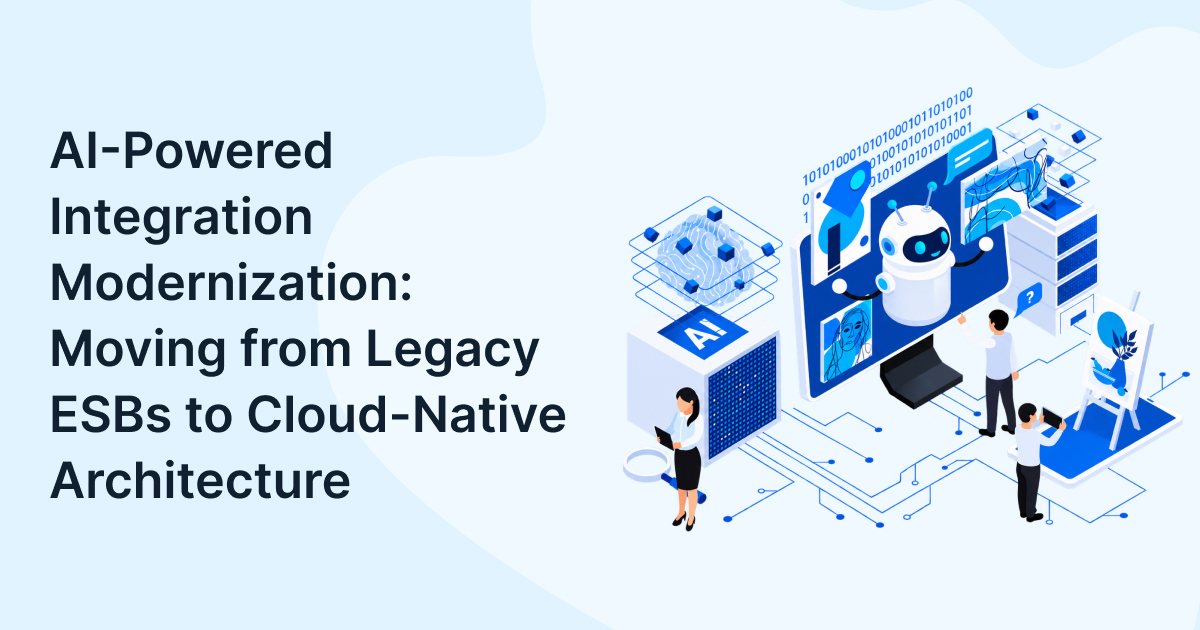
AI-powered integration modernization helps enterprises transform legacy ESB environments into cloud-native, API-first architectures by using artificial intelligence to discover dependencies, automate assessments, accelerate migration planning, improve testing & optimize post-migration operations. This approach reduces modernization risks, shortens project timelines, and creates a more scalable enterprise integration architecture.
Enterprise integration has evolved significantly over the last decade. Traditional Enterprise Service Bus (ESB) platforms once provided a reliable way to connect applications, systems, and data across the organization. However, modern enterprises are now operating in multi-cloud environments, integrating hundreds of SaaS applications, managing real-time data flows & deploying microservices at scale.
The challenge is that many existing integration ecosystems were never designed for this level of agility and complexity.
As organizations pursue digital transformation, legacy integration platforms often become barriers rather than enablers. Businesses face increasing maintenance costs, fragmented visibility, integration technical debt, and slower innovation cycles.
This has placed AI-powered integration modernization at the center of enterprise transformation initiatives. By combining intelligent automation, cloud integration capabilities, and modern integration solutions, organizations can modernize their enterprise integration architecture while minimizing disruption.
Companies beginning this journey often leverage specialized integration engineering services to assess integration landscapes, design modernization roadmaps, and execute migrations strategically.
Summary
- Legacy ESBs struggle to support modern cloud-native business environments.
- AI accelerates integration modernization by improving discovery, assessment, testing, and governance.
- API-first, event-driven, and cloud-native architectures are replacing centralized integration models.
- Organizations that modernize integrations reduce technical debt and increase business agility.
- The future of enterprise integration includes Agentic AI, self-healing integrations, and intelligent observability.
This integration gap is one of the primary reasons enterprises are investing heavily in integration modernization initiatives and intelligent integration solutions.
Why Are Enterprises Moving Away from Legacy ESBs?
Enterprises are reassessing legacy ESBs as integration requirements expand across cloud, SaaS, APIs, events, and distributed applications. Depending on business and technical constraints, modernization may involve selective replacement, re-platforming, API enablement, coexistence, or retirement rather than a single ESB-to-cloud migration path.
ESBs solved critical integration challenges in the early stages of enterprise digitization. They provided centralized routing, transformation, orchestration, and connectivity.
However, enterprise technology landscapes have changed dramatically. Today’s organizations need to support –
- Multi-cloud deployments
- SaaS-to-SaaS integrations
- Real-time analytics
- Microservices architectures
- Event-driven workflows
- AI-enabled business processes
Legacy ESB environments frequently become bottlenecks because every integration must pass through a central layer, increasing complexity as systems grow.
Common Challenges of Legacy ESBs
- Increasing Technical Debt – Years of undocumented integrations often create hidden dependencies that make modernization difficult.
- Limited Scalability – Traditional ESBs were not designed for elastic cloud workloads or rapidly changing business requirements.
- High Maintenance Costs – Specialized skills, infrastructure overhead, and ongoing support requirements can significantly increase operational expenses.
- Slower Innovation – New integrations may take weeks or months to implement due to complex dependencies and governance processes.

What Is AI-Powered Integration Modernization?
AI-powered integration modernization uses artificial intelligence and machine learning to analyse integration environments, identify modernization opportunities, automate migration activities & continuously optimize system performance throughout the transformation lifecycle.
Unlike traditional modernization approaches that rely heavily on manual assessments and documentation, AI introduces intelligence into every stage of the process.
Key AI capabilities include –
- Intelligent Dependency Discovery – AI can scan applications, interfaces, and middleware environments to uncover hidden integration relationships.
- Automated Documentation – Many organizations struggle with missing documentation. AI can generate integration maps and technical documentation automatically.
- Migration Recommendations – AI can evaluate workloads and recommend whether integrations should be rehosted, refactored, re-platformed, replaced, or retired.
- AI-Assisted Testing – Modern AI integration tools can generate test scenarios, identify anomalies, and improve quality assurance outcomes.
- Predictive Risk Analysis – Machine learning helps identify potential modernization risks before migration activities begin.
These capabilities allow organizations to modernize their enterprise integration architecture with greater confidence and visibility.
How Does AI Accelerate Legacy ESB Modernization?
To accelerate legacy ESB modernization, AI reduces the manual effort required for discovery, assessment, planning, testing, and operational monitoring while improving decision-making accuracy throughout the migration process.
The biggest modernization challenge is usually understanding existing integrations before making changes.
AI significantly reduces this complexity.
1. Faster Assessment of Existing Integrations
Before modernization begins, organizations need visibility into application dependencies, usage patterns & integration complexity.
A structured integration migration assessment helps establish this foundation while AI accelerates data collection and analysis.
2. Smarter Modernization Prioritization
AI can identify:
- High-risk integrations
- High-value modernization opportunities
- Legacy systems nearing end-of-life
- Integration bottlenecks affecting business performance
3. Improved API Discovery
AI can analyse service interactions and identify reusable API opportunities, helping organizations adopt API-first architecture principles.
4. Enhanced Testing and Validation
Machine learning can detect anomalies that traditional testing approaches often miss.
5. Continuous Optimization
After migration, AI monitors integration performance, identifies failures, and recommends optimization opportunities.
The AI-MAP Framework for Integration Modernization
Successful AI-powered integration modernization requires a structured approach. The AI-MAP Framework helps organizations modernize integrations by focusing on Mapping, Assessing, and Predicting throughout the transformation journey.
M – Map the Integration Landscape
Use AI to identify –
- Applications
- Dependencies
- Data flows
- Integration patterns
- Technical debt
This creates complete visibility into the existing environment.
A – Assess Modernization Readiness
Evaluate –
- Cloud readiness
- Security requirements
- Business criticality
- API opportunities
- Migration complexity
Organizations often combine this with broader integration modernization planning frameworks to develop realistic migration roadmaps.
P – Predict Risks and Outcomes
AI models can identify –
- Failure risks
- Downtime exposure
- Migration dependencies
- Resource requirements
The result is a more predictable modernization programme. This AI-MAP methodology represents a practical way to reduce uncertainty while improving modernization outcomes.
What Does a Modern Cloud-Native Integration Architecture Look Like?
A cloud-native integration architecture uses APIs, microservices, events, containers, and intelligent automation instead of relying on centralized middleware to manage enterprise connectivity.
Modern architectures prioritize flexibility and scalability. Core characteristics include –
- API-led connectivity
- Event-driven architecture
- Containerized services
- Hybrid cloud support
- Real-time integration
- Intelligent observability
- Built-in governance
Legacy ESB vs Cloud-Native Architecture
| Dimension | Legacy ESB environment | Modernization options |
| Integration style | Centralized orchestration and messaging | APIs, events, messaging, orchestration |
| Deployment | Often on-premises or tightly coupled infrastructure | Cloud, hybrid or managed platforms |
| Connectivity | Existing enterprise applications and middleware | APIs, SaaS, events and legacy connectivity |
| Scalability | Dependent on platform architecture and workload | Can use elastic cloud services where appropriate |
| Modernization approach | Existing flows and dependencies | Retain, wrap, re-platform, refactor or retire |
| Observability | Existing middleware monitoring | Distributed tracing, centralized telemetry and integration observability |
| Governance | Existing middleware policies | API, event, security and platform governance |
| Operating model | Often platform-centric | Can become product/domain/platform-oriented |
This shift is increasingly defining modern enterprise integration architecture strategies across industries.
Which Technologies Are Driving Modern Integration Modernization?
Most organizations modernizing integrations adopt API management, iPaaS platforms, event-driven architecture, automation platforms, and intelligent cloud integration technologies.
Key technologies include –
- API Management Platforms – Enable secure, governed, and scalable application connectivity.
- Integration Platform as a Service (iPaaS) – Provides flexible cloud integration capabilities without maintaining extensive infrastructure.
- Event-Driven Architecture – Supports real-time communication and reduces system dependencies.
- Microservices – Allows applications to evolve independently without impacting the entire ecosystem.
- Integration Observability Platforms – Provide visibility into integration performance, failures, and operational health.
Many organizations first evaluate whether they need migration or modernization by understanding the distinction between integration migration and integration modernization initiatives.
What Mistakes Commonly Derail Integration Modernization Projects?
To improve modernization outcomes, organizations should avoid rushing migrations, underestimating technical debt, ignoring governance requirements, and treating migration as a simple infrastructure exercise.
Several recurring mistakes increase project risks.
- Migrating Before Assessment – Without understanding dependencies, organizations risk disrupting business-critical processes.
- Confusing Migration with Modernization – Moving integrations to a new platform without architectural improvements often recreates existing problems.
- Ignoring Governance – API governance, security policies, and compliance requirements must be addressed from the beginning.
- Underestimating Integration Technical Debt – Years of accumulated integrations often require significant rationalization before modernization.
- Over-Automating AI Decisions – AI should accelerate decision-making, not replace human oversight entirely.
Human-in-the-loop governance remains critical. Cloud-first initiatives are one of the largest drivers behind enterprise investment in cloud integration and modernization strategies.
How Will AI Transform Integration Modernization Beyond 2026?
The future of integration modernization will be driven by Agentic AI, self-healing integrations, intelligent governance, and automated architectural decision-making.
Several emerging trends are already reshaping enterprise integration.
- Agentic AI for Integration Operations – AI agents will monitor integrations, identify issues, recommend resolutions, and assist engineering teams with modernization decisions.
- Self-Healing Integrations – Future platforms will automatically resolve common failures before they impact business operations.
- Natural Language Integration Design – Users may define integrations using conversational prompts rather than complex coding workflows.
- AI-Generated APIs – AI will help organizations rapidly build APIs based on existing services and business requirements.
- Intelligent Governance – Governance engines will continuously monitor security, performance, compliance, and operational risks.
Organizations exploring long-term modernization strategies are increasingly evaluating broader AI-Powered Integration Migration: How Enterprises Can Modernize Legacy ESBs approaches as part of their transformation roadmaps.

Conclusion
Moving from legacy ESBs to cloud-native architecture is no longer simply a technology upgrade. It is a strategic initiative that directly impacts agility, innovation, customer experience, and operational efficiency.
Organizations pursuing AI-powered integration modernization gain a significant advantage through faster assessments, intelligent migration planning, automated testing, improved visibility & more resilient integration ecosystems.
The most successful programmes combine modern integration solutions, AI-driven decision-making, cloud integration strategies, and a scalable enterprise integration architecture built for future business needs.
If your organization is evaluating legacy ESB modernization or planning a broader integration transformation initiative, partnering with experienced specialists can help reduce risk and accelerate results.
Ready to modernize your integration landscape? Connect with the experts at LedgeSure and build a future-ready integration strategy.
FAQs
Q. What is AI-powered integration modernization?
AI-powered integration modernization is the use of artificial intelligence to analyse, assess, migrate, optimize, and manage enterprise integrations while transitioning from legacy systems to modern cloud-native architectures. It helps organizations reduce manual effort, improve visibility, and accelerate transformation initiatives.
Q. Why are organizations modernizing legacy ESBs?
Organizations modernize legacy ESBs because traditional integration platforms often struggle with scalability, cloud connectivity, maintenance complexity, and innovation requirements. Modern integration architectures provide greater flexibility, resilience, and support for digital transformation goals.
Q. How does AI help during integration modernization projects?
AI helps identify dependencies, generate documentation, recommend migration paths, automate testing, detect anomalies & monitor integration performance. These capabilities reduce project risks and improve modernization outcomes.
Q. What is the difference between integration migration and integration modernization?
Migration typically focuses on moving integrations from one environment to another. Modernization involves redesigning architecture, reducing technical debt, improving scalability, adopting APIs, and preparing the organization for future growth.
Q. What technologies replace traditional ESBs?
Modern alternatives include API management platforms, iPaaS solutions, event-driven architectures, microservices, cloud integration services & integration observability platforms.
Q. What is integration technical debt?
Integration technical debt refers to outdated, undocumented, or inefficient integrations that increase maintenance effort, create operational risks, and slow modernization initiatives.
Q. How long does integration modernization take?
Project timelines vary based on architecture complexity, integration volume, business dependencies, and modernization goals. Most enterprises adopt phased modernization strategies to minimize risk and disruption.
Q. Will AI replace integration architects?
No. AI enhances decision-making and improves efficiency, but human expertise remains essential for governance, architecture design, business alignment, compliance & strategic planning.