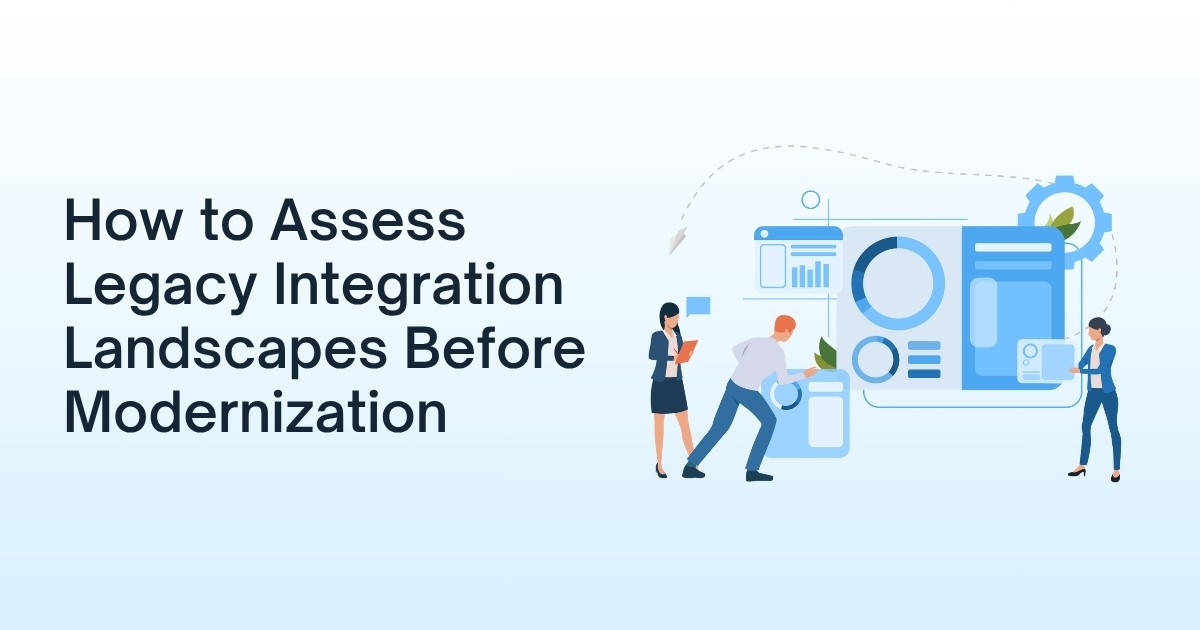
Modern enterprises are under constant pressure to modernize applications, improve operational agility & accelerate digital transformation initiatives. However, one critical step is often overlooked: understanding the existing integration landscape before modernization begins. Years of accumulated integrations, custom connectors, legacy middleware, and undocumented dependencies can make modernization far more complex than expected.
To successfully execute Legacy System Modernization, organizations must first assess their existing integration landscape, including applications, data flows, APIs, dependencies, security controls & middleware platforms. A comprehensive assessment helps identify modernization priorities, mitigate migration risks, reduce technical debt & build a roadmap for effective Integration Modernization and Application Modernization initiatives.
The reality is that most enterprises do not struggle because their applications are old. They struggle because those applications are deeply interconnected through years of custom integrations and business-specific workflows. Before replacing or modernizing any system, organizations need complete visibility into how information moves across their ecosystem.
As more businesses embrace cloud technologies and digital transformation, investing in modern integration solutions has become a strategic requirement for reducing complexity and creating a scalable foundation for future growth.
Industry Insight
“According to IBM’s Cost of a Data Breach Report 2024, organizations that extensively use AI and automation experienced breach costs that were USD 2.22 million lower than organizations without these capabilities.”
Why Is Assessing the Integration Landscape Important Before Legacy System Modernization?
To reduce modernization risks and improve project success rates, organizations need a clear understanding of how their systems communicate and exchange information. Assessing the integration landscape uncovers dependencies, bottlenecks & technical debt that could otherwise impact business continuity during modernization.
Many modernization initiatives focus heavily on applications while underestimating the complexity of the integrations connecting them. Integrations often contain years of business logic, customer data flows, reporting processes, and operational workflows that are critical to day-to-day operations.
Drive Digital Innovation & Transform Your Business
Struggling to find tailored IT solutions that truly accelerate your digital transformation journey? Partner with LedgeSure to unlock the true potential of technology.
A detailed assessment helps organizations –
Identify Business-Critical Integrations
Not all integrations have the same importance. Some support customer-facing processes, while others facilitate internal reporting or operational activities. Understanding business impact helps prioritize modernization efforts.
Uncover Undocumented Dependencies
Over time, teams create workarounds, scripts & custom connections that may never be formally documented. These hidden dependencies can become major sources of risk during migration projects.
Evaluate Technical Debt
Legacy integrations often rely on outdated technologies, unsupported software, and inefficient architectures. Identifying these areas early helps organizations build a more realistic modernization strategy.
Reduce Modernization Costs
Unexpected integration issues are a major contributor to project delays and budget overruns. A thorough assessment significantly reduces the likelihood of costly surprises.
What Should Be Included in a Legacy Integration Assessment?
To create an accurate modernization roadmap, organizations must evaluate applications, integrations, middleware, APIs, data flows & business processes. This provides a complete picture of the current environment and highlights areas that require transformation.
A comprehensive assessment should go beyond technical discovery and examine how integrations support real business outcomes.
-
Application Inventory
Begin by documenting all applications that participate in the enterprise ecosystem.
This includes:
- ERP systems
- CRM platforms
- Supply chain applications
- Custom-built software
- SaaS applications
- Industry-specific tools
Each application should be assessed for business criticality, ownership, support status & modernization readiness.
-
Integration Inventory
Understanding how systems communicate is equally important. Document all existing:
- APIs
- File-based transfers
- Event-driven integrations
- Message queues
- ETL pipelines
- Legacy integration services
- Database connections
Many enterprises discover dozens of undocumented integrations during this stage, making this one of the most valuable parts of the assessment process.
-
Middleware Integration Analysis
Most legacy environments rely heavily on some form of middleware integration.
Organizations should evaluate –
- Existing ESBs
- Integration brokers
- SOA platforms
- Messaging systems
- Custom middleware solutions
Questions worth asking include –
- Is the platform still supported?
- Can it scale with future requirements?
- Does it support cloud-native integration models?
- Is maintenance becoming increasingly expensive?
Organizations exploring modern integration architectures can also learn how today’s platforms improve scalability and connectivity in our guide on How Integration Platforms Connect Applications, Data and Processes.
How Can Organizations Identify Hidden Dependencies?
To identify hidden dependencies, organizations must combine automated discovery tools with business process analysis and stakeholder interviews. This approach helps uncover critical relationships that may not appear in system documentation.
Hidden dependencies are among the most common reasons modernization projects experience delays or disruptions.
Use Automated Discovery Tools
Modern platforms powered by integration AI can automatically identify relationships between applications, APIs, databases & services.
These tools help organizations –
- Map dependencies faster
- Reduce manual effort
- Improve visibility
- Discover unknown integrations
Conduct Stakeholder Interviews
Technology teams may not have complete visibility into how systems are used.
Business leaders, operations teams & process owners often provide valuable insights into –
- Workarounds
- Manual processes
- Critical business workflows
- Customer-impacting integrations
Analyze Historical Logs
Application and integration logs often reveal patterns that documentation misses.
Log analysis can uncover –
- Frequently used integrations
- Transaction volumes
- Failure points
- Performance bottlenecks
By combining technical and business perspectives, organizations gain a more accurate understanding of the environment they intend to modernize.
| 💡 Did You Know?
“According to Flexera’s 2026 State of the Cloud Report, managing cloud costs and integrating existing systems remain among the most significant challenges organizations face during modernization and cloud transformation projects.” |
Which Legacy Integrations Create the Highest Modernization Risk?
To minimize migration failures, organizations should focus first on integrations that combine high business criticality with high technical complexity. These integrations represent the greatest operational risk and require additional assessment before modernization begins.
Certain integration types consistently create challenges during Legacy System Modernization initiatives.
Point-to-Point Integrations
These direct connections often grow organically over time. While they may initially seem simple, organizations frequently discover hundreds of interconnected dependencies that become difficult to manage or replace.
Shared Databases
When multiple applications rely on the same database, even small changes can affect numerous business processes. These dependencies require careful planning before modernization.
Custom Middleware Connectors
Many legacy environments contain custom-built integrations developed years ago by teams that are no longer with the organization. These integrations often lack documentation and can be difficult to recreate.
Hard-Coded Business Rules
Business logic embedded within integrations creates additional risk during migration because it may not exist anywhere else in the architecture. Understanding these rules is critical for successful Legacy Application Modernization.
How Should Data Flow and Performance Be Evaluated?
To support efficient modernization planning, organizations need to understand how data moves throughout their ecosystem and where performance bottlenecks occur. Data flow analysis helps identify opportunities for optimization and scalability improvements. Data movement is often the hidden engine behind enterprise operations.
Analyze Transaction Volumes
Understanding transaction patterns helps teams determine future scalability requirements.
Organizations should evaluate –
- Peak processing periods
- Average transaction volumes
- Seasonal demand spikes
- Growth forecasts
Measure Integration Latency
Response times directly affect user experience and operational efficiency. Assess –
- API response times
- Batch processing windows
- Data synchronization delays
- Real-time integration requirements
Review Error Rates
Frequent failures often indicate architectural weaknesses. Organizations should assess –
- Failed transactions
- Data quality issues
- Retry mechanisms
- Integration outages
How Can Integration AI Improve Modernization Assessments?
To accelerate discovery and improve assessment accuracy, organizations increasingly leverage integration AI technologies. AI-powered analysis helps identify patterns, dependencies, risks & optimization opportunities that traditional assessments may overlook.
AI is becoming an increasingly important component of modernization planning.
Automated Dependency Discovery
AI-based analysis can process large environments much faster than manual approaches.
This enables teams to identify –
- Application relationships
- Service interactions
- Integration patterns
- Hidden dependencies
Impact Analysis
Before making changes, organizations need to understand what systems may be affected.
AI helps predict –
- Potential disruptions
- Failed dependencies
- Service impacts
- Risk areas
Optimization Recommendations
Many AI-powered platforms can recommend –
- API-based alternatives
- Integration consolidation opportunities
- Cloud migration paths
- Performance improvements
These capabilities can significantly reduce the effort involved in large-scale Application Modernization programs.
What Should a Legacy System Modernization Roadmap Include?
To successfully transition from legacy environments to modern architectures, organizations need a structured roadmap that prioritizes business value, minimizes risk & provides clear execution milestones.
Modernization should never be approached as a single large migration project.
Define the Current State
Organizations should document –
- Existing architecture
- Integration inventory
- Technical debt
- Operational challenges
This establishes the baseline for planning future-state improvements.
Establish the Future State
Define what modernization success looks like. Consider –
- Cloud adoption goals
- API strategy
- Security improvements
- Business scalability requirements
Many organizations create phased roadmaps similar to the approach outlined in our Integration Modernization Roadmap for Large Enterprises.
Prioritize Modernization Initiatives
Not every system requires immediate modernization. Prioritization should consider –
- Business impact
- Risk level
- Technical complexity
- Resource requirements
Align with Enterprise Transformation Goals
Integration assessments should support broader modernization initiatives across the organization. This is where structured IT modernization frameworks often help organizations improve governance, prioritization & long-term planning.
At this stage, organizations should also begin documenting an Integration Migration and Modernization: The Complete Enterprise Guide framework that can later serve as a blueprint for migration sequencing, governance, risk mitigation & transformation planning.
Conclusion
Modernization is no longer optional for enterprises looking to stay competitive. However, the success of any Legacy System Modernization initiative depends on understanding the environment before making changes.
By thoroughly assessing applications, integrations, data flows, dependencies, security requirements & middleware integration platforms, organizations can reduce risk, improve planning accuracy, and maximize modernization outcomes. Whether your goal is Legacy Application Modernization, Integration Modernization, or broader Application Modernization, a structured assessment provides the foundation for sustainable transformation.
If you’re planning a modernization initiative and need expert support with integration discovery, assessment, architecture design, or execution, connect with the LedgeSure team.
Empower Your Workforce with AI & Automated Innovations
Want to boost efficiency and reduce costs? Explore how LedgeSure’s AI-driven solutions simplify workflows and drive real outcomes.
Key Takeaways
- Legacy integration assessments should always precede modernization efforts.
- Hidden dependencies are one of the biggest causes of migration challenges.
- Application, integration & middleware analysis provide critical modernization insights.
- Data flow assessments help uncover performance and scalability issues.
- Integration AI can significantly improve discovery, visibility & risk analysis.
- A phased roadmap reduces modernization risks and improves outcomes.
- Effective Legacy System Modernization starts with a complete understanding of the current environment.