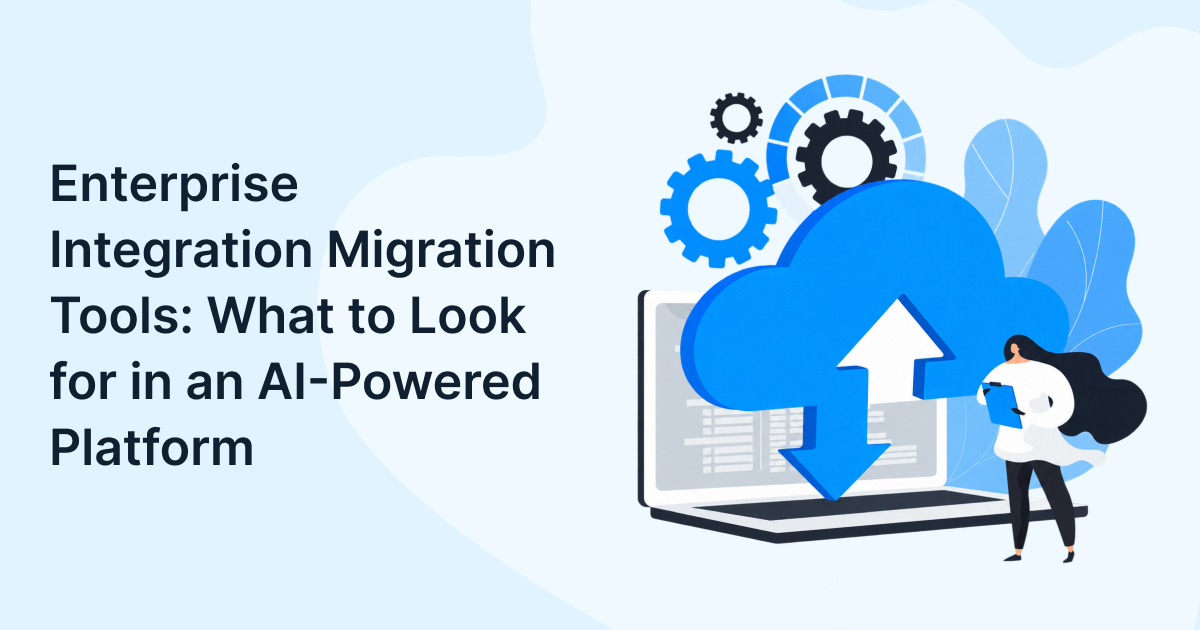
Enterprise integration migration tools help organizations discover, assess, migrate, and modernize integrations with lower risk and greater efficiency. AI-powered platforms go beyond traditional migration by automating dependency mapping, identifying risks, accelerating modernization & providing deeper visibility into complex integration environments.
As enterprises continue modernizing their application landscapes, integration environments are becoming increasingly difficult to manage. Years of application growth, custom middleware, legacy ESBs, point-to-point connections, and undocumented workflows create complexity that slows innovation and increases operational risk.
This is why organizations are increasingly investing in advanced integration migration tools that not only move integrations from one platform to another but also help modernize and optimize the overall integration ecosystem.
Whether you’re migrating from IBM Integration Bus, Oracle Service Bus, TIBCO BusinessWorks, Mule ESB, or other middleware platforms, choosing the right AI-powered integration migration platform can significantly impact project success.
For organizations beginning their modernization journey, robust integration engineering services can provide the expertise and roadmap necessary to reduce migration risks while accelerating transformation.
Summary
- AI-powered integration migration tools automate discovery, analysis, migration, testing & documentation.
- Enterprises should prioritize governance, observability, dependency mapping, and AI-driven risk assessment.
- Migration should be viewed as a modernization initiative, not just a platform replacement.
- Agentic AI is emerging as the next evolution of enterprise migration automation.
- The best platforms reduce technical debt while preparing organizations for future growth.
Why Are Enterprises Replacing Legacy Integration Platforms?
Enterprises are replacing legacy integration platforms because older middleware environments often limit scalability, increase maintenance costs, and slow digital transformation initiatives.
Many organizations built their integration ecosystems years ago when cloud-native architectures, modern APIs, and AI-assisted operations were not common requirements. As business demands evolve, these legacy environments struggle to support modern workflows.
Key drivers include –
- Cloud transformation initiatives
- API-led integration strategies
- Security and compliance requirements
- Increased maintenance costs
- Platform end-of-life concerns
- Lack of scalability
- Technical debt accumulation
A modern enterprise integration architecture requires flexibility, visibility, and the ability to quickly adapt to changing business needs. Legacy environments frequently create bottlenecks that prevent organizations from achieving these goals.
Organizations evaluating modernization options often start by conducting an enterprise migration assessment to understand dependencies, risks, and migration readiness before building a modernization roadmap.

What Are Integration Migration Tools?
Integration migration tools help organizations move integrations, data flows, APIs, workflows, and middleware assets from legacy platforms to modern integration environments.
These tools support migration activities across –
- Enterprise Service Bus (ESB) platforms
- Integration middleware
- Application integrations
- Hybrid cloud architectures
- API ecosystems
- Business process workflows
Modern enterprise migration software typically includes –
- Automated Discovery – The platform identifies integration assets, interfaces, dependencies, and workflows that need migration.
- Dependency Mapping – Integration dependencies are automatically analyzed to prevent migration surprises later in the project.
- Migration Automation – AI-assisted tools can significantly reduce manual effort required for mapping, transformation, and testing activities.
- Validation and Monitoring – Migration platforms help validate migrated assets and monitor production environments after deployment.
Unlike traditional tools, modern AI migration tools support both migration and modernization, allowing organizations to improve architecture while transitioning platforms.
How Do AI Migration Tools Improve Migration Success?
AI migration tools improve migration success by automating complex tasks, reducing manual errors, accelerating analysis & identifying risks earlier in the project lifecycle.
Traditional migration projects often require extensive manual documentation, dependency analysis, and testing. This can extend project timelines and increase operational risk.
AI-powered capabilities help address these challenges through –
- Intelligent Discovery – AI rapidly scans integration environments and generates inventories of applications, interfaces, workflows, and messaging systems.
- Dependency Intelligence – Machine learning algorithms identify hidden dependencies that could otherwise cause unexpected migration failures.
- Automated Documentation – One of the most overlooked migration challenges is incomplete documentation. AI can automatically generate architecture summaries and migration documentation.
- Predictive Risk Analysis – AI helps identify integrations likely to encounter issues before migration begins.
For enterprises comparing approaches, our guide on AI vs. manual integration migration explores how automation impacts migration speed, cost, and outcomes.
What Features Should You Look for in an AI-Powered Integration Migration Platform?
A strong integration migration platform should combine automation, governance, observability, modernization support, and AI-driven intelligence in a single solution.
Automated Dependency Discovery
Migration success starts with understanding your existing environment. Look for platforms that automatically discover –
- Applications
- APIs
- Data flows
- Workflows
- Messaging queues
- Integration services
AI-Based Impact Analysis
Understanding the impact of migration changes is critical in enterprise environments. Strong platforms can –
- Identify business-critical integrations
- Assess dependency risks
- Recommend migration strategies
- Predict operational impact
Workflow Transformation
Beyond migration, leading platforms help modernize workflows for API-first and cloud-native architectures.
Governance and Compliance
Migration projects require strong governance controls such as –
- Audit logging
- Role-based access control
- Policy management
- Version tracking
Real-Time Observability
Observability capabilities help teams monitor migrated integrations and quickly identify issues.
AI-Assisted Documentation
Automatically generated documentation reduces knowledge gaps and supports long-term maintainability.
How Do Integration Migration Tools Help Reduce Technical Debt?
To reduce technical debt, enterprises need integration migration tools that identify redundant integrations, modernize outdated architectures, and eliminate unsupported middleware dependencies.
Technical debt is one of the primary reasons organizations pursue modernization initiatives. Over time, integration environments accumulate –
- Duplicate services
- Redundant workflows
- Unsupported technologies
- Poor documentation
- Complex point-to-point integrations
The right integration solutions do more than move integrations. They help simplify and optimize the environment, making future enhancements faster and less expensive.
Can Enterprises Migrate Integrations Without Downtime?
Yes, enterprises can significantly reduce or avoid downtime through phased migration strategies, parallel deployments, automated validation, and intelligent monitoring.
Business disruption remains one of the biggest concerns during migration initiatives.
Best practices include –
- Phased Migration – Migrate integrations incrementally instead of replacing the entire platform at once.
- Parallel Operations – Run legacy and modern environments simultaneously during validation phases.
- Automated Testing – Validate integrations continuously throughout the migration process.
- Real-Time Monitoring – Observability platforms provide visibility into performance and transaction health before, during, and after cutover.
ESB Migration vs Integration Modernization: What’s the Difference?
ESB migration focuses on moving integrations from one platform to another, while modernization improves architecture, scalability, governance & future readiness during the migration process.
| ESB Migration | Integration Modernization |
| Platform replacement | Business transformation |
| Focuses on moving assets | Focuses on improving architecture |
| Limited business value | Long-term strategic value |
| Often maintains existing design | Encourages optimization |
| Short-term objective | Long-term modernization roadmap |
Organizations planning modernization initiatives often gain additional value by moving from legacy middleware toward cloud-native architectures. Our guide on AI-powered integration modernization explores this transition in greater detail.
What Questions Should Enterprise Leaders Ask Before Choosing a Migration Platform?
Enterprise leaders should evaluate how well a platform supports automation, modernization, governance, scalability, and long-term operational success. Before selecting enterprise migration software, decision-makers should ask –
- Can the platform automatically discover integrations? – Manual discovery increases risk and project duration.
- Does it support modernization, not just migration? – Migration alone may not justify the investment.
- How much migration effort can be automated? – The level of automation directly impacts timelines and costs.
- Does it support governance and compliance? – Enterprise migrations require auditability and security controls.
- Can it scale across thousands of integrations? – Large organizations need enterprise-grade scalability.
- What post-migration visibility is available? – Observability capabilities are critical for ongoing operations.
How Is Agentic AI Transforming Integration Migration?
Agentic AI represents the next evolution of migration technology by enabling AI systems to analyze, recommend, execute, and continuously optimize migration activities with reduced human intervention.
Traditional AI helps automate individual migration tasks. Agentic AI expands this capability by supporting –
- Intelligent migration planning
- Automated dependency analysis
- Workflow transformation recommendations
- Test generation
- Optimization suggestions
- Continuous environment assessment
While human oversight remains essential, agentic AI has the potential to significantly reduce migration effort and accelerate enterprise modernization initiatives.
This trend is expected to become increasingly important as organizations manage larger and more complex integration environments.
How Does Genova IQ Support Enterprise Integration Modernization?
AI-powered modernization initiatives require visibility, intelligence, and automation. Genova IQ helps enterprises accelerate migration projects by providing deeper insight into integration environments and modernization opportunities.
Through AI-assisted capabilities, Genova IQ helps organizations –
- Analyze integration landscapes
- Identify dependencies
- Reduce migration risks
- Improve planning accuracy
- Accelerate modernization initiatives
Rather than replacing expert decision-making, intelligent automation enables teams to focus on architecture and business outcomes rather than repetitive manual activities.
These capabilities align closely with the growing demand for AI-powered integration solutions and scalable enterprise integration architecture modernization.
If I’m migrating from a legacy ESB, should I migrate or modernize?
Modernization typically delivers more business value. Migration moves integrations to a new platform, while modernization improves architecture, scalability, governance, and future readiness.
Can AI automate enterprise integration migration?
AI can automate many activities including discovery, dependency mapping, documentation, testing support, and risk analysis. However, strategic architecture decisions and business validation still require human expertise.
What’s the fastest way to migrate enterprise integrations?
The fastest approach combines automated assessment, AI-assisted migration tools, phased implementation, and continuous validation throughout the migration lifecycle.

Conclusion
The role of integration migration tools has evolved significantly. Enterprises no longer need platforms that simply move integrations from one environment to another. They need intelligent solutions that discover dependencies, assess risks, automate complex tasks, and support long-term modernization goals.
As integration ecosystems continue growing in complexity, AI-powered platforms will become an essential component of successful transformation programs. Organizations that combine intelligent automation, strong governance, and modernization-focused strategies will be better positioned to reduce technical debt, accelerate innovation, and improve operational agility.
If you’re evaluating modernization opportunities, planning a migration initiative, or exploring ways to optimize your existing integration landscape, connect with Ledgesure’s experts to discuss your next steps.
FAQs
Q. What are integration migration tools?
Integration migration tools help organizations move integrations, APIs, workflows, and middleware assets from one environment to another. Modern platforms also support modernization, governance, and automation.
Q. What is an integration migration platform?
An integration migration platform provides centralized capabilities for discovery, planning, migration, validation, monitoring, and modernization.
Q. How do AI migration tools reduce migration risk?
AI migration tools identify dependencies, assess risks, automate documentation, and recommend migration strategies before implementation begins.
Q. What are ESB migration tools?
ESB migration tools help organizations move integrations away from legacy Enterprise Service Bus platforms toward modern integration architectures.
Q. How long does enterprise integration migration take?
Timelines vary significantly depending on environment complexity, application dependencies, migration scope, and modernization objectives.
Q. Can AI completely automate integration migration?
No. AI can automate significant portions of the migration lifecycle, but architectural decisions, governance oversight, and business validation still require human expertise.
Q. What is the difference between migration and modernization?
Migration focuses on moving assets from one platform to another. Modernization improves architecture, processes, scalability, and operational efficiency.
Q. How do organizations reduce migration costs?
Organizations can reduce costs through automated discovery, AI-assisted migration, phased implementation, and proactive risk management strategies.
Q. What should enterprises prioritize when selecting migration software?
Key priorities include automation capabilities, governance controls, observability, scalability, dependency intelligence, and modernization support.
Q. Which industries benefit most from integration modernization?
Industries with complex application ecosystems, including financial services, healthcare, manufacturing, retail, and technology organizations, often see the greatest benefits.