Modern enterprises run hundreds of applications, databases, cloud platforms, APIs, and legacy systems. Yet none of them deliver value if they cannot communicate with each other efficiently. This is where middleware integration becomes the foundation of digital transformation, enabling seamless connectivity, data exchange, and business process automation across complex IT environments.
Middleware integration is the process of connecting applications, systems, databases, and services through an intermediary software layer that manages communication, data transformation, security, and orchestration. It helps organisations simplify application integration, improve interoperability, and support cloud, on-premises, and hybrid environments through a unified integration approach.
As organisations expand their technology ecosystem, point-to-point integrations often become difficult to manage. Middleware can reduce this challenge by providing reusable integration capabilities and common patterns, but the architecture still needs governance and careful design.
Companies investing in scalable integration solutions can reduce operational complexity, accelerate innovation, and build a future-ready technology stack. Organisations seeking specialised middleware integration services often use middleware to modernise legacy environments while supporting cloud-native applications and AI-driven workflows.
For businesses planning integration initiatives, LedgeSure’s Integration Engineering Services provide support for designing, implementing, and modernising enterprise integration ecosystems.
Why Is Middleware Integration Important for Modern Enterprises?
To connect increasingly complex technology ecosystems, organisations need middleware integration that enables systems to communicate, exchange data, and automate processes without requiring direct connections between every application.
Today’s enterprise IT landscape includes –
- SaaS applications
- ERP systems
- CRM platforms
- Data warehouses
- Legacy systems
- Cloud-native applications
- Partner ecosystems
Without integration middleware, each application would require multiple custom integrations. As the number of systems grows, the number of potential integration dependencies can increase rapidly, making point-to-point architectures harder to govern and maintain.
Middleware provides a centralised approach to application integration by handling communication between systems while reducing maintenance effort and technical debt.

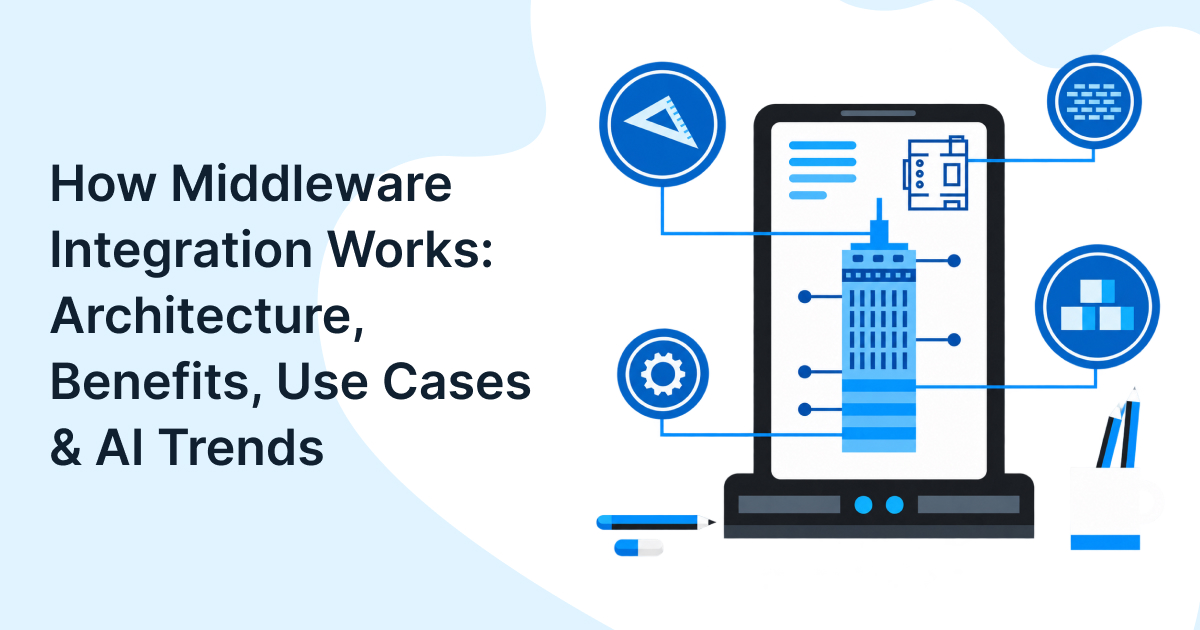
How Does Middleware Integration Work?
Middleware integration works by receiving data from one application, processing or transforming it as needed, and then securely delivering it to another system through predefined rules and workflows.
Think of middleware as an intelligent translator and traffic controller between business systems.
Communication Layer
The communication layer enables applications to exchange messages regardless of underlying technologies.
For example –
- SAP sends customer data
- Middleware receives the information
- Middleware routes data to Salesforce
- Salesforce updates customer records
Neither system needs to understand the other’s internal architecture.
Data Transformation Layer
Applications often store information differently. Middleware converts –
- Data formats
- Protocols
- Schemas
- Business rules
This ensures consistent information exchange between systems.
Routing and Orchestration Layer
Integration middleware determines –
- Where data should go
- Which system responds first
- What actions to trigger
- How workflows should execute
This orchestration capability is especially valuable in enterprise environments.
Security Layer
Modern middleware architecture includes –
- Authentication
- Authorisation
- Encryption
- Compliance controls
- Audit logging
These functions help protect sensitive enterprise data while enabling secure connectivity.
What Are the Core Components of Middleware Architecture?
Middleware architecture combines multiple technical layers that work together to support secure, scalable, and reliable system integration.
| Component | Role |
| Messaging Engine | Manages communication between systems |
| Data Transformation | Converts formats and structures |
| Workflow Engine | Automates business processes |
| API Management | Supports API connectivity |
| Event Processing | Handles real-time events |
| Security Layer | Protects data and access |
| Observability & Monitoring | Tracks performance and reliability |
A well-designed middleware architecture ensures systems remain loosely coupled while supporting enterprise scalability requirements.
What Types of Middleware Are Commonly Used Today?
Different middleware categories solve different integration challenges. The best approach depends on business requirements, system complexity, and scalability needs.
Application Middleware
Supports communication between business applications. Use cases –
- ERP integration
- CRM integration
- HR system integration
Message-Oriented Middleware
Uses messaging queues to exchange information asynchronously. Examples –
- RabbitMQ
- ActiveMQ
- IBM MQ
Database Middleware
Enables communication between databases and applications while simplifying data access.
Cloud Middleware
Designed specifically for hybrid cloud and multi-cloud environments. Supports integration between –
- SaaS platforms
- Cloud-native applications
- Enterprise systems
Event-Driven Middleware
Supports real-time processing and event streaming. Examples include –
- Apache Kafka
- Azure Event Hubs
This area is becoming increasingly important for organisations pursuing real-time analytics and operational intelligence.
Middleware vs API Integration: What’s the Difference?
APIs enable connectivity between systems, while middleware manages, orchestrates, secures, and scales those integrations across an enterprise ecosystem.
| Middleware Integration | API Integration |
| Acts as intermediary layer | Provides communication endpoint |
| Handles orchestration | Handles requests and responses |
| Supports multiple systems | Typically connects specific systems |
| Includes transformation capabilities | Usually requires additional processing |
| Enterprise-scale management | Interface-level connectivity |
APIs and middleware often work together rather than compete. A modern integration strategy typically uses APIs within a broader middleware architecture framework.
What Are the Benefits of Middleware Integration?
Middleware integration improves connectivity, automation, scalability, and operational efficiency while reducing the complexity associated with managing multiple business applications.
Improved System Interoperability
Many organisations use solutions from multiple vendors, including ERP platforms, CRM systems, HR applications, analytics tools, and cloud services. Middleware enables these systems to communicate without extensive custom development.
For example, customer information captured in a CRM can automatically update an ERP system, support platform, and analytics dashboard without requiring separate integrations for each system.
Faster Integration of New Applications
Businesses frequently adopt new software to support growth. Without middleware, every addition may require multiple custom connections.
Middleware accelerates onboarding by providing reusable integration frameworks and standardised communication methods. This allows IT teams to integrate new systems faster while reducing implementation effort.
Better Data Consistency and Accuracy
Data silos often lead to duplicate records, outdated information, and reporting inaccuracies.
Middleware can synchronise data across applications in real time, near real time, or scheduled/batch workflows depending on the integration design. This improves decision-making and reduces manual reconciliation efforts.
Increased Business Process Automation
A well-designed middleware architecture can automate processes that would otherwise require manual intervention.
Examples include –
- Automatically creating invoices when orders are processed
- Triggering inventory updates after sales transactions
- Routing support tickets to the correct teams
- Synchronising employee records across HR systems
These automated workflows improve efficiency and reduce operational bottlenecks.
Greater Scalability for Enterprise Growth
As organisations expand, the number of integration points often grows rapidly.
Middleware provides a scalable integration layer that can accommodate new applications, users, data sources, and business processes without requiring major architectural changes.
Centralised Security and Governance
A well-governed integration architecture can centralise or standardise security and governance controls across integration flows. This allows organisations to enforce –
- Authentication policies
- Access controls
- Encryption standards
- Audit logging
- Compliance requirements
Centralised governance becomes particularly important for regulated industries such as healthcare, banking, insurance, and manufacturing.
Stronger Support for Hybrid and Multi-Cloud Environments
Most enterprises now operate across a mix of on-premises and cloud environments. Middleware enables secure connectivity between:
- Legacy applications
- SaaS platforms
- Public cloud services
- Private cloud infrastructure
This flexibility helps organisations modernise at their own pace without disrupting business operations.
Real-World Middleware Integration Use Cases
Middleware integration supports a wide range of business processes across industries by connecting systems that would otherwise operate in isolation.
ERP and CRM Integration
Businesses often connect ERP and CRM systems to maintain consistent customer, sales, and financial information.
Healthcare Systems
Hospitals use middleware to integrate –
- Electronic health records
- Billing platforms
- Laboratory systems
- Patient portals
Financial Services
Banks rely on middleware architecture to connect transaction systems, fraud detection tools, customer platforms, and regulatory reporting applications.
E-Commerce Operations
Middleware synchronises –
- Inventory management
- Order processing
- Payment platforms
- Customer service tools
Manufacturing
Manufacturers connect IoT devices, production systems, ERP platforms, and analytics tools through integration middleware.
How Is AI Transforming Middleware Integration?
AI is making middleware integration more intelligent by automating mapping, monitoring, troubleshooting, and workflow optimisation activities that traditionally required significant manual effort.
This represents one of the biggest shifts in enterprise integration today. AI-powered integration platforms can –
- Recommend mappings automatically
- Detect integration issues proactively
- Predict failures before disruptions occur
- Accelerate migration projects
- Improve operational visibility
For example, enterprises exploring AI-powered integration migration strategies often use AI to modernise legacy ESB environments while reducing risk and project timelines.
Similarly, organisations evaluating automation benefits may find insights in LedgeSure’s article on AI versus manual integration migration approaches.
Genova IQ and Enterprise Integration Modernisation
As integration environments become more complex, organisations increasingly require intelligent visibility into systems, dependencies, and migration opportunities.
Genova IQ helps enterprises uncover integration insights, accelerate assessment efforts, and support modernisation initiatives across large ecosystems.
How Can Organisations Choose the Right Middleware Architecture?
The right middleware architecture depends on integration complexity, scalability requirements, security needs, and long-term digital transformation goals.
Decision-makers should evaluate –
Integration Scope
How many systems need connectivity?
Deployment Model
- Cloud
- Hybrid
- On-premises
- Multi-cloud
Performance Requirements
Determine whether business processes require –
- Real-time integration
- Batch processing
- Event-driven communication
Future Growth
Choose solutions capable of supporting future expansion and transformation initiatives.
Businesses conducting an enterprise integration assessment often identify architectural gaps before selecting integration platforms.
What Are the Common Middleware Integration Challenges?
Most integration challenges stem from legacy systems, growing complexity, security concerns, and scalability limitations. A structured integration strategy significantly reduces these risks.
Common challenges include –
- Legacy technology constraints
- Data quality issues
- Security requirements
- Performance bottlenecks
- Integration sprawl
- Limited visibility across systems
Best practices include –
- Standardising integration patterns
- Implementing strong governance
- Adopting API-first principles
- Using automation where appropriate
- Monitoring integrations continuously
Organisations moving from traditional ESBs to cloud-native integration models can learn from this guide on modernising legacy integration platforms.
Businesses evaluating transformation budgets may also find value in understanding where AI automation reduces migration effort and costs.
Key Takeaways
- Middleware integration remains a critical component of enterprise digital transformation.
- Modern middleware architecture supports cloud, hybrid, legacy, and AI-driven environments.
- APIs and middleware complement each other rather than compete.
- AI is reshaping integration management through automation and intelligence.
- A scalable integration strategy improves efficiency, interoperability, and business agility.
- Choosing the right integration architecture today creates a stronger foundation for future innovation.
Conclusion
Middleware integration has evolved far beyond traditional enterprise connectivity. Today, it serves as the backbone of digital ecosystems, enabling seamless communication across applications, cloud platforms, data sources, and legacy systems.
As organisations continue modernising their technology landscape, successful application integration requires more than connecting systems. It requires a scalable middleware architecture that supports automation, governance, security, and future growth.
If your organisation is evaluating integration solutions, planning platform modernisation, or looking for expert middleware integration services, LedgeSure can help you design and implement an integration strategy aligned with your business goals.

FAQs
Q: What is middleware integration in simple terms?
A: Middleware integration is a software layer that allows different applications, databases, and systems to communicate and exchange information. It acts as an intermediary between technologies that may use different formats, protocols, or architectures.
Q: Is middleware the same as an API?
A: No. APIs provide specific communication interfaces between systems, while middleware manages, transforms, orchestrates, secures, and scales those integrations across multiple applications and environments.
Q: Why is middleware important in cloud environments?
A: Cloud environments often involve numerous applications and services. Middleware simplifies connectivity, improves security, and supports consistent data exchange across cloud, on-premises, and hybrid infrastructures.
Q: What are examples of middleware?
A: Common examples include MuleSoft, Boomi, IBM MQ, Red Hat Integration, Apache Kafka, Oracle Integration Cloud, and Microsoft Azure Integration Services.
Q: Can middleware integrate legacy systems?
A: Yes. One of the primary benefits of middleware integration is connecting legacy applications with modern cloud platforms, APIs, mobile applications, and enterprise systems.
Q: What is the difference between middleware and ESB?
A: An Enterprise Service Bus (ESB) is a type of middleware. Modern middleware platforms often provide broader capabilities including APIs, event-driven integration, cloud connectivity, automation, and observability.
Q: Does middleware help improve security?
A: Yes. Middleware often includes authentication, authorisation, encryption, monitoring, and compliance controls that enhance security across integrated systems.
Q: Is middleware still relevant in modern architectures?
A: Absolutely. Even in API-first and cloud-native environments, middleware remains essential for orchestration, transformation, governance, monitoring, and enterprise-scale integration management.