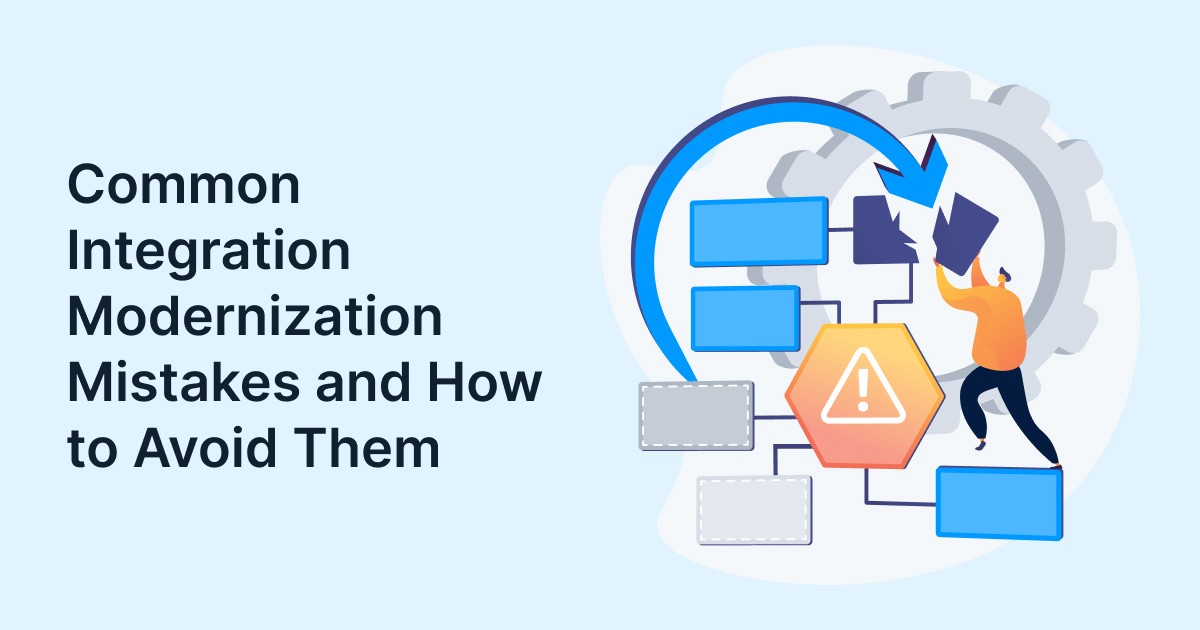
To successfully implement integration modernization, you need a clear integration strategy, scalable enterprise application integration architecture & strong governance. Avoiding common integration modernization mistakes, such as weak planning, lack of integration automation & poor system alignment, ensures smooth digital transformation and long-term scalability.
In an increasingly connected digital landscape, integration modernization plays a central role in enabling businesses to scale, innovate & remain competitive. Organisations are rapidly moving from legacy systems to cloud-native environments powered by APIs, microservices & integration automation.
However, many enterprises struggle with integration modernization mistakes that lead to inefficiencies, increased costs & delayed transformation outcomes.
To avoid these challenges, businesses must adopt robust enterprise integration solutions early in their journey. Exploring scalable integration modernization services ensures the foundation for seamless enterprise application integration and future-ready systems.
Summary
- Integration modernization fails without a clear integration strategy
- Legacy systems and lack of planning are major blockers
- Integration automation is critical for scaling operations
- Enterprise integration solutions must be flexible and API-driven
- Avoiding common mistakes significantly improves ROI
Key Statistics
- “According to McKinsey, 70% of digital transformation initiatives fail, often due to poor planning and lack of integration strategy”
- “According to a report by CIO, most IT modernisation failures stem from underestimating complexity and overestimating internal capabilities, highlighting the need for expert-led integration modernization strategies.”
Drive Digital Innovation & Transform Your Business
Struggling to find tailored IT solutions that truly accelerate your digital transformation journey? Partner with LedgeSure to unlock the true potential of technology.
Why Does Integration Modernization Fail Without a Proper Strategy?
To avoid failure in integration modernization, you need a clearly defined integration strategy aligned with business goals, technology architecture & scalability requirements. Without this, enterprises risk fragmented systems instead of seamless enterprise application integration.
A well-defined integration strategy ensures –
- Business–IT alignment: Ensures integration investments support real business outcomes, not just technical upgrades
- Clear roadmap: Helps prioritise integrations based on business impact and system dependencies
- Scalability planning: Supports growth without constant rework or system redesign
- Effective integration automation: Reduces manual effort and accelerates workflows
- Risk minimisation: Identifies potential challenges in legacy transformation early
If you’re building your roadmap, refer to this detailed guide on integration modernization roadmap for large enterprises to structure your approach effectively.
What Are the Most Common Integration Modernization Mistakes?
To prevent failure in integration modernization, you need to recognise common mistakes like poor planning, ignoring legacy dependencies, lack of integration automation & scalability issues. Addressing these early ensures smoother enterprise application integration and long-term success.
-
Lack of a Clear Integration Strategy
Many organisations dive straight into tools and technologies without defining a clear strategy.
Why this is a problem –
- Leads to disconnected systems
- Creates redundant integrations
- Increases long-term maintenance costs
How to avoid –
- Define clear business objectives and KPIs
- Build a phased integration modernization roadmap
- Align integration automation initiatives with business needs
-
Ignoring Legacy System Dependencies
Legacy systems often form the backbone of enterprise operations, making them difficult to replace.
Why this is a problem:
- Hidden dependencies can disrupt operations
- Sudden system replacement may cause downtime
- Data inconsistency risks increase
How to avoid:
- Conduct a complete system audit before modernisation
- Use API layers to bridge old and new systems
- Adopt a phased modernisation approach
-
Choosing the Wrong Integration Architecture
Selecting outdated or rigid architectures limits scalability and flexibility.
Why this is a problem:
- Inflexible systems fail to adapt to new technologies
- Increased complexity in maintenance
- Limited compatibility with cloud ecosystems
How to avoid:
- Adopt API-led enterprise application integration
- Use cloud-native enterprise integration solutions
- Ensure architecture supports microservices and modular growth
For a deeper understanding, explore modern API integration services for the enterprise.
-
Lack of Integration Automation
Manual processes slow down integration and increase the chance of errors.
Why this is a problem:
- Increased operational costs
- Slower data processing
- Higher chances of human error
How to avoid:
- Automate workflows and data pipelines
- Implement real-time monitoring systems
- Use AI-enabled integration tools
-
Poor Data Governance and Security
Ignoring governance can lead to compliance issues and data inconsistencies.
Why this is a problem:
- Data duplication and inaccuracies
- Security vulnerabilities
- Regulatory compliance risks
How to avoid:
- Define clear data ownership policies
- Implement strong security frameworks
- Align with compliance regulations like GDPR
-
Overlooking Scalability Requirements
Integration systems must support future growth, not just current needs.
Why this is a problem:
- Systems fail under increased load
- Frequent re-architecting required
- Poor customer experience
How to avoid:
- Use cloud-based enterprise integration solutions
- Design modular architectures
- Build reusable APIs
Did you know?
“Organisations lose up to 30% of revenue annually due to inefficiencies caused by disconnected systems and data silos, according to IBM Data Integration.”
How Can a Strong Integration Strategy Help Avoid These Mistakes?
To reduce integration modernization mistakes, you need a well-defined integration strategy that prioritises scalability, governance & integration automation. This helps streamline enterprise application integration and ensures efficient system performance.
A strong strategy enables:
- Faster deployment cycles
- Lower operational costs
- Better system scalability
- Improved user experience
- Seamless cross-system communication
To understand its broader impact, read why integration solutions are critical for business growth.
Integration Approaches Comparison
| Approach | Benefits | Challenges | Best Use Case |
| Point-to-Point | Easy to build | Hard to scale | Small businesses |
| Middleware | Centralised control | Complex management | Mid-sized enterprises |
| API-led Integration | Scalable, flexible | Requires governance | Large enterprises |
| iPaaS | Cloud-native, automated | Vendor dependency | Digital-first organisations |
How Does Integration Automation Improve Modernization Success?
To improve integration modernization outcomes, you need integration automation to streamline workflows, reduce manual tasks & improve data accuracy. This is essential for scaling enterprise application integration efficiently.
Key benefits include:
- Operational efficiency: Faster execution of integrations
- Error reduction: Minimises manual intervention
- Real-time processing: Enables instant data exchange
- Cost savings: Reduces reliance on manual operations
Integration automation is a critical pillar of modern enterprise integration solutions.
Empower Your Workforce with AI & Automated Innovations
Want to boost efficiency and reduce costs? Explore how LedgeSure’s AI-driven solutions simplify workflows and drive real outcomes.
What Are the Best Practices for Successful Enterprise Application Integration?
To achieve successful enterprise application integration, you need to follow best practices like API-first design, strong governance & phased modernization to reduce integration modernization mistakes and improve efficiency.
Key Best Practices
- Adopt API-first design for flexibility and scalability
- Use reusable integration components to reduce duplication
- Implement monitoring and analytics tools for performance tracking
- Ensure cross-team collaboration between IT and business units
- Invest in scalable enterprise integration solutions for long-term growth
Conclusion
Integration modernization is not just about upgrading technology, it’s about building a scalable, future-ready ecosystem that supports business growth. Avoiding common integration modernization mistakes ensures smoother transitions, better system performance & improved operational efficiency.
If you’re planning to modernise your systems and implement scalable enterprise application integration, now is the time to take action and Connect with our integration experts.