Enterprise technology landscapes have grown vastly more complex over the past decade. Where organisations once managed a handful of business applications, today they operate hundreds of interconnected systems spanning ERP, CRM, HR, analytics, eCommerce, supply chain management, customer experience platforms & industry-specific applications.
At the centre of this transformation lies one fundamental challenge: ensuring these systems communicate effectively. Disconnected applications create data silos. Manual data transfers increase operational costs. Legacy integration architectures slow innovation. As organisations pursue cloud transformation and AI-driven innovation, traditional integration approaches increasingly become barriers to growth.
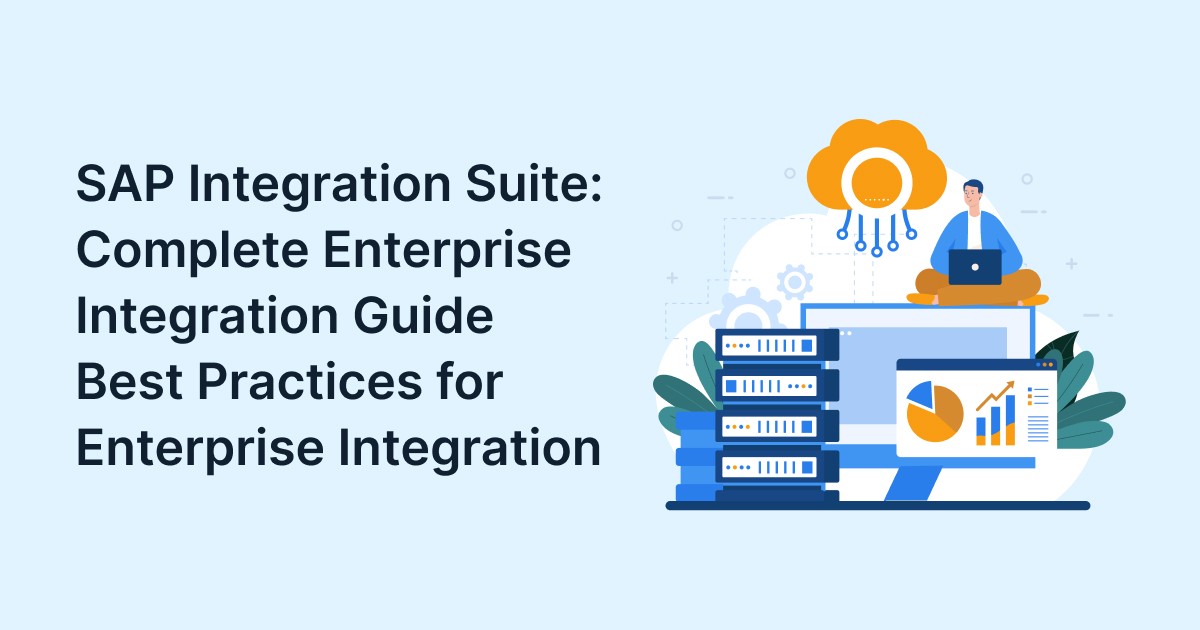
SAP recognised this shift and introduced SAP Integration Suite as its strategic integration platform capable of supporting modern enterprise requirements. As part of SAP Business Technology Platform (SAP BTP), it enables organisations to connect SAP and third-party applications, manage APIs, support event-driven architectures, automate business processes & establish secure B2B integrations from a single platform.
For many organisations, SAP Integration Suite is no longer simply a technical solution. It is becoming the foundation of their digital transformation strategy.
Summary
- SAP Integration Suite is SAP’s enterprise integration and API management platform
- It is a core service within SAP Business Technology Platform
- It supports application integration, API management, event-driven architecture, B2B integration & process connectivity
- It enables SAP Hybrid Integration across cloud and on-premises landscapes
- It reduces integration complexity while improving governance and scalability
- It acts as the foundation for modern SAP BTP integration initiatives
What Is SAP Integration Suite?
SAP Integration Suite is SAP’s Integration Platform as a Service (iPaaS) offering within SAP Business Technology Platform. Rather than relying on individual middleware solutions for different integration requirements, SAP Integration Suite provides a comprehensive environment that supports multiple integration patterns from a single platform.
The platform allows organisations to connect –
- SAP S/4HANA
- SAP SuccessFactors
- SAP Ariba
- SAP Customer Experience
- Salesforce
- Microsoft Dynamics
- ServiceNow
- Workday
- Legacy ERP platforms
- Custom applications
- Partner ecosystems
This ability to connect virtually any application landscape makes SAP Integration Suite one of the most important services within SAP BTP. More importantly, it helps organisations move away from rigid, point-to-point integrations that become increasingly difficult to manage as systems expand.
Drive Digital Innovation & Transform Your Business
Struggling to find tailored IT solutions that truly accelerate your digital transformation journey? Partner with LedgeSure to unlock the true potential of technology.
Why Integration Has Become an Enterprise Priority
To compete in today’s digital economy, organisations need systems that exchange information seamlessly, support automation & provide real-time visibility into business operations. This is why integration is now viewed as a strategic business capability rather than simply an IT function.
Consider a typical enterprise environment today –
- Sales teams use Salesforce to manage customer relationships
- Finance operates SAP S/4HANA
- HR uses SuccessFactors
- Procurement relies on Ariba
- Supply chain teams access external logistics platforms
If these systems cannot communicate efficiently, organisations encounter –
- Duplicate customer records
- Reporting inconsistencies
- Delayed decision-making
- Higher operational costs
- Poor customer experiences
The challenge grows exponentially as new applications are added. This is why modern enterprises increasingly prioritise SAP integration platforms capable of supporting large-scale connectivity without increasing complexity.
How SAP Integration Suite Fits Within SAP BTP
SAP BTP consists of four major pillars that work together to enable digital transformation –
| SAP BTP Pillar | Purpose |
| Application Development | Build and extend applications |
| Data & Analytics | Data management and insights |
| AI & Automation | Intelligent workflows |
| SAP Integration Suite | Enterprise connectivity |
Without integration, these capabilities operate in isolation. SAP Integration Suite enables organisations to create a connected platform where data, applications, analytics & automation services work together seamlessly.
This is particularly important when designing scalable SAP BTP integration initiatives that support future business growth. In fact, architecture planning often begins with understanding how integration services fit within broader platform strategies. Organisations designing future-ready ecosystems frequently start by defining a robust SAP BTP integration architecture that aligns development, analytics, automation & integration under a unified framework.
Core Components of SAP Integration Suite
Cloud Integration
Cloud Integration serves as the foundation for application-to-application connectivity within SAP Integration Suite –
- Application-to-application integration – Prebuilt adapters and connectors for SAP and non-SAP systems
- Process orchestration – Visual workflow designer for complex business logic
- Message routing – Content-based routing and conditional logic
- Data transformation – Built-in mapping editors for XML, JSON, IDoc & CSV
- Real-time connectivity – Synchronous and asynchronous communication patterns
API Management
API Management provides the governance layer necessary for exposing, securing, and monitoring APIs –
- Gateway and developer portal – Centralised API exposure and documentation
- Policy enforcement – Authentication, rate limiting & threat protection
- Visibility and monetisation – Usage tracking and API productisation
- Versioning and lifecycle – Governed API evolution and deprecation
Open Connectors
Open Connectors provide prebuilt, standardised connectors to hundreds of SaaS applications –
- Broad coverage – Salesforce, Workday, ServiceNow, Zendesk, Shopify & more
- Normalisation – Consistent meta-model across different applications
- Reduced custom work – Standardised authentication and data models
- Extensibility – Custom connector creation for niche systems
Event Mesh
Event Mesh enables event-driven architectures across cloud and on-premises environments –
- Asynchronous communication – Decoupled producers and consumers
- Distributed events – Real-time propagation across hybrid landscapes
- Microservices support – Event-based connectivity for modern architectures
- Improved responsiveness – Near-real-time reactions to business events
Integration Advisor
Integration Advisor uses AI to accelerate integration development –
- Recommendations – AI-assisted mapping and transformation logic
- Productivity gains – Reduced manual mapping work
- Learning over time – Continuous improvement from approved patterns
Trading Partner Management
Trading Partner Management supports B2B and EDI integrations at scale –
- Partner onboarding – Standardised templates and profiles
- Agreement management – EDI agreements and versioning requirements
- Monitoring and exception handling – Audit trails and compliance support
- Protocol support: AS2, AS4, SFTP & traditional EDI standards
Key Statistics
| Statistic | Source |
| By 2027, over 65% of integration activity will support composable business initiatives | Gartner |
| Global spending on integration and API management software continues to grow as enterprises accelerate cloud adoption | IDC |
| Organisations using modern iPaaS report 40% faster time-to-market for new digital initiatives | SAP |
| 78% of enterprises cite integration complexity as a major barrier to digital transformation | McKinsey |
Understanding SAP BTP Integration
SAP BTP integration refers to the combined practices and components used to integrate applications and data across the SAP cloud and on-premises ecosystem. Integration projects on SAP BTP typically focus on –
- Aligning integration with platform governance, security, and identity
- Leveraging prebuilt content from SAP API Business Hub
- Designing for extensibility so new services can consume integrated data
Integration becomes a first-class concern during cloud adoption planning and application modernization programs.
What Is SAP Hybrid Integration?
Most enterprises still operate a mix of –
- SAP ECC
- Legacy databases
- Industry-specific software
- Private cloud platforms
- Public cloud applications
Migrating everything at once is rarely practical. SAP Integration Suite allows businesses to create connectivity between these environments while gradually modernising applications and infrastructure.
Key benefits include –
- Reduced migration risk
- Better investment protection
- Improved flexibility
- Faster cloud adoption
- Easier scalability
Common Enterprise Integration Challenges
Why Do Data Silos Continue to Exist?
Data silos persist due to decentralised decision-making, poor data governance & accumulated technical debt. Business units often procure point solutions without centralised integration plans, creating isolated data repositories.
Why Are Point-to-Point Integrations Difficult to Manage?
Point-to-point integrations create exponential complexity –
- Adding n systems leads to O(n²) connections
- Changes in one system require updates across many integrations
- Common patterns are rarely modularised for reuse
How Does Integration Complexity Increase Costs?
Integration complexity drives up costs through –
- Operational overhead from multiple middleware tools
- Rework from unclear interfaces and undocumented dependencies
- Compliance costs from fragmented logging and inconsistent controls
Why Is Governance Often Overlooked?
Governance is frequently deprioritised due to –
- Short-term project pressures
- Cultural resistance to centralised controls
- Lack of tooling to enforce policies automatically
Benefits of SAP Integration Suite
| Benefit | Impact |
| Faster Time-to-Market | 40% reduction in integration project timelines |
| Improved Customer Experience | Unified customer views across all touchpoints |
| Enhanced Operational Efficiency | Automated manual processes reduce errors by 60% |
| Better Decision-Making | Consistent, real-time data for analytics |
| Reduced Technical Debt | Consolidated middleware reduces maintenance costs |
| Improved Business Agility | API-led architectures enable rapid innovation |
Faster Time-to-Market
Prebuilt integration content and Open Connectors accelerate project delivery. Low-code and visual integration tools reduce dependency on specialist developers.
Improved Customer Experience
Integrated CRM, commerce & backend systems provide unified customer views. Real-time synchronization reduces order errors and duplicate records.
Enhanced Operational Efficiency
Automation of manual processes reduces processing time and human error. Event-driven architectures improve responsiveness and reduce polling overhead.
Better Decision-Making Through Connected Data
Integrated data pipelines feed analytics and AI models with consistent, timely data. Centralised lineage and transformation logic make it easier to trust insights.
Reduced Technical Debt
Consolidating integration logic on a managed platform reduces bespoke middleware. Reusability frameworks prevent redundant interfaces and duplicated functionality.
Improved Business Agility
API-led and event-driven architectures let product teams compose capabilities rapidly. Integration Suite’s governance tools enable safe evolution of interfaces.
Enterprise Use Cases and Real-World Applications
SAP S/4HANA Integration
Scenario – Synchronising master data and transactional data between S/4HANA and peripheral systems
Approach – Use prebuilt content from SAP and Cloud Integration to transform and route messages
Benefits – Reduced latency for order-to-cash processes, consistent master data
SuccessFactors Integration
Scenario – Integrating HR events with payroll, IT provisioning & analytics platforms
Approach – Open Connectors and Cloud Integration flows normalise HR events
Benefits – Automated onboarding/offboarding, consolidated HR reporting
Customer Experience Integration
Scenario – Connecting commerce and customer data to ERP, logistics & marketing automation
Approach – API Management exposes services; Event Mesh propagates inventory events
Benefits – Omnichannel consistency, real-time inventory visibility
Procurement and Supply Chain Integration
Scenario – Automating PO creation, confirmations & shipment updates
Approach – Trading Partner Management manages EDI exchanges
Benefits – Faster procurement cycles, better supplier collaboration
B2B and EDI Integration
Scenario – Large-scale partner exchanges of purchase orders, invoices & ASN
Approach – Trading Partner Management with protocol support (AS2/AS4)
Benefits – Scalable partner onboarding, audit-ready exchanges
API-Led Digital Transformation
Scenario – Exposing business capabilities as managed APIs
Approach – Design APIs as products with API Management governance
Benefits – Faster product development, ecosystem monetisation
Real-Time Event-Driven Operations
Scenario – Supply chain visibility with automated responses to events
Approach – Event Mesh publishes events; subscribers react in near real-time
Benefits – Proactive exception handling, improved SLA adherence
Building an Effective SAP Integration Strategy
A successful integration strategy requires business alignment, governance, repeatable patterns & the right tools.
Current-state assessment –
- Inventory existing integrations, interfaces, data flows & owners
- Map upstream/downstream dependencies
- Categorise interfaces by modernity and support status
Integration maturity analysis –
- Measure current capabilities against desired end-state
- Identify gaps in API-first and event-driven approaches
Governance model –
- Define ownership for APIs, integration flows & data domains
- Establish policies for naming, versioning, security & SLAs
- Create a Centre of Excellence to enforce standards
API-first approach –
- Design APIs as products with defined consumers and SLAs
- Use developer portal for clear onboarding guidance
- Implement versioning and deprecation policies
Event-driven architecture adoption –
- Identify use cases where asynchronous behaviour provides benefits
- Define standard event contracts and versioning approaches
- Implement Event Mesh with monitoring and replay strategies
Reusability frameworks –
- Build shared integration libraries for common transformations
- Create integration pattern catalogues for frequent problems
Measurement KPIs –
- Time-to-delivery for new integrations
- API adoption and usage metrics
- Mean time to detect and resolve incidents
- Percentage of reuse across new projects
SAP BTP Integration Architecture Best Practices
- Modularise: Break integrations into composable micro-flows
- Secure by design: Integrate identity and access management from the start
- Use prebuilt content: Leverage SAP API Business Hub accelerators
- Centralised monitoring: Aggregate logs, metrics, and traces
- Automate CI/CD: Treat integration artifacts as code
- Plan for scale: Use asynchronous patterns and Event Mesh where needed
- Governance-as-code: Enforce policies through automated gates
Migrating to SAP Integration Suite
Many organisations adopting SAP Integration Suite today are moving from –
- SAP Process Orchestration
- Traditional ESBs
- Custom middleware
- Legacy integration platforms
This transition requires careful planning. A good starting point is assessing existing interfaces, dependencies & integration patterns. Once this visibility is established, organisations can prioritise migrations based on business criticality and complexity.
Our detailed guide on SAP BTP migration planning explores proven migration phases, readiness assessments, governance considerations & best practices for minimising disruption during cloud transformation initiatives.
Migration phases –
- Assessment and planning: Create detailed inventory and prioritisation
- Proof-of-concept: Validate non-functional requirements with pilot projects
- Execution waves: Parallel runs with legacy systems for validation
- Operational readiness: Configure monitoring, alerts, and runbooks
- Governance and continuous improvement: Capture lessons learnt
Common pitfalls to avoid –
- Underestimating hidden dependencies
- Skipping realistic test data preparation
- Postponing governance until after migration
SAP Integration Suite vs MuleSoft
Organisations evaluating enterprise integration platforms frequently compare SAP Integration Suite and MuleSoft, particularly when operating mixed SAP and non-SAP environments. We explored this comparison in greater depth in our detailed guide on SAP Integration Suite vs MuleSoft, where we analyse architecture, governance, API management, costs & platform alignment considerations.
| Feature | SAP Integration Suite | MuleSoft |
| Platform alignment | Native SAP BTP integration | Vendor-agnostic |
| Prebuilt content | Strong SAP ecosystem | Broad connector library |
| API management | Comprehensive gateway | Robust Anypoint Platform |
| Hybrid support | Strong SAP on-premises integration | Flexible deployment options |
| Cost model | SAP licensing structure | Anypoint platform pricing |
| Skills ecosystem | SAP partner network | Large independent community |
Decision criteria –
- SAP-heavy landscapes: Prefer SAP Integration Suite
- Heterogeneous ecosystems: Consider MuleSoft for vendor neutrality
- Existing investments: Evaluate current middleware and skillsets
- TCO and roadmap: Model costs based on projected usage
Security, Governance, and Compliance
Integration platforms mediate sensitive business data; security and governance must be foundational.
Identity management –
- Integrate with enterprise identity providers for SSO
- Role-based access control for administrative and runtime access
API security –
- OAuth 2.0, JWT authentication
- Transport security (TLS)
- Rate limiting and threat protection
Compliance –
- Data residency and processing controls
- Audit trails for transactions and configuration changes
Auditing and monitoring –
- Centralised logging and tracing
- Anomaly detection for unusual traffic patterns
Operational security –
- Patch and update management
- Regular vulnerability scanning and penetration testing
Why SAP Integration Suite Consulting Matters
Enterprise migrations and platform adoptions succeed when technical capability aligns with business strategy. Consulting partners add value across assessment, architecture, migration & managed services.
How consultants help –
- Assessments: Interface inventories, technical debt analysis, migration roadmaps
- Architecture design: Integration patterns, governance models, reusable libraries
- Migration execution: Phased plans, POCs, operational runbooks
- Managed services: Platform operations, monitoring, continuous optimisation
LedgeSure offers comprehensive SAP Integration Suite consulting services including assessments, architecture design, migration support, governance frameworks & managed services. Working with experienced partners reduces risk, accelerates time-to-value & ensures sustainable design patterns.
Explore our SAP Integration Suite services to learn how we can support your transformation journey.
Empower Your Workforce with AI & Automated Innovations
Want to boost efficiency and reduce costs? Explore how LedgeSure’s AI-driven solutions simplify workflows and drive real outcomes.
Future Trends in Enterprise Integration
Integration will continue to evolve with emerging technologies and architectural paradigms.
AI-powered integration –
- Automated mapping and anomaly detection
- Predictive recommendations for failing interfaces
Low-code development –
- Citizen integrators assembling flows with governance guardrails
- Co-development between IT and business teams
Composable enterprise –
- APIs and event contracts as discrete, composable products
- Integration Suite as marketplace and governance layer
Event-driven enterprises –
- Shift from batch to streaming and event-first patterns
- Event Mesh fundamental for supply chain, IoT, real-time analytics
Autonomous integration monitoring –
- Automated remediation scripts and self-healing constructs
- Out-of-the-box health checks and recovery mechanisms
Conclusion
Enterprise integration has evolved from a technical necessity into a strategic differentiator. Whether organisations are implementing SAP S/4HANA, modernising legacy middleware, expanding SAP BTP adoption, or enabling digital transformation initiatives, SAP Integration Suite provides the connectivity foundation required to support these goals.
By combining application integration, API management, event-driven architecture, hybrid integration support & governance capabilities in a single platform, it enables enterprises to reduce complexity while creating a scalable path for innovation.
If your organisation is evaluating SAP Integration Suite, planning SAP BTP integration projects, or looking to modernise its integration landscape, working with experienced specialists can significantly improve the success of your transformation journey.
Ready to build a future-ready integration strategy? Contact the experts at LedgeSure to discuss your SAP integration requirements and transformation goals.