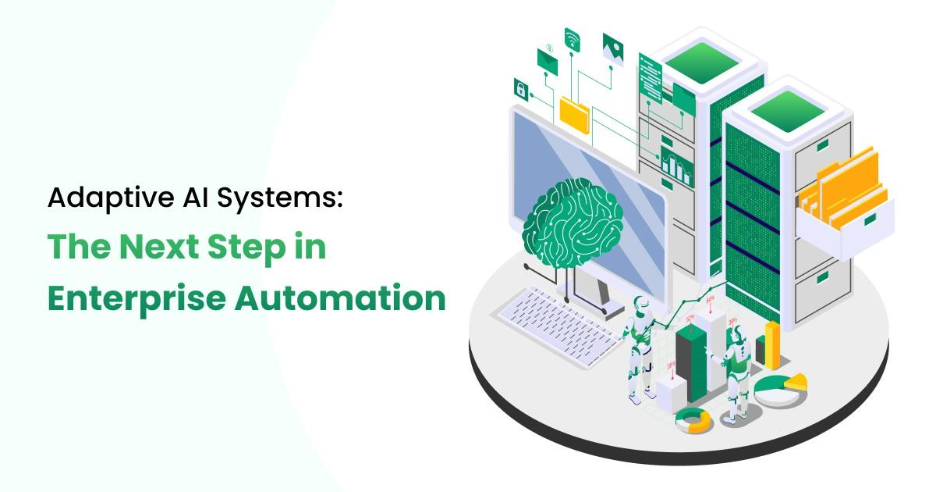
Some of the challenges that continue to plague enterprises today include operational rigidity, slow decision making, and automation systems that can no longer keep up with the ever-changing nature of the business. Rule-based automation tends to fail as workflows face unforeseen variables resulting in inefficiencies and more human intervention. Adaptive AI systems close to this divide through the ability to automate, adapt, and react intelligently to changing business circumstances, instead of being based on hard logic.
This blog will discuss how adaptive AI systems in enterprise automation supported by innovative AI solutions that enable intelligent workflows, overcome the drawbacks of the rigid, rule-based processes. Such systems facilitate on-loop learning and context-fluent decision-making in the operations. Automation is also effective in dynamic business environments because it adapts in real-time. This method assists businesses to enhance efficiency, resilience, and long-term performance of operations.
Why Adaptive AI Systems Matter for Enterprises
Enterprises face rapid market changes and complex operations that traditional automation can’t handle. AI systems enable workflows to learn, adapt, and make context-aware decisions in real time. By leveraging AI learning loops, organizations improve responsiveness, scale efficiently, and enhance operational resilience. Businesses adopting adaptive intelligence gain a competitive edge by aligning automation with strategic goals and ensuring processes remain intelligent, efficient, and future-ready.
Drive Digital Innovation & Transform Your Business
Struggling to find tailored IT solutions that truly accelerate your digital transformation journey? Partner with LedgeSure to unlock the true potential of technology.
What Makes Adaptive AI Systems Distinct in Business Automation
Traditional automation is meant to follow pre-programmed instructions based on fixed conditions. Adaptive AI systems in business operations, on the contrary, constantly analyze the received information, evaluate the results, and real-time change the business processes. It enables the enterprises to deal with variability without human intervention continuously or reconfiguration of systems frequently.
Some of the most important distinguishing factors are self-enhancing decision-making logic, situational awareness, and independent execution on integrated platforms.
Dynamic Automation Models as the Foundation of Intelligent Workflows
Dynamic automation models are very effective in helping companies implement workflows that can respond to changes rather than keeping to some predetermined rules. Such models ensure that there is room for growth and improvement in how a company operates.
Real-time Data Acquisition
Data is continuously collected from other systems, and thus, the workflows can quickly react to emerging conditions.
Smart decision-making
Automation is an activity that changes actions based on the business situation, rather than simply following a set of rules; thus, actions are more relevant.
Integrated learning through AI
The effects of these automated processes are analyzed in order to make decisions in the future.
Predictive Workflow Improvement
Historical and real-time data is used to anticipate disruptions and recalibrate workflows proactively.
System Consistency in Performance
Workflows have good performance as they scale in various departments and platforms.
Self-correcting Processes
Once problems are identified, automatic actions are performed to ensure that operations are stabilized.
These elements come together to create intelligent, adaptive workflows that leverage automation models to meet evolving enterprise needs.
Challenges and Considerations for Enterprise Adoption
Successful adoption of adaptive intelligence requires careful planning and early alignment across technical, organizational, and governance dimensions, which can be guided by enterprise AI adaptation best practices.
Data quality and governance
Reliable, unbiased, and well-governed data is essential to ensure enterprise AI adaptation delivers accurate and dependable outcomes.
Organizational readiness
Enterprises must prepare teams, processes, and structures to work alongside adaptive systems and interpret AI-driven decisions effectively.
Skill development and expertise
Specialized skills are required to manage, monitor, and optimize adaptive systems as they evolve over time.
Change management and trust
Building confidence in autonomous decision-making is critical to ensure adoption across business and technical stakeholders.
Ethical and regulatory compliance
Learning mechanisms must align with regulatory standards and ethical guidelines to support responsible and sustainable AI deployment.
Addressing these considerations during strategy and design phases significantly improves long-term adoption of success and operational stability.
Enterprise AI Adaptation and the Shift Toward Autonomous Operations
Enterprise AI adaptation represents the transition from automation support to decision autonomy. Adaptive systems increasingly perform complex operational actions independently, reducing reliance on constant human oversight. Leveraging advanced AI solutions, enterprises can implement predictive control, real-time optimization, and self-correcting workflows more effectively.
The table below illustrates how adaptive execution capabilities translate into tangible improvements across enterprise operational functions.
| Capability | Impact on Enterprise Operations |
| Autonomous decision-making | Faster response times |
| Predictive execution | Reduced operational risks |
| Self-healing workflows | Increased system resilience |
| Minimal human intervention | Improved scalability |
Together, these impacts demonstrate the role of autonomous operations in enabling scalable, self-directed enterprise environments.
Business Impact Across Core Enterprise Functions
Adaptive intelligence delivers measurable value across multiple enterprise functions. In operations and supply chains, systems dynamically adjust to demand fluctuations, logistics disruptions, and resource constraints. Customer experience functions benefit from automation that adapts to behavioral signals and contextual inputs.
Risk management capabilities improve through adaptive anomaly detection and response mechanisms. Human resource functions leverage adaptive intelligence to optimize workforce planning, learning pathways, and internal knowledge delivery. Across functions, adaptive automation improves speed, accuracy, and alignment between strategic objectives and execution outcomes.
Measuring ROI and Performance Metrics for Adaptive AI Systems
Measuring the impact of adaptive AI systems requires continuous evaluation rather than static assessments. Since adaptive intelligence improves through learning, return on investment compounds as systems mature rather than plateauing after deployment.
The table below summarizes common performance indicators used to evaluate adaptive intelligence initiatives over time.
| Performance Indicator | Enterprise Outcome |
| Process cycle time | Faster task completion |
| Decision accuracy | Reduced operational errors |
| Manual intervention rate | Higher system maturity |
| Cost optimization | Improved resource efficiency |
| Learning velocity | Faster model improvement |
| Exception resolution | Autonomous issue handling |
Tracking these metrics consistently enables enterprise AI adaptation by linking operational improvements with long-term strategic value.
Future Outlook: Strategic Implications of Adaptive AI Systems
The evolution of adaptive AI systems in business operations is reshaping enterprise strategy. Automation is shifting from task execution to intelligent orchestration aligned with organizational goals. Adaptive intelligence enables near-real-time responses to regulatory changes, market volatility, and customer expectations.
As adoption increases, autonomous operations will integrate more deeply with enterprise planning frameworks. Predictive scenario modeling and self-optimizing strategies will become standard capabilities. Enterprises that embed on adaptive intelligence will gain resilience and competitive differentiation in complex global markets.
Empower Your Workforce with AI & Automated Innovations
Want to boost efficiency and reduce costs? Explore how LedgeSure’s AI-driven solutions simplify workflows and drive real outcomes.
Ledgesure’s Perspective on Adaptive Enterprise Innovation
Adaptive AI systems are the basis of next-generation enterprise automation at Ledgesure. Strategic IT consulting services are aimed at coordinating intelligent automation efforts with long-term business goals. The solutions are meant to be compatible with existing infrastructure and be able to support scalable and data-driven decision-making.
Ledgesure helps organizations develop a robust operational structure that brings a quantifiable and positive long-term value by applying adaptive intelligence and integrates a cloud transformation with enterprise integration expertise.
The Next Step in Enterprise Automation: Adaptive AI Systems in Action
Adaptive AI Systems are a future trend in corporate automation whereby smart learning and execution independence are combined to open agility, resilience, and scale. Dynamic automation models allow companies to work efficiently in situations of constant change, so adaptive automation is not a bonus option but essential. Companies that incorporate adaptive intelligence into operational processes are on the verge of establishing new operational excellence.
Companies that strategically plan the shift to automation to intelligent autonomy enjoy systematic implementation. Partnering with Ledgesure helps businesses develop structures that meet governance, scalability, and long-term growth goals, which will guarantee quantifiable value and viable operational performance.
FAQs
Q: What are adaptive AI systems used for Enterprises?
A: Adaptive AI systems automate complex workflows, improve decision accuracy, and enable continuous learning from operational outcomes.
Q: How do adaptive AI systems differ from traditional automation?
A: Traditional automation follows fixed rules, while adaptive systems evolve dynamically through data-driven learning.
Q: How do adaptive AI systems support enterprise automation?
A: Adaptive AI systems in enterprise automation enable workflows to adjust in real time, improving efficiency and resilience.
Q: Why are adaptive AI systems important for business operations?
A: Adaptive AI systems in business operations help organizations respond to change, optimize resources, and reduce operational risks.
Q: What challenges should enterprises consider before adoption?
A: Key challenges include data governance, organizational readiness, ethical compliance, and change management.