Introduction: Why DevOps Needs Intelligence Today
Software developers are always trying to update their software faster and maintain stable systems. To keep up with the demands of cloud services, microservices, and the rapid deployment methodologies, traditional methods of DevOps are not effective anymore. There is still a human approval requirement for many of the technical choices that have been automized, and that is still leading to remediation of problems when they occur, slower release, and unexpected failures. As the goal is to deploy new versions of the software faster, it is becoming increasingly difficult to keep things stable.
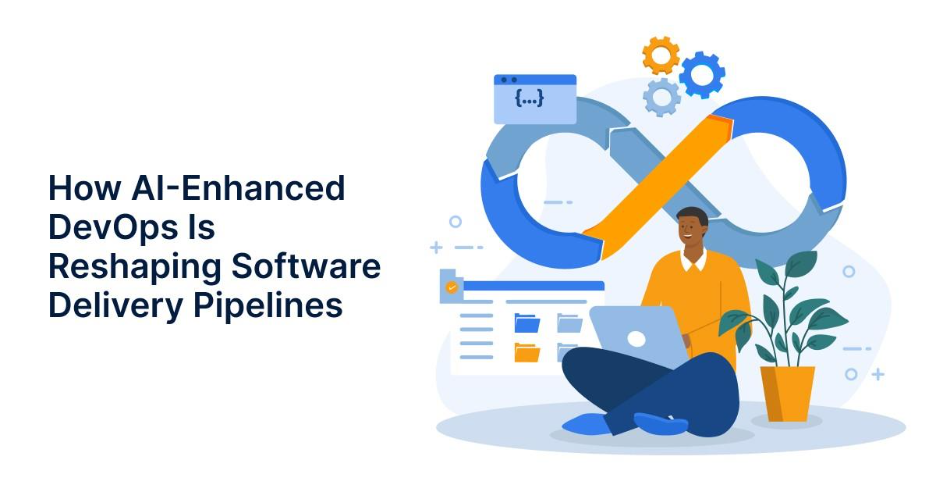
This is where AI-enhanced DevOps addresses the challenge by introducing predictive data intelligence into software delivery workflows. AI analyzes historical pipeline data and system behavior to identify risks early, replacing reactive fixes with informed decision-making. This blog explores how intelligent DevOps pipelines improve CI/CD efficiency, reduce failures, strengthen release management, and support reliable software delivery at scale.
From Automation to Intelligent DevOps Pipelines
Automation was a big advance for the world of DevOps, but the problem is that static policies are not adaptable for dynamic environments. Today, Modern DevOps automation tools have integrated the concepts of both automation and analysis based on artificial intelligence techniques. Such tools are constantly analyzing the data from builds, deployments, and system executions and actions.
Current pipelines are not bound by static scripts; instead, they have the ability to learn from their failures and successful executions. Research has indicated that the success rate for deployments would improve by over 30% with the help of intelligent automation.
Drive Digital Innovation & Transform Your Business
Struggling to find tailored IT solutions that truly accelerate your digital transformation journey? Partner with LedgeSure to unlock the true potential of technology.
How AI Strengthens CI/CD Pipelines
Data is produced in volumes through AI in CI/CD pipelines, yet most go unutilized. AI can transform unstructured data into meaningful information. AI will analyze build failures, test outcomes, and deployment patterns to identify potential issues. This enables teams to catch problems earlier. AI enhances testing with the concentration on high-risk areas rather than the execution of tests that are not needed.
Businesses using AI with their Continuous Integration and Continuous Deployment pipelines noticed the benefits of faster releases with fewer failures. Decision-making becomes reproducible and based on data without much dependence on individual experience. As the pace of delivery increases, AI maintains quality and stability.
Predictive Insights That Reduce Deployment Failures
Modern DevOps pipelines benefit from proactive risk detection. Predictive deployment insights analyze historical pipeline data to estimate the likelihood of deployment failure. This approach reduces unexpected outages and last-minute rollbacks. Industry data indicates that data intelligence can reduce production incidents by up to 50%.
Key benefits include:
- Early risk identification
AI detects patterns linked to past failures and flags similar risks early.
- Smarter release decisions
Data-backed go-or-no-go recommendations reduce uncertainty.
- Focused testing efforts
High-risk code areas receive deeper validation.
- Faster recovery times
Contextual insights help identify root causes quickly.
Using predictive deployment insights shifts DevOps from reactive problem-solving to proactive prevention, improving release confidence.
Mordern DevOps pipelines benefit from being able to discover potential issues earlier. Predictive deployment insights analyze previous data from pipelines to estimate how probably any deployment will fail. It prevents unexpected and last-minute issues and fixes. Research demonstrates that with this approach, production problems are reduced by as much as 50% at least.
Main advantages:
- Early risk identification
AI finds patterns related to past failures and warns about similar risks early.
- Better release choices
Data-driven recommendations help decide if a release should go ahead or not.
- Targeted testing
Areas of code that might have issues get more thorough checks.
- Quicker recovery
Helpful insights find the main causes of problems fast.
Using predictive deployment insights helps DevOps move from fixing problems after they happen to prevent them, which boosts confidence in releases.
Intelligent Release Management for Complex Systems
As apps use many services and work in different places, coordinating releases can be hard. Intelligent release management uses AI to check if the system is ready, understands connections between parts, and looks at traffic before launching. This helps make sure releases happen at the best times with little effect on users. AI tools also help to quickly fix problems if performance gets worse.
Companies that use release methods see less downtime and smoother launches. There is less need for manual checks, and it’s easier to see what’s happening across different environments. Smart release management helps teams deliver faster while keeping the system reliable and the user experience good.
Business Benefits of AI-Driven DevOps Practices
AI-driven DevOps delivers faster time to market, improved software quality, and lower operational costs. Pipeline visibility ensures teams monitor builds and deployments for better decisions and fewer failures.
Many organizations also adopt DataOps for teams to maintain clean, reliable data flows that power predictive insights and automation. Together, AI-driven DevOps and DataOps enable agility, stability, and a better customer experience.
Key business benefits include:
- Faster time to market
Reduced delays enable quicker feature delivery.
- Lower operational costs
Fewer failures reduce rework and downtime.
- Improved software quality
Early issue detection leads to stable releases.
- Better customer experience
Reliable systems increase trust and satisfaction.
- Stronger IT-business alignment
- Data-driven delivery supports strategic planning.
AI-enhanced DevOps ensures engineering efforts directly support business performance.
Empower Your Workforce with AI & Automated Innovations
Want to boost efficiency and reduce costs? Explore how LedgeSure’s AI-driven solutions simplify workflows and drive real outcomes.
AI-Driven DevOps Impact Across Industries
AI enhanced DevOps practices are no longer limited to technology-centric companies today. Organizations in regulated, high-traffic, and mission-critical domains are also leveraging AI-amplified DevOps pipelines today to minimize operational risk and service downtime in production. The power of AI can be particularly seen when analyzing the use of analytics-infused automation in deployment, tackling challenges existent in their operational domains in their respective industries.
| Industry | Key Outcomes |
| Financial Services | Reduced deployment risk and compliance support |
| SaaS | Faster releases with improved stability |
| E-commerce | Reliable deployments during peak traffic |
| Healthcare Technology | Higher system reliability |
These examples show how intelligent DevOps pipelines deliver consistent value across industries.
How Ledgesure Supports Intelligent DevOps
Ledgesure helps companies create smart and strong DevOps systems by adding AI to their current processes. The main goals are to improve visibility, reliability, and results. Ledgesure allows teams to see how well the pipeline is working, identify risks in deployments, and check if they are ready to release updates without causing problems.
By matching AI tools with real DevOps needs, Ledgesure helps teams grow and improve over time. This organized method provides lasting benefits from smart automation while keeping operations clear and under control.
Getting Started with AI-Enhanced DevOps
Successful adoption begins with strong pipeline visibility and consistent data. AI should be introduced gradually, starting with testing and release planning. Clear goals and cross-team alignment are essential. AI works best when integrated into existing workflows rather than treated as a standalone solution. Organizations that follow a structured approach achieve faster results and improve delivery confidence. AI-enhanced DevOps empowers teams to make better decisions while maintaining stability at scale.
Organizations modernizing software delivery pipelines benefit from understanding intelligent DevOps practices. Explore Ledgesure’s approach to DevOps transformation and predictive insights, intelligent automation, and AI-driven release strategies to improve reliability and scalability through Ledgesure’s approach to intelligent DevOps transformation.
Frequently Asked Questions:
Q: What is AI-enhanced DevOps?
A: AI-enhanced DevOps applies artificial intelligence to DevOps workflows to improve delivery decisions. Combined with AI in CI/CD, it enables faster and more reliable releases.
Q: How do predictive deployment insights improve releases?
A: Predictive deployment insights identify risks early. When supported by DevOps automation tools, they reduce failed deployments and rollbacks.
Q: Why is intelligent release management important?
A: Intelligent release management coordinates deployments across complex systems by evaluating readiness and performance signals.
Q: Can AI-driven DevOps support scalability?
A: AI-driven DevOps improves consistency and reliability, making delivery pipelines easier to scale.
Q: What enables successful AI-driven DevOps adoption?
A: Clear data visibility, strong observability, and phased implementation support long-term success.