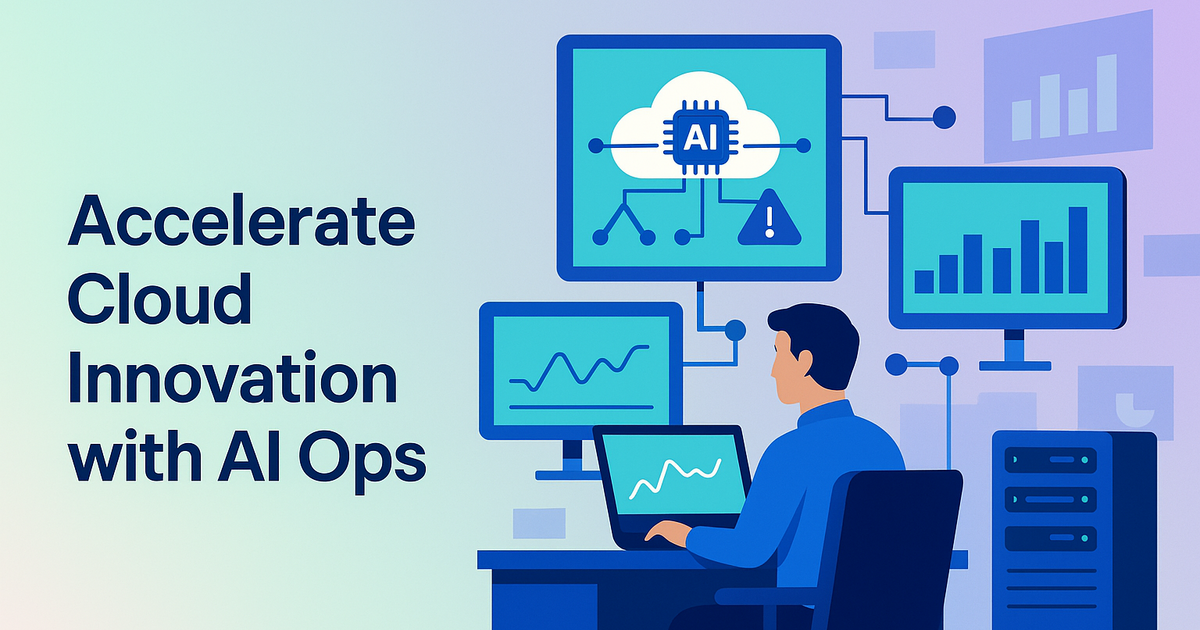
Most leaders assume a slick AI strategy deck will fix spiraling cloud costs. But by month three, dashboards explode with alerts, scripts pile up, and budgets bleed while competitors scale smoothly. This article shows how cloud management automation with AI Ops can bridge that gap. This article maps the gap between aspiration and execution and shows you a roadmap to close it with cloud management automation anchored in AI Ops.
The Hidden Execution Tax in Cloud Management Automation
AI Ops promises “self-healing” clouds, yet many initiatives die in rollout. The real culprit is the Execution Tax, costly rework caused by four blind spots.
- Silent Data Silos – Metrics, logs, and traces live in separate tools, so AI models never see a full picture.
- Script Sprawl – Different teams write one-off automation, creating brittle dependencies.
- Legacy Process Lag – Change approvals designed for on-prem take days, throttling automated fixes to minutes.
- Vendor Tunnel Vision – Tool vendors push feature lists, not integration commitments, leaving buyers to stitch parts together.
Result: Incident MTTR actually rises, audits flag policy drift, and cloud operations automation loses executive backing.
Drive Digital Innovation & Transform Your Business
Struggling to find tailored IT solutions that truly accelerate your digital transformation journey? Partner with LedgeSure to unlock the true potential of technology.
The AI Ops Alignment Model – Marrying Data, Automation, and Human Insight
We call our framework the AI Ops Alignment Model, a three-layer approach that turns scattered scripts into a reliable cloud management automation platform.
Layer 1: Unified Telemetry Spine
- Aggregate everything: Metrics, events, and traces funnel into one open schema (Prometheus, OpenTelemetry).
- Normalize early: Common tags ensure later machine learning isn’t guessing.
Layer 2: Intelligent Automation Core
- Policy-driven playbooks: Encode fixes as reusable actions that map to business SLAs.
- Event correlation: AI clusters alerts to cut noise before execution triggers.
Layer 3: Human Feedback Loop
- Continuous learning: Engineers rank automated actions; the model retrains on that feedback.
- Guardrails first: Manual approval limits during the first 90 days build trust.
Pillar 1 – Reality-Based Discovery & Transparent Scoping
This is where LedgeSure’s principle of Transparent Project Scoping flips the script.
Start with a 30-Day Baseline
- No assumptions: Discovery agents map every dependency instance, serverless, and AWS cloud automation tools already in use.
- Realistic timelines: Findings drive phased goals instead of big-bang migrations.
Link Automation to KPIs You Already Track
- Business-specific solutions: Tie an automation to “orders per minute,” not generic CPU thresholds.
- Executive clarity: The scope doc shows cost impact and risk side by side.
Empower Your Workforce with AI & Automated Innovations
Want to boost efficiency and reduce costs? Explore how LedgeSure’s AI-driven solutions simplify workflows and drive real outcomes.
Pillar 2 – Smart Orchestration with Open and Trusted Tools
Brand-neutral guidance for selecting the right engine.
Evaluate Four Tool Classes
- Open-source tools for cloud management automation, like Terraform and Ansible, cut license costs and avoid lock-in.
- Cloud-native services, AWS Systems Manager, or Azure Automation for quick starts.
- Hybrid orchestrators that span Kubernetes and virtual machines, ideal for cloud infrastructure automation.
- Specialized AI Ops suites that layer correlation and prediction on top.
Decision Matrix (Mobile-Friendly)
| Fit Question | Open Source | Cloud-Native | AI Ops Suite |
|---|---|---|---|
| Multi-cloud? | Strong | Weak | Moderate |
| Data science staff ready? | Moderate | Weak | Strong |
| Budget flexibility? | High | High | Variable |
Pillar 3 – Continuity Loop for Ongoing Support & Change Management
Automation is a living system.
Embed Change Management Guidance
- Runbooks in Git: Every change uses pull requests auditable and reversible.
- Weekly playbook retros: Teams rate each automated fix for confidence.
Create an Automation Steering Council
- Cross-functional: Ops, SecOps, Finance.
- Quarterly health check: Reviews automation debt, cloud management automation implementation progress, and new regulatory needs.
Beyond Uptime: How AI-Driven Cloud Operations Build Long-Term Advantage
The Alignment Model doesn’t merely reduce alarms; it buys strategic time.
- Faster product cycles: Engineers shift from firefighting to feature delivery, accelerating releases.
- Spend predictability: Declarative policies throttle over-provisioning before invoices arrive, an edge many CIOs crave.
- Cultural shift: Transparency and ongoing support boost morale, shrinking attrition risk.
This momentum compounds, positioning your organization to outpace future disruptions while keeping cloud management services lean.
Ready to move from aspirations to solid execution? Schedule a transparent project scoping session with LedgeSure today.