Every digital transformation initiative eventually comes down to one critical question: Can your systems communicate effectively with each other?
For many organizations running SAP environments, this is where challenges begin. Years of custom integrations, point-to-point interfaces, legacy middleware & disconnected applications often create a complex landscape that is expensive to manage and difficult to scale.
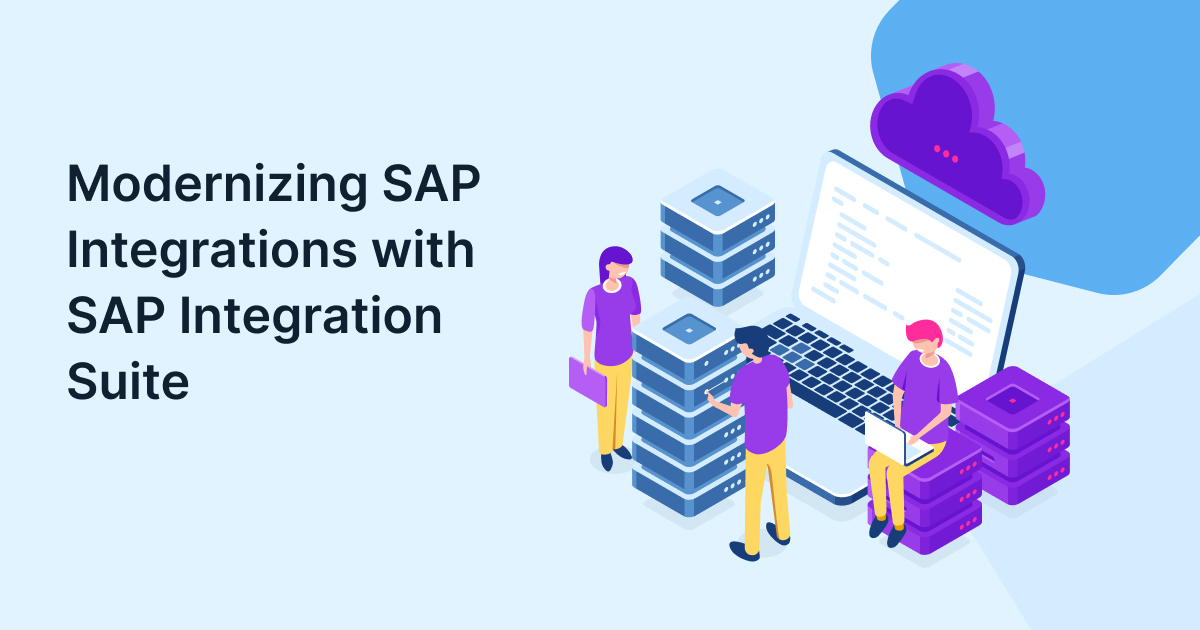
To modernize SAP integrations, organizations need a unified integration platform that can connect SAP and non-SAP applications, support cloud and hybrid environments, enable API-led connectivity & simplify governance. SAP Integration Suite with integration solutions brings these capabilities together in a single platform, helping enterprises reduce integration complexity while accelerating innovation.
As businesses migrate to SAP S/4HANA, adopt cloud applications, and invest in AI-driven operations, traditional integration approaches are no longer enough. Modern enterprises require flexible and scalable solutions that can support real-time data exchange, process automation & enterprise-wide connectivity without introducing additional complexity.
This is where SAP Integration Suite has emerged as a key enabler of SAP Integration Modernization, helping organizations transform fragmented integration landscapes into connected digital ecosystems.
Summary
- SAP Integration Suite helps organizations modernize legacy SAP integrations.
- It supports cloud, hybrid, API-led, event-driven & B2B integration scenarios.
- SAP Integration Suite is a core component of SAP BTP integration strategies.
- Prebuilt connectors, APIs, and integration content accelerate implementation.
- AI-powered capabilities help improve integration development and monitoring.
- Modernization improves scalability, governance & business agility.
Why Are Enterprises Modernizing SAP Integrations?
To support digital transformation, businesses need integration architectures that are agile, scalable, and cloud-ready. Legacy integration environments were designed for a different era and often struggle to support today’s business requirements.
A typical enterprise SAP landscape may include SAP S/4HANA, SAP SuccessFactors, Salesforce, Microsoft applications, data platforms, partner systems & industry-specific solutions. As these systems grow, maintaining hundreds of custom integrations becomes increasingly difficult.
Drive Digital Innovation & Transform Your Business
Struggling to find tailored IT solutions that truly accelerate your digital transformation journey? Partner with LedgeSure to unlock the true potential of technology.
Many organizations experience –
- Integration sprawl
- High maintenance costs
- Slow onboarding of new systems
- Limited visibility into business processes
- Challenges supporting cloud applications
- Difficulty scaling integrations across regions and business units
These challenges have made SAP Integration Modernization a strategic priority rather than simply an IT upgrade.
| 💡 Did You Know?
SAP Integration Suite combines API management, application integration, B2B integration, event-driven architecture & integration assessment capabilities within a single platform, reducing the need for multiple standalone integration tools. |
What Is SAP Integration Suite and Why Has It Become Central to Modernization?
To simplify enterprise connectivity, organizations need an integration platform that supports various integration approaches without requiring multiple tools. SAP Integration Suite provides exactly that foundation.
At its core, SAP Integration Suite is an Integration Platform as a Service (iPaaS) that connects applications, data, business processes & partners across cloud and on-premises environments.
Many organizations begin evaluating the platform while planning modernization initiatives or SAP S/4HANA migrations. Before diving deeper into implementation strategies, it’s useful to understand the individual capabilities that make up the platform. Our detailed SAP Integration Suite Complete Guide explores those capabilities, licensing considerations & use cases in greater depth.
The suite combines several powerful services –
Cloud Integration
Enables application and process integration across SAP and non-SAP landscapes.
API Management
Provides a centralized framework for creating, securing, monitoring, and governing APIs.
Open Connectors
Reduces development effort through prebuilt connectors for hundreds of third-party applications.
Integration Advisor
Automates B2B mapping and simplifies partner onboarding.
Event Mesh
Supports real-time event-driven architectures and asynchronous communication.
Trading Partner Management
Streamlines EDI and B2B integration processes.
Together, these services create a modern foundation for Enterprise SAP Integration.
What Challenges Do Legacy SAP Integration Architectures Create?
To successfully modernize SAP integrations, organizations must first understand where traditional approaches create limitations.
Historically, many SAP environments relied on point-to-point integrations. While these integrations solved immediate business needs, they often became difficult to scale over time.
Point-to-Point Dependency
Every new application requires additional connections, increasing maintenance effort and complexity.
Limited Cloud Readiness
Many legacy solutions were designed before cloud adoption became mainstream, making cloud integration more challenging.
Lack of Real-Time Visibility
Batch processing approaches often delay data synchronization, affecting reporting and decision-making.
Rising Operational Costs
Custom integrations require continuous maintenance, upgrades, testing & monitoring.
As organizations expand digital operations, these limitations frequently become significant barriers to innovation.
How Does SAP BTP Integration Support Enterprise Transformation?
To build connected enterprises, organizations need a platform that integrates applications, analytics, automation, AI & data management capabilities. This is where SAP Business Technology Platform plays a critical role.
SAP Integration Suite operates as a key service within SAP BTP, enabling organizations to create a unified digital ecosystem. Businesses can use SAP BTP integration to –
- Connect SAP and non-SAP systems
- Build API-led architectures
- Enable process automation
- Support application development
- Create intelligent workflows
- Establish enterprise-wide governance
One area that often causes confusion for organizations is understanding how SAP Integration Suite fits within the broader SAP BTP architecture. Our guide to SAP BTP Integration Architecture breaks down this relationship and explains how enterprises can build scalable integration frameworks.
Which SAP Integration Suite Capabilities Deliver the Greatest Modernization Impact?
To accelerate modernization, organizations need capabilities that reduce integration complexity while increasing flexibility.
| Capability | How It Supports Modernization |
| Cloud Integration | Connects SAP and non-SAP applications |
| API Management | Enables reusable and governed APIs |
| Open Connectors | Accelerates third-party integrations |
| Event Mesh | Supports real-time communication |
| Integration Advisor | Simplifies B2B integrations |
| Trading Partner Management | Reduces onboarding effort |
What makes these capabilities particularly valuable is that they support both immediate business requirements and long-term transformation objectives.
Organizations can modernize incrementally without replacing their entire integration landscape at once.
Industry Insight
According to the 2024 MuleSoft Connectivity Benchmark Report, 95% of IT leaders say integration challenges are hindering their digital transformation efforts, underscoring the growing need for modern integration platforms that simplify connectivity across applications, data & business processes.
How Is Integration AI Changing SAP Integration Services?
To improve development productivity and operational efficiency, enterprises are increasingly leveraging AI-powered integration capabilities.
Modern SAP integration services now extend far beyond connectivity. They also support intelligent development, monitoring & optimization. AI capabilities are helping organizations –
- Accelerate Data Mapping – Reduce manual effort through intelligent field mapping suggestions.
- Improve Development Efficiency – Recommend integration patterns and reusable assets.
- Enhance Monitoring – Identify anomalies and potential issues before business processes are affected.
- Optimize Process Performance – Use analytics-driven insights to improve integration outcomes.
As SAP continues enhancing Joule and AI-enabled business services, integration AI will play an increasingly important role in enterprise integration strategies.
What Does a Successful SAP Integration Modernization Roadmap Look Like?
To modernize effectively, organizations should approach modernization as a phased transformation rather than a one-time migration project.
| Phase | Objective |
| Assessment | Evaluate the current integration landscape |
| Rationalization | Eliminate redundant interfaces |
| API Strategy | Develop reusable service architecture |
| Migration | Move integrations to cloud-native platforms |
| Optimization | Improve monitoring and governance |
Interestingly, many organizations initially focus on migrating interfaces and applications but later discover that integration modernization requires a broader transformation strategy involving governance, API management, cloud operating models & organizational processes.
That’s exactly where Integration Migration and Modernization: The Complete Enterprise Guide, will serve as a resource for enterprises looking to build a long-term modernization roadmap that extends beyond SAP integration projects alone.
SAP Integration Suite vs Traditional Middleware: Which Approach Is Better?
To support modern enterprise requirements, organizations increasingly prefer cloud-native integration platforms over legacy middleware solutions.
| Feature | Traditional Middleware | SAP Integration Suite |
| Cloud Readiness | Limited | Native |
| API Management | External Tools | Built-In |
| Scalability | Infrastructure Dependent | Cloud Scalable |
| Event-Driven Architecture | Complex | Native Support |
| Third-Party Connectivity | Custom Development | Prebuilt Connectors |
This comparison becomes especially important when organizations evaluate alternative enterprise integration platforms.
For businesses comparing integration technologies in detail, our analysis of SAP Integration Suite vs MuleSoft: Key Differences explores differences in architecture, governance, connectivity, ecosystem alignment & long-term scalability.
Empower Your Workforce with AI & Automated Innovations
Want to boost efficiency and reduce costs? Explore how LedgeSure’s AI-driven solutions simplify workflows and drive real outcomes.
Conclusion
Modernizing SAP integrations is no longer optional for organizations pursuing cloud transformation, business agility & AI-driven innovation.
SAP Integration Suite provides a unified platform for connecting applications, data, processes, and business partners through scalable, cloud-native integration capabilities. Whether your modernization journey involves SAP S/4HANA migration, API-led architecture, hybrid integration, or broader SAP BTP adoption, the platform offers the flexibility and governance needed to support long-term growth.
Most importantly, successful modernization is not only about replacing old technology. It is about building an integration foundation that can adapt to future business requirements, emerging technologies & evolving customer expectations.
If you’re evaluating modernization opportunities or planning your next SAP integration initiative, speak with the LedgeSure team to discuss your integration goals.