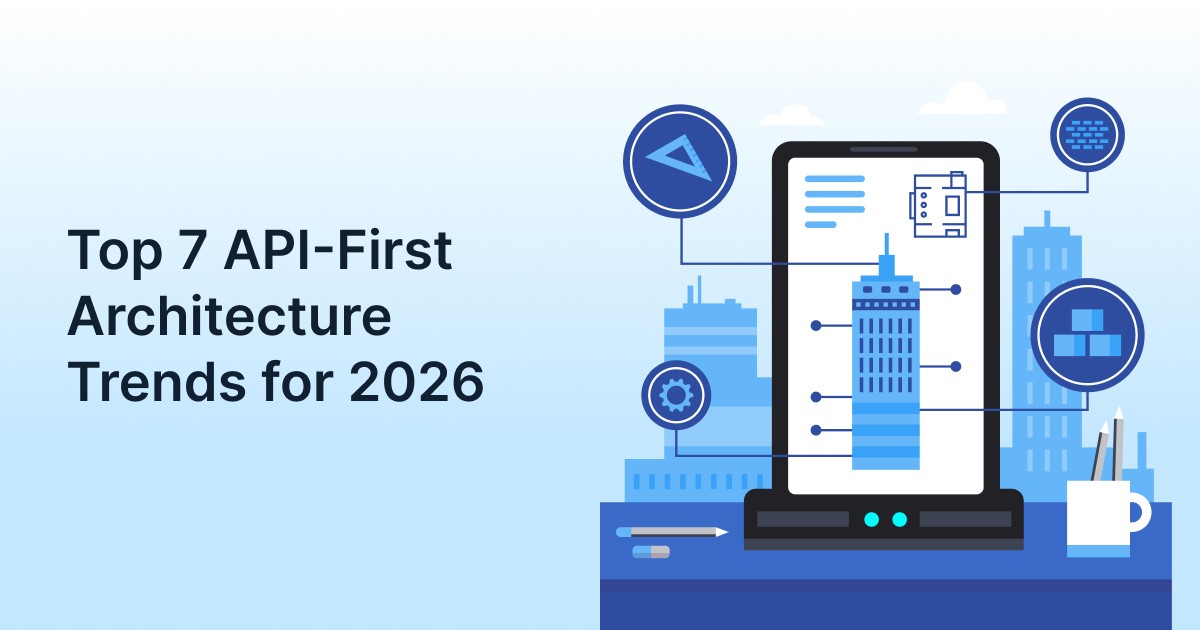
To build scalable, flexible systems in 2026, you need to design APIs before applications, treating them as first-class products. API-first architecture means defining contracts, behavior & governance up front, then building services and frontends around them. This approach reduces integration pain, speeds up development & supports composable, cloud-native systems. With rising complexity from AI, microservices & multi-cloud environments, API-first is no longer optional; it’s foundational.
APIs are the connective tissue of modern enterprises. They link internal systems, third-party services, partner ecosystems & customer-facing apps. In 2026, organizations that treat APIs as strategic assets, not just technical endpoints, will move faster, innovate more & scale with fewer breaking changes.
Key Takeaways
- API-first architecture is now a core strategy for modern, scalable systems.
- In 2026, key trends include AI-powered APIs, stronger security & governance, composable and event-driven designs & API productization.
- This post covers 7 actionable trends, practical steps to adopt them & how they fit into your digital transformation plans.
- Use these insights to guide your 2026 API roadmap and avoid costly re-architecture later.
Drive Digital Innovation & Transform Your Business
Struggling to find tailored IT solutions that truly accelerate your digital transformation journey? Partner with LedgeSure to unlock the true potential of technology.
Which 7 Trends Are Shaping API-First Architecture in 2026?
To stay competitive in 2026, you need to align your API strategy with emerging trends in AI, security, design patterns & governance. These seven trends reflect how leading enterprises are evolving their API-first approach.
-
How Are AI-Powered APIs Changing API-First Design?
To leverage AI in 2026, you need APIs that expose and consume AI capabilities as core services, not add-ons. AI-powered APIs include endpoints for generative models, prediction, classification & natural language processing, all designed with clear contracts and versioning.
This shifts API design from simple CRUD operations to intent-driven, context-aware interactions. Teams are embedding AI directly into API gateways and management layers for intelligent routing, automated anomaly detection & dynamic rate limiting based on behavior.
This trend makes API-first architecture more adaptive and “self-healing,” but also demands stronger governance around model drift, data privacy & bias.
-
Why Is API Security and Governance a Top Priority?
To protect APIs in 2026, you need zero-trust security models, fine-grained access controls & automated policy enforcement at the gateway and service levels. Attack surfaces have expanded with microservices, third-party integrations & public APIs, making security and governance non-negotiable.
Key focus areas include identity and access with OAuth 2.1, OIDC, mTLS, and workload identities, along with threat protection like API-specific WAF rules, bot detection & schema validation.
Proper governance ensures that API-first doesn’t become “API-everywhere-without-control,” which is a common failure mode in large enterprises. As more organizations rethink their perimeter, API gateway security is getting fresh attention in 2026. This could be more deeply understood through the blog on Why API Gateway Demands Fresh Attention.
-
How Is Composable Architecture Reinforcing API-First Design?
To enable rapid change without breaking systems, you need composable architectures built on well-defined, reusable APIs. Composable architecture treats business capabilities as modular services connected via APIs, allowing teams to swap, upgrade, or scale components independently.
In practice, this means domain-driven API design aligned to business capabilities, clear separation between orchestration logic and core domain APIs, and reuse of API fragments across channels like web, mobile, partner & IoT. For enterprises pursuing digital transformation, composable API-first design is the backbone that makes change manageable and low-risk.
-
What Role Do Event-Driven and Real-Time APIs Play?
To support real-time experiences and decoupled systems, you need event-driven APIs alongside traditional request/response APIs. Event-driven architectures use streaming, webhooks & pub/sub-APIs to push changes as they happen, enabling responsive, scalable systems.
Common patterns include webhooks for partner integrations and SaaS events, streaming APIs for telemetry and real-time analytics, and async APIs for background processing and eventual consistency. In 2026, API-first strategies must explicitly include event-driven designs, not treat them as afterthoughts.
-
How Are Unified API Management Platforms Evolving?
To reduce tool sprawl and improve developer experience, you need unified API management platforms that cover design, security, analytics & monetization in one place. These platforms are evolving from simple gateways to full lifecycle management suites.
Capabilities to look for include design-first tooling with OpenAPI and GraphQL support, built-in security policies and governance workflows, developer portals with interactive docs and sandboxes & usage analytics with monetization hooks. A unified platform makes it easier to enforce standards and measure API performance across the organization.
-
Why Is API Productization and Monetization Gaining Traction?
To turn APIs into revenue streams or strategic levers, you need to treat them as products with clear owners, SLAs & pricing models. API productization means defining target users, value propositions, and success metrics for each API, not just exposing endpoints.
Monetization models include usage-based pricing per call or per MB, tiered access with free, standard, and premium levels & partner revenue sharing through marketplace models. This trend is especially relevant for platforms and ecosystems that want to scale beyond internal use. Explore more about this on API and Importance of Monetization.
-
How Are Developer Experience and Spec-Driven Development Improving?
To accelerate delivery and reduce integration errors, you need spec-driven development with excellent developer experience. This means designing APIs with OpenAPI or GraphQL schemas first, then generating code, tests & docs from those specs.
DX improvements include interactive API portals with “try-it” consoles, SDKs and code samples in multiple languages, and clear versioning, changelogs & deprecation notices. Good DX reduces time-to-first-call for internal and external developers, which directly impacts adoption and ROI.
| 💡 Did You Know?
“According to a 2024 report on API security, by Salt Security, 94% of organizations experienced at least one API-related security incident in the past year, underscoring the urgency of strong security and governance in API-first strategies.” |
API-First vs API-Last: What’s the Real Difference in 2026?
To decide between API-first and API-last, you need to understand how each approach affects speed, cost & long-term maintainability. The table below highlights the practical differences for enterprises planning their 2026 roadmaps.
| Aspect | API-First Architecture | API-Last Architecture |
| Design starting point | APIs designed before applications | APIs exposed after applications are built |
| Integration effort | Lower, due to clear contracts upfront | Higher, often requiring rework and adapters |
| Change management | Easier to evolve with versioned APIs | Harder; changes often break existing integrations |
| Developer experience | Consistent docs, SDKs, and sandboxes from day one | Inconsistent, retrofitted documentation |
| Alignment with business | Tightly aligned to business capabilities | Often reflects technical, not business, boundaries |
| Suitability for 2026 | Ideal for composable, AI-driven, multi-cloud systems | Risky for complex, fast-changing environments |
For most enterprises targeting scale and agility, API-first is the clear choice in 2026.
How Can Enterprises Implement API-First Architecture in 2026?
To implement API-first successfully, you need a structured approach that covers strategy, standards, tooling & governance. Here’s a practical roadmap.
1. Define API strategy and business goals.
Start by mapping business capabilities to potential APIs. Ask which processes must be exposed to partners or channels, where you need real-time data sharing, and which services should be reusable across products. Document clear objectives: faster onboarding, ecosystem growth, internal efficiency, or monetization.
2. Establishdesign standards and governance.
To avoid chaos, you need shared standards for API design, naming, versioning & documentation. Adopt OpenAPI for REST, GraphQL schemas where appropriate, consistent error formats and status codes & a centralized API governance board or guild. This ensures all teams move in the same direction.
3. Invest in the right tooling.
Choose platforms that support design-first workflows, automated testing and contract validation, security policies and observability & developer portals with analytics. Avoid point solutions that create silos; aim for an integrated stack.
4. Pilot, measure& scale.
Start with a high-visibility domain such as customer data, payments, or orders. Run a pilot, define success metrics like time-to-integration, adoption & defects, gather feedback from internal and external developers & refine standards and tooling before scaling. Then expand to other domains using lessons learned.
What Challenges Should Teams Anticipate?
To avoid pitfalls, you need to anticipate cultural, technical & operational challenges early. Common issues include cultural resistance where teams used to “code-first” may see API-first as overhead, inconsistent adoption where some groups follow standards while others don’t, over-engineering by designing overly complex APIs too early & security gaps without embedded security. Recognizing these challenges upfront makes it easier to plan mitigations.
Empower Your Workforce with AI & Automated Innovations
Want to boost efficiency and reduce costs? Explore how LedgeSure’s AI-driven solutions simplify workflows and drive real outcomes.
How Do These Trends Fit into Your Digital Transformation Roadmap?
To make API-first work for transformation, you need to align it with broader goals like cloud migration, data unification & customer experience improvements. API-first architecture enables faster integration of new SaaS tools and legacy systems, cleaner data flows between systems supporting analytics and AI, modular upgrades without full rewrites & ecosystem growth via partner and customer-facing APIs. If your transformation strategy doesn’t explicitly include API-first, you risk building rigid, hard-to-change systems.
Conclusion
API-first architecture is no longer a niche approach, it’s the default for enterprises that want to stay agile, secure & innovation-ready in 2026. The seven trends covered here, from AI-powered APIs and stronger security to composable design and API productization, show how API-first is evolving beyond “just integration.”
If you’re planning your 2026 tech roadmap, now is the right time to review your API strategy, tighten governance & align your architecture with these trends. Ledgesure works with large enterprises to design and implement API-first architectures that scale with their business. Talk to our team about your API and integration roadmap.