Summary:
Cloud cost optimization has become a critical financial mandate for the modern enterprise. As organizations scale their multi-cloud environments, the disconnect between engineering speed and financial governance often leads to massive budget overruns. This article breaks down how a mature FinOps strategy bridges that gap, transforming unpredictable cloud spend into transparent unit economics. By implementing robust chargeback models, rightsizing resources, and aligning cross-functional teams, CFOs can stop revenue leakage and ensure every dollar spent in the cloud drives measurable business value.
Opening a monthly AWS or Microsoft Azure invoice to find a six-figure variance is a rite of passage no financial leader wants to experience. When engineering teams are incentivized to move fast and deploy on demand, infrastructure costs scale exponentially, often with zero correlation to revenue growth.
The friction between IT needing agility and Finance needing predictability creates a costly operational blind spot. Traditional procurement models, built for predictable on-premises hardware cycles, completely collapse in the variable-spend reality of the cloud. You cannot simply cut your way to cloud efficiency without breaking production systems.
To gain control, enterprises are shifting away from reactive cost-cutting and adopting FinOps. Here is exactly how financial and technical decision-makers can implement a FinOps strategy to master cloud cost optimization and turn infrastructure spend into a strategic advantage.
The Core Problem: Why Cloud Spend Spirals Out of Control
Cloud environments are fundamentally decentralized. Any engineer with the right permissions can spin up servers, databases, and machine learning clusters in seconds. While this accelerates innovation, it bypasses the traditional financial gating that protects corporate budgets.
Without strict governance, companies inevitably pay for “zombie” infrastructure resources provisioned for a temporary project but never spun down.
Drive Digital Innovation & Transform Your Business
Struggling to find tailored IT solutions that truly accelerate your digital transformation journey? Partner with LedgeSure to unlock the true potential of technology.
The Real Cost of Cloud Waste
According to the Flexera 2024 State of the Cloud Report, organizations self-estimate that 27% of their cloud spend is completely wasted.
For every million dollars invested in cloud infrastructure, nearly $300,000 is burned on idle resources or over-provisioned instances.
According to recent data from Capgemini, over 65% of enterprise IT leaders report that unpredictable multi-cloud spend remains their primary operational challenge, frequently exceeding allocated budgets by 20% to 30%.
Failing to establish predictable unit economics directly drains capital that should be funding new AI initiatives and core business transformation.
What is a FinOps Strategy? (Bridging IT and Finance)
FinOps (Cloud Financial Operations) is not merely a category of cloud cost optimization software. It is a cultural practice and operating model that brings financial accountability to the variable spend model of the cloud.
A successful FinOps strategy forces engineering, finance, and business teams to collaborate on data-driven spending decisions. Instead of IT throwing a bill over the wall to Finance at the end of the month, teams work together to understand exactly what infrastructure costs, why it is needed, and how it impacts product margins.
Traditional IT vs. FinOps Operating Model
| Capability | Traditional IT Procurement | Modern FinOps Model |
| Pacing | Annual or quarterly budgeting cycles | Real-time or daily spend monitoring |
| Ownership | Finance sets budgets; IT manages infrastructure | Cross-functional teams own their specific cloud usage |
| Visibility | Cost center allocations | Granular unit economics (e.g., cost per transaction) |
| Optimization | Reactive, post-invoice audits | Continuous, automated rightsizing and rate optimization |
Did You Know?Organizations that successfully implement a FinOps practice report an average of 20% to 30% reduction in their total cloud spending within the first six months, simply by establishing visibility and basic tagging hygiene. |
| Source: FinOps Foundation, State of FinOps Report, 2023 |
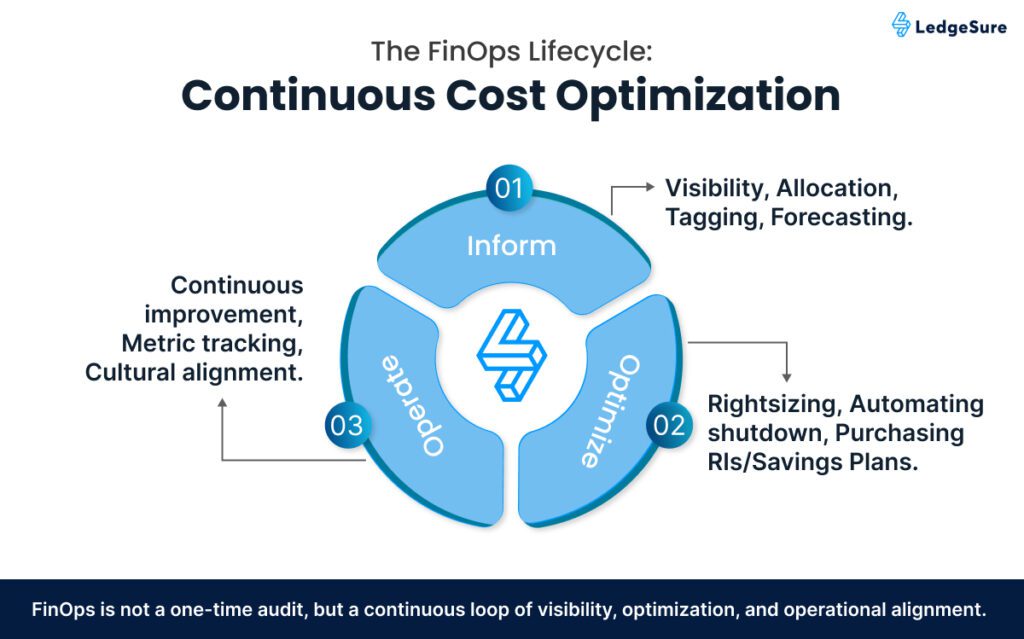
Proven Cloud Cost Optimization Strategies
Deploying the best cloud cost management tools will fail if the underlying organizational processes are broken. To achieve sustainable efficiency, enterprises must focus on three strategic pillars.
1. Visibility and Allocation (Showbackand Chargeback)
You cannot optimize what you cannot measure. The first step is implementing a rigorous tagging architecture. Every cloud asset must be tagged with its corresponding business unit, project, or product line.
Once tagging is in place, organizations can move from a ‘showback’ model to a ‘chargeback’ model. This creates immediate behavioral change. Eliminating these financial blind spots and properly decoding your FinOps strategy ensures that engineering teams factor cost into their architectural decisions.
2. Usage Optimization (Rightsizing)
Usage optimization is about ensuring you only use the resources you actually need. Engineers frequently over-provision server sizes “just to be safe,” paying for enterprise-grade compute power to run lightweight background tasks.
Implementing automated rightsizing rules and aggressive auto-scaling ensures that your infrastructure expands during peak traffic and contracts during off-hours. A comprehensive cloud transformation approach links to evaluates these architectural efficiencies during the migration phase, not just after the fact.
3. Rate Optimization (Commitment Discounts)
Once usage is stabilized, finance teams can leverage purchasing strategies to lower the unit cost of compute. Cloud providers offer steep discounts (up to 72%) in exchange for committed usage over one- or three-year terms.
Utilizing Reserved Instances (RIs) or AWS Savings Plans requires accurate forecasting. A strong FinOps team will balance on-demand flexibility with baseline commitments to maximize financial leverage.
Empower Your Workforce with AI & Automated Innovations
Want to boost efficiency and reduce costs? Explore how LedgeSure’s AI-driven solutions simplify workflows and drive real outcomes.
The Enterprise Cost Pivot
During the economic shifts of 2020, Airbnb experienced a sudden drop in platform demand and needed to rapidly control AWS costs. By launching a centralized cloud efficiency program, they focused heavily on identifying zombie resources, enforcing strict resource tagging, and aggressively adopting AWS Savings Plans. Over nine months, this coordinated effort between finance and engineering resulted in a reported $63.5 million reduction in annualized cloud hosting costs, proving that disciplined FinOps can yield massive bottom-line impact.
Structuring Your FinOps Team for Success
Cloud cost optimization cannot be a side project. It requires a dedicated FinOps unit often reporting to the CTO or CIO, but working in lockstep with the CFO.
This team acts as the central nervous system for cloud spend management, setting up the guardrails, negotiating enterprise agreements, and providing engineers with the data they need to build cost-effectively.
| “FinOps is an evolving cloud financial management discipline and cultural practice that enables organizations to get maximum business value by helping engineering, finance, technology and business teams to collaborate on data-driven spending decisions.” — J.R. Storment, Executive Director, FinOps Foundation |
| Source: FinOps Foundation |
Making the Shift
Cloud cost optimization is ultimately a measure of operational maturity. When left unmanaged, the cloud is a financial liability; when governed by a strong FinOps strategy, it becomes an engine for profitable growth.
By prioritizing granular cost visibility, aligning cross-functional teams, and leveraging both usage and rate optimizations, enterprise leaders can transform their cloud infrastructure from a black-box expense into a strategic, measurable investment. Stop paying for waste and start paying for performance.
Wrestling with unpredictable cloud invoices month after month drains resources that should be funding innovation.
If your enterprise is struggling to align technical architecture with financial governance; Contact us and our cloud architects will help you build a sustainable FinOps framework.
FAQ:
What is the difference between cloud cost management tools and FinOps?
Cloud cost optimization software provides the dashboards and data needed to identify waste and track spending. FinOps is the organizational culture and process required to act on that data, ensuring engineering and finance teams collaborate to improve unit economics.
How long does it take to see ROI from a FinOps strategy?
Organizations typically see initial cost reductions within 30 to 90 days of implementation, primarily through “quick wins” like terminating unattached storage volumes, spinning down idle non-production environments, and purchasing baseline commitment discounts.
Should the FinOps team sit in Finance or IT?
While the exact placement varies by enterprise, successful FinOps teams typically report into the CTO or CIO organization to maintain credibility with engineering, while maintaining a direct dotted-line reporting structure to the CFO for financial accountability.
Does implementing a FinOps strategy slow down engineering teams?
No, a mature FinOps practice actually empowers engineering speed by removing financial bottlenecks. Instead of waiting for top-down budget approvals, developers are given clear financial guardrails and real-time visibility into their unit economics. The goal of FinOps is not to halt deployments to save money, but to ensure that fast-moving teams are building cost-effective architectures by default.
How do you manage FinOps across a multi-cloud environment?
Managing spend across AWS, Azure, or hybrid environments requires abstracting your visibility layer away from native provider tools. Enterprises must implement a centralized FinOps platform that normalizes billing data from all providers into a single pane of glass. Combined with a universal tagging taxonomy, this allows leaders to track cross-cloud unit economics and compare true performance costs accurately.