Summary:
Call volumes are outpacing human capacity, leaving enterprise helpdesks struggling with agent burnout and delayed resolution times. Implementing AI in customer support shifts the operational burden from your frontline team to intelligent routing, semantic search, and automated workflows. This guide breaks down the core enterprise use cases, measurable business benefits, and software tools necessary to modernize your contact center. For organizations looking to implement these strategies rapidly, leveraging expert Customer Support operational partnerships ensures seamless AI integration without disrupting the daily customer experience.
Helpdesk queues are choking on repetitive queries, yet customer satisfaction scores remain stagnant across the enterprise landscape. For operations heads, the pressure is binary: scale service capacity without proportionally increasing headcount, or risk losing market share to competitors with immediate response times.
Legacy ticketing systems rely entirely on human triage, forcing highly skilled agents to act as manual routers rather than complex problem solvers. This approach fundamentally breaks down under high volume.
According to a 2024 survey by Gartner, 85% of the customer service leaders were looking to explore consumer-facing generative AI.
Organizations delaying AI adoption will face a permanent cost-to-serve disadvantage as competitors automate their baseline operations.
Deploying AI in customer support changes the architecture of your contact center. By inserting natural language understanding (NLU) and machine learning between the customer and the agent, enterprises can resolve basic friction instantly. Here is how modern support teams are executing this shift to protect their margins.
Drive Digital Innovation & Transform Your Business
Struggling to find tailored IT solutions that truly accelerate your digital transformation journey? Partner with LedgeSure to unlock the true potential of technology.
Core Enterprise Use Cases for AI Helpdesks
The most effective AI deployments do not try to replicate human empathy. Instead, they target high-frequency, low-complexity operational bottlenecks that drain your team’s daily bandwidth.
Predictive Ticket Routing and Triage
Manual dispatch is a massive drain on operational efficiency. AI helpdesk systems analyze incoming requests, whether via email, chat, or social media—and categorize them by intent and sentiment. The system then automatically routes the ticket to the agent with the exact skill set required, bypassing the Tier 1 triage bottleneck entirely.
To understand how these self-learning models evolve alongside your operational needs, explore how adaptive AI systems are becoming the next step in enterprise automation.
Agent-Assist Copilots
AI is not just for customer-facing chatbot automation. Behind the scenes, generative AI listens to live calls or scans active chats in real-time. It automatically surfaces relevant knowledge base articles; drafts suggested responses and summarizes the customer’s history. This reduces average handle time (AHT) while ensuring strict compliance and consistency in answers.
Intelligent Self-Service
Basic decision trees are frustrating for users and ineffective for deflection. Modern customer care AI uses semantic search to understand exactly what a user is asking, even if they misspelled words or use regional slang. It delivers precise, natural language answers extracted directly from your internal documents rather than forcing the customer to read a generic FAQ page.
Measuring the Real Benefits of AI-Powered Customer Service
Enterprise leaders need concrete metrics, not conceptual promises, to justify the deployment of AI customer service software. The transition shifts the contact center from a rigid cost center to a dynamic, scalable operation.
→ Applying AI to customer care functions can increase operational efficiency by 30 to 45% [McKinsey].
This efficiency directly funds more complex problem-solving and proactive customer retention efforts.
| Operational Metric | Traditional Helpdesk Model | AI-Powered Support Model | Business Impact |
| First Response Time | Hours to Days (Queue dependent) | Milliseconds (Immediate intent capture) | Eliminates queue abandonment and reduces customer anxiety. |
| Tier 1 Resolution Rate | 20% – 40% (High manual escalation) | 60%+ (Resolved via intelligent self-service) | Frees human agents to handle high-value, complex interventions. |
| Agent Onboarding Time | 3 – 6 Months (Extensive memorization) | 3 – 4 Weeks (Guided by Agent-Assist tools) | Drastically lowers training costs and accelerates time-to-value. |
| Scaling Capability | Linear (Requires 1:1 headcount growth) | Exponential (Software scales seamlessly) | Handles seasonal volume spikes without emergency hiring. |
The Technology Stack: Choosing AI Customer Service Software
Selecting the right tooling determines whether your AI deployment becomes a seamless operational asset or an integration nightmare. Enterprise architecture requires platforms that integrate smoothly with existing CRMs (like Salesforce or Microsoft Dynamics) and omnichannel communication hubs.
When evaluating an AI-powered customer service platform, prioritize natural language processing (NLP) capabilities over basic keyword recognition. The system must understand context and intent. Furthermore, secure data management is non-negotiable; the AI must compartmentalize personally identifiable information (PII) before processing requests to maintain compliance.
Did You Know?Organizations that integrate AI into their customer care workflows frequently see a reduction in cost per query of up to 30%, alongside significant improvements in customer satisfaction scores due to the total elimination of initial wait times. |
| Source: IBM: How AI is changing customer service 2022 |
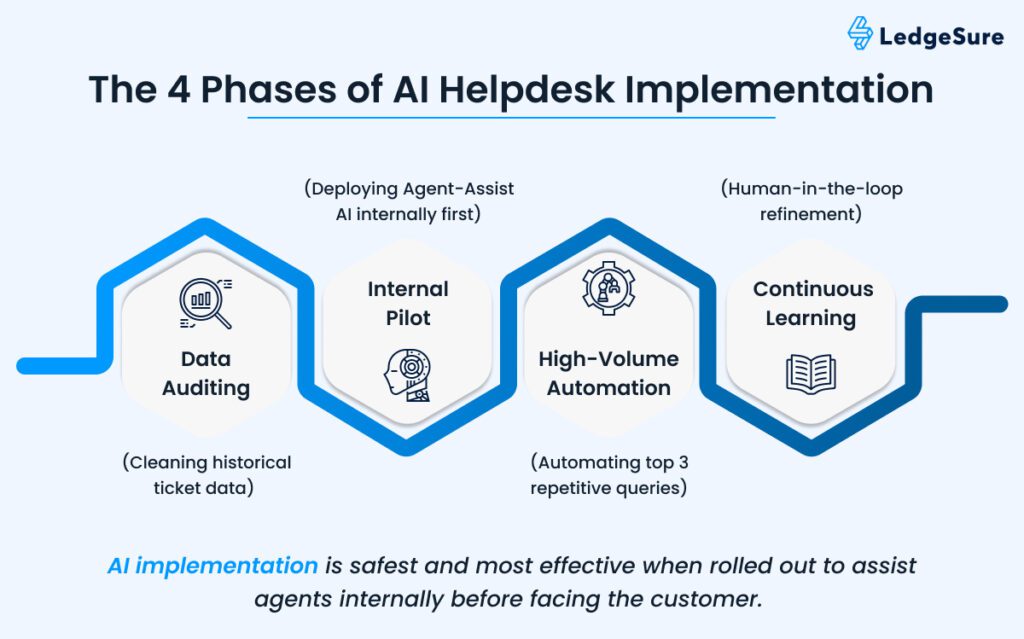
Implementing these systems requires a robust foundation of clean, structured historical data. A machine learning model is only as intelligent as the interactions it learns from. You can learn more about preparing your infrastructure by using customer support data to improve service.
Empower Your Workforce with AI & Automated Innovations
Want to boost efficiency and reduce costs? Explore how LedgeSure’s AI-driven solutions simplify workflows and drive real outcomes.
Real-World Case Study: Automation at Enterprise Scale
📋 Illustrative Example: Multinational Telecommunications Carrier
A leading global telecom provider was facing a crisis of scale, managing over 50 million inbound customer queries annually. Their human agents were overwhelmed by repetitive requests regarding billing cycles, SIM activation, and basic connectivity troubleshooting.
They deployed a conversational AI virtual agent integrated directly into their mobile app and WhatsApp channels. Rather than using rigid decision trees, the NLU-powered bot recognized over 150 specific customer intents.
The Outcome:
Within 12 months, the AI handled over 20% of all customer interactions end-to-end without any human intervention. Average handle times for escalated tickets dropped by 15%, as the AI pre-collected necessary account details and authenticated the user before routing them to a live specialist. LedgeSure routinely sees similar efficiency gains when executing digital transformation strategies for enterprise clients.
Conclusion
The bottleneck in modern enterprise customer support is no longer a lack of channels; it is a lack of automated intelligence managing those channels. Throwing more headcount at a fundamental routing and triage problem only inflates operational costs without improving the customer experience.
By implementing AI helpdesks and agent-assist copilots, you restructure your contact center to be proactive rather than reactive. The next step is not to purchase an isolated chatbot, but to audit your current ticket data to identify exactly which operational workflows are ripe for immediate, high-impact automation.
Transitioning from a manual ticketing system to an AI-driven helpdesk requires mapping your unique business logic to the right models. If your team is struggling to scale support operations efficiently, Talk to our experts at LedgeSure, and we can help architect a custom solution for you!
FAQs:
What is the difference between an AI helpdesk and a traditional chatbot?
Traditional chatbots rely on rigid, pre-programmed, keyword-based rules and decision trees that fail when users ask complex questions. An AI helpdesk uses natural language understanding (NLU) and machine learning to understand intent, learn from past resolutions, and generate dynamic responses based on enterprise knowledge bases.
How does AI in customer support impact data privacy?
Enterprise-grade AI customer service software is designed with compliance as a foundational pillar. It uses automated data masking to redact personally identifiable information (PII) before the data ever reaches the language model, ensuring strict compliance with GDPR, CCPA, and industry-specific regulations.
What is the typical ROI timeline for AI customer service software?
While initial integration, data cleaning, and model training can take 2 to 4 months, most mid-to-large enterprises see a measurable return on investment within 6 to 9 months. This ROI is driven primarily by the immediate deflection of Tier 1 tickets and a sharp reduction in average handle times for live agents.
How difficult is it to integrate AI customer service tools with our existing CRM?
Most enterprise AI support platforms come with pre-built APIs designed for seamless integration with major CRM systems like Salesforce, Zendesk, and Microsoft Dynamics. The technical connection typically takes only a few weeks, with the bulk of the timeline dedicated to mapping data flows and ensuring the AI can accurately read historical ticket context. For older or custom-built legacy systems, integration may require dedicated middleware to securely bridge the data gap without disrupting operations.
What happens when the AI helpdesk cannot resolve a complex customer issue?
Modern AI systems utilize sentiment analysis and confidence scoring to detect when a query exceeds their training or when a customer is becoming frustrated. When this threshold is met, the system triggers a seamless escalation, immediately routing the interaction to the most appropriate human agent. The agent receives the full conversation transcript and account context instantly, ensuring the customer never has to repeat their problem.