Summary:
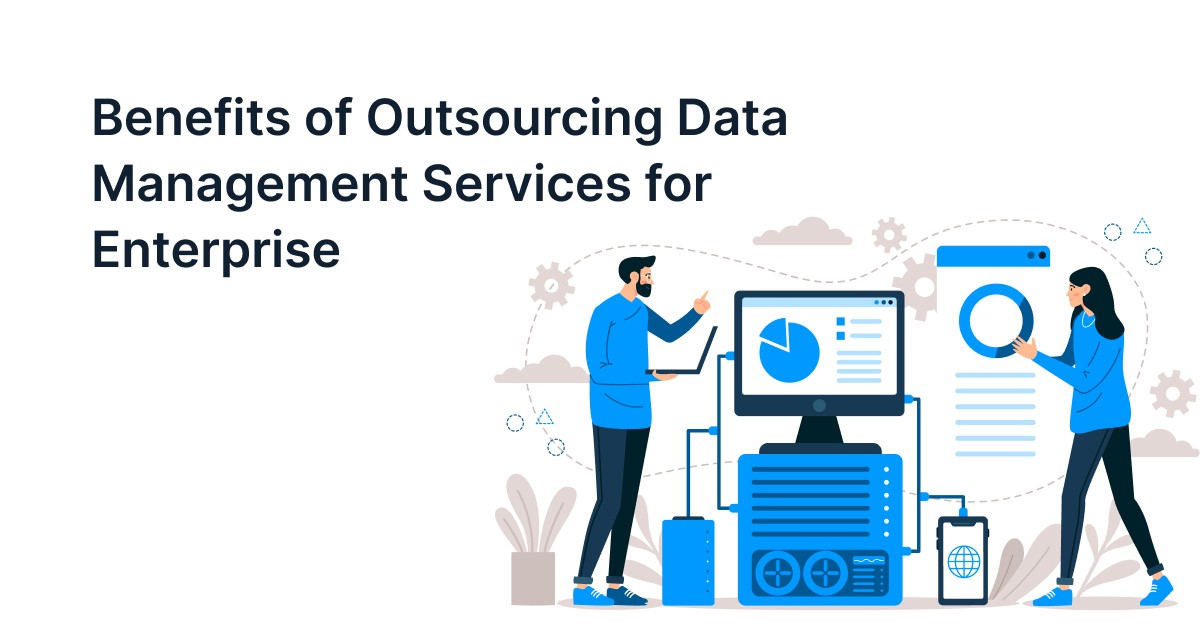
Enterprise data pipelines are expanding faster than internal teams can govern them, leading to engineering bottlenecks, compliance risks, and unused business intelligence. Outsourcing these capabilities provides a scalable way to implement robust master data management, ensure continuous data quality, and reduce operational overhead. By leveraging expert data management services, organizations can accelerate their data maturity without sacrificing security. This post breaks down the strategic advantages of transitioning to a managed model, offering a clear framework to evaluate the build-versus-buy decision.
Data engineering backlogs are paralyzing enterprise decision-making. Your infrastructure might be capturing terabytes of customer interactions, supply chain events, and financial metrics every day, but if your internal team is entirely consumed by basic pipeline maintenance, that data isn’t generating value. Data silos harden, governance slips, and the time-to-insight extends from hours to weeks.
For CIOs and Chief Data Officers, the mandate is clear: turn raw data into a reliable, governed asset. Building this capability entirely in-house requires recruiting scarce talent, maintaining complex infrastructure, and fighting continuous operational fires. That friction is precisely why a growing number of organizations are exploring external data management services to bypass the talent crunch and accelerate their data maturity.
Drive Digital Innovation & Transform Your Business
Struggling to find tailored IT solutions that truly accelerate your digital transformation journey? Partner with LedgeSure to unlock the true potential of technology.
The Breaking Point for Internal Data Teams
The shift toward outsourcing rarely happens overnight. It typically occurs when a business realizes that managing its data management system has become more expensive and time-consuming than actually analyzing the data. When highly paid data scientists spend 80% of their time cleaning records rather than building predictive models, the internal operational model is broken.
The True Cost of Poor Data Hygiene
Relying on stretched internal teams often results in delayed quality control. This creates a direct hit to the bottom line. Poor data quality costs organizations an average of $12.9 million every year. According to Gartner’s data and analytics insights, this underscores why having a dedicated, scalable team managing data hygiene is a financial necessity, not just an IT preference.
| 💡 Did You Know? Customer data decays at an estimated rate of 30% per year due to job changes, company acquisitions, and shifting contact information. Without continuous master data management (MDM) processes in place, a CRM system can become functionally obsolete in just 36 months. |
| Source:DAMA International |
Core Business Benefits of Managed Data Services for Enterprises
Transitioning to an outsourced model fundamentally changes how IT departments allocate their resources. Instead of managing the mechanics of data movement, leadership can focus on data strategy.
Predictable Cost Scaling
Hiring full-time data stewards, governance leads, and pipeline engineers involves massive overhead, recruitment fees, and retention battles. Outsourcing converts these unpredictable capital expenditures into predictable operational expenses. You pay for the exact level of data processing, cleansing, and governance you need, scaling up seamlessly during migrations or major acquisitions.
Accelerated Data Governance and Compliance
Regulatory environments surrounding data privacy (GDPR, CCPA, HIPAA) are unforgiving. Managed data services for enterprises come with built-in compliance frameworks. Specialized vendors maintain strict adherence to global standards, ensuring that data masking, encryption, and access controls are actively monitored rather than periodically audited. To fully grasp what frameworks your organization might be missing, reviewing the types and challenges of data management can highlight internal gaps.
Access to Specialized Tools and Frameworks
Building a modern data stack requires integrating disparate tools for ETL (Extract, Transform, Load), master data management, and data cataloging. Outsourcing providers bring established technology partnerships and pre-configured architectures. This eliminates the trial-and-error phase of enterprise integration, getting your data ready for analytics months faster than an internal build.
Empower Your Workforce with AI & Automated Innovations
Want to boost efficiency and reduce costs? Explore how LedgeSure’s AI-driven solutions simplify workflows and drive real outcomes.
In-House vs. Outsourced: Making the Right Call
Evaluating the shift to outsourced data operations requires a clear comparison of long-term operational impacts.
| Capability | In-House Data Management | Outsourced Data Management Services |
| Resource Allocation | High overhead; teams stuck on maintenance. | Internal teams focus on strategic BI and AI modeling. |
| Scalability | Slow; bound by hiring and onboarding cycles. | Elastic; scales instantly to handle high data volumes. |
| Tooling & Tech Stack | Requires separate licensing and vendor management. | Often includes access to enterprise-grade tools. |
| Compliance & Security | Requires dedicated internal compliance officers. | Built-in, continuous governance and audit readiness. |
| Speed to Value | 6–12 months to build robust data pipelines. | Immediate deployment leveraging existing vendor frameworks. |
Real-World Outcomes: How Enterprises Win with Managed Data
When structured correctly, secure outsourcing data management services act as a force multiplier for enterprise agility. A global logistics provider struggles with a fragmented data management system following three regional acquisitions. And that is mainly due to supply chain data; customer records, and fleet telematics were trapped in incompatible legacy systems. So, what is the solution? One of the easy options is partnering with a managed data services provider. You outsource data mapping, cleansing, and master data management operations.
In a short time, the terabytes of disparate records can be consolidated into a single, governed cloud data lake. Your logistics firm’s internal IT team, gets freed from manual ETL scripting, deployed a real-time predictive dashboard that reduced fleet idle time by 14%. Furthermore, knowing how data encoding improves storage efficiency, shrinks your cloud hosting costs by standardizing input formats across all regional branches.
| “The future of data management is automated, augmented, and continuous. Organizations that fail to adopt agile, managed approaches will find themselves drowning in data swamps rather than leveraging data lakes.” |
| Source: Gartner Data Management Research |
Ensuring Secure Outsourcing Data Management Services
Security is typically the final hurdle in the outsourcing conversation. The assumption that internal networks are inherently safer than managed vendor environments is increasingly outdated. Top-tier providers utilize multi-cloud orchestration, advanced encryption (in transit and at rest), and strict identity and access management (IAM) protocols to protect enterprise assets.
When establishing the partnership, define robust Service Level Agreements (SLAs) regarding data residency, breach notification protocols, and disaster recovery timelines.
Moving Toward a Data-Driven Future
Your organization’s data should act as a compass, not an anchor. When internal IT teams are overwhelmed by the sheer volume and complexity of data maintenance, the entire business slows down.
Outsourcing data management services is a strategic realignment. It allows enterprises to offload the heavy lifting of data cleansing, pipeline monitoring, and compliance governance to specialized experts. By making this transition, you regain control over your technology roadmap, ensuring your data is always accurate, secure, and ready to drive your next major business decision.
Is your internal team spending more time fixing broken data pipelines than building business intelligence? Contact us and let’s map out a scalable approach to govern, clean, and manage your enterprise data efficiently.