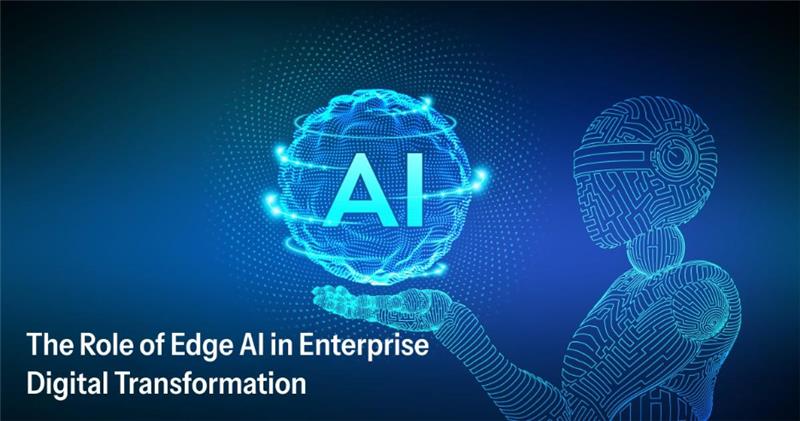
Companies now create large amounts of data in a second, but the majority can hardly translate it into usable information within seconds. Centralized systems will bring about latency, bandwidth, and low visibility of distributed operations. Such delays influence efficiency, safety, and continuity of service. The solution to this is to bring intelligence nearer to data production as well as decision implementation. This strategy is the basis of Edge AI in enterprises.
In this blog, we shall examine how Edge AI transforms enterprise decision-making, supercharges the digital revolution, and enhances operational resiliency. We will also discuss real-life applications and quantifiable results, explore barriers to operation with practical solutions, and highlight the role of edge computing architecture in driving measurable business outcomes.
Understanding Edge AI in the Enterprise Landscape
Edge AI is defined as applying artificial intelligence models close to their sources of data, such as sensors, cameras, and industrial equipment. This is opposed to applying AI models on central computers.
It helps to minimize latency and optimize bandwidth and allows for instant decision-making. A robust edge computing architecture offers a structure to handle IoT devices and optimize enterprise IT policy for reliability of operations.
Did You Know?
97% of enterprise CIOs have Edge AI on their technology roadmap, highlighting the widespread strategic focus on local AI processing. Deploying AI at the edge enables organizations to gain faster insights, reduce downtime, and make real-time operational decisions.
Drive Digital Innovation & Transform Your Business
Struggling to find tailored IT solutions that truly accelerate your digital transformation journey? Partner with LedgeSure to unlock the true potential of technology.
Why Centralized AI Models Fall Short
Traditional AI relies heavily on centralized cloud infrastructure. While effective for batch analytics, it introduces delays in scenarios requiring rapid action. High data volumes, remote locations, and intermittent connectivity further exacerbate the problem.
AI at the edge processes data locally, enabling immediate decision-making and operational continuity. This decentralized approach ensures critical decisions are executed where and when they matter most.
How Edge AI Enables Real-Time Enterprise Decisions
Edge AI empowers organizations to act on data instantly at the point of creation. Real-time data processing allows for rapid anomaly detection, automated responses, and operational optimization.
Industries such as manufacturing, energy, logistics, and healthcare benefit significantly. By processing information locally, enterprises reduce downtime, improve accuracy, and transition from reactive management to proactive operational strategies.
Enterprise Use Cases Where Edge AI Delivers Impact
Edge AI provides measurable value by addressing real operational problems rather than just experimenting with technology. Many enterprises across industries have already realized significant improvements by implementing Edge AI in enterprises. The table below highlights some key enterprise use cases and their measurable outcomes:
| Industry | Use Case | Outcome |
| Manufacturing | Predictive maintenance | Reduced downtime by up to 25% |
| Retail | Inventory management | Improved stock accuracy by 90% |
| Healthcare | Patient monitoring | Faster response times |
| Logistics | Fleet optimization | Lower delivery delays |
| Energy | Load balancing | Reduced energy waste by 15-20% |
These examples show how operational decision-making improves directly at the source. Implementing Edge AI technology for your enterprise ensures insights are actionable, timely, and scalable across multiple locations.
Industry Adoption Trends and Measurable Outcomes
Edge AI is gaining popularity as a result of the need for businesses to function effectively and make effective decisions. The following are some of the pros of edge AI technology:
- Faster Response Time: Organizations which implement the help of Edge AI claim they respond faster, which results in fewer delays in critical activities.
- Operational Risk: Edge AI not only monitors systems but does so within close proximity to the point of operation, ensuring less unexpected downtime.
- Cost Efficiency: Using edge AI with cloud support reduces the costs involved in transporting the data and makes it more reliable compared to using cloud alone.
- Better Scalability: Companies can expand their business with confidence without sacrificing control and performance.
The advantages listed above clearly indicate that Edge AI is not only a technological advancement but also a smart mechanism for achieving greater performance, reducing risks, and making swift decisions.
Did You Know?
A recent survey shows that 97% of enterprise CIOs include Edge AI on their technology roadmap, and 90% of organizations are increasing budgets for Edge AI solutions, highlighting its growing role in enterprise digital transformation.
Edge AI Challenges: Risks and Solutions for Enterprises
Despite clear benefits, edge AI in enterprise digital transformation introduces operational complexities. Enterprises face challenges in managing devices, integrating systems, maintaining model accuracy, and ensuring security. The table below highlights the main challenges, and actionable solutions organizations can implement to overcome them:
| Challenge | Solution |
| Device management | Centralized monitoring and automated updates |
| Model consistency | Regular retraining and edge optimizations |
| Legacy system integration | Use modular connectors and APIs |
| Endpoint security | Encrypt data and enforce compliance |
| Scaling complexity | Standardized architecture and phased rollout |
By pairing each challenge with practical AI solutions, enterprises can maximize Edge AI benefits while reducing risks.
Overcoming Deployment and Integration Complexity
Successful Edge AI deployment requires alignment with enterprise workflows. Modular deployments make it easier to integrate and support incremental rollouts.
Organizations can introduce local intelligence using AI at the edge without causing any disturbance to existing systems. This, in turn, guarantees operational continuity while enabling scalable digital transformation initiatives.
Data Governance and Security at the Edge
Local processing of data mitigates risks, and their systems are less prone to vulnerabilities. Enterprises would be able to better preserve data and continue its operations by storing sensitive data nearby. Edge AI in enterprises is also beneficial in addressing privacy regulations, regulatory policies, and data ownership.
An effective edge computing architecture has encryption, device authentication, and clear policy controls. This makes deployments easy, reliable, and monitored. In the right governance, enterprises can comfortably scale Edge AI projects, as well as make real time decisions by adhering to regulations.
Empower Your Workforce with AI & Automated Innovations
Want to boost efficiency and reduce costs? Explore how LedgeSure’s AI-driven solutions simplify workflows and drive real outcomes.
Measuring Business Value from Edge AI
The advantages of Edge AI are efficiency, cost savings, and faster reaction time. Businesses using real-time data processing report better resource management, fewer instances of things going wrong, and more getting done.
Edge AI is able to convert basic data into meaningful information that improves business decisions.
Strategic Considerations for Enterprise Leaders
Enterprises planning Edge AI adoption should focus on:
- Evaluate Infrastructure Readiness: Assess IT and OT systems to ensure they can support edge deployments.
- Define Operational Priorities: Identify processes where edge AI technology for your enterprise provides measurable value.
- Plan for Data Governance: Establish policies for security, privacy, and compliance across distributed operations.
- Ensure Scalability: Design edge computing architecture that grows with enterprise needs.
- Align With Enterprise Strategy: Integrate Edge AI initiatives with broader digital transformation objectives.
These points help leaders make informed decisions, reduce risk, and position Edge AI as a sustainable competitive advantage.
Ledgesure: Driving Enterprise-Grade Edge AI
Ledgesure integrates scalability architecture and effective deployment models to suit complex enterprise setups. The technology is able to support high-performance, secure, and reliable operation.
Ledgesure achieves these factors by empowering the edge in making decisions. Through edge AI in business or edge AI in the enterprises, scalability and efficiency are improved.
Transforming Enterprise Operations with Edge AI
Edge AI is important for today’s businesses. It helps make operations faster, stronger, and better at making decisions. With edge AI, companies can get real-time information, lower risks, and grow their systems easily.
Businesses should check if they are ready, find key areas to improve, and make sure their plans match their digital upgrade goals. Ledgesure offers strong and secure Edge AI solutions that can easily grow with your needs. Schedule a demo with Ledgesure to see how it can help you.
Frequently Asked Questions (FAQs)
Q: Which businesses benefit the most from Edge AI?
A: Businesses with many locations or large amounts of data can get quick insights and make faster decisions with Edge AI.
Q: How is Edge AI different from cloud-based AI?
A: Edge AI processes data on-site, which means it works faster and uses less internet, while cloud AI uses central servers.
Q: Why is Edge AI important for digital change?
A: Edge AI helps businesses automate tasks faster, work more efficiently, and make quick decisions.
Q: What infrastructure is required for Edge AI deployment?
A: Deployments need a strong edge computing setup with safe devices and connection to current systems.
Q: How long does it take to see benefits from Edge AI?
A: Operational improvements such as efficiency and faster decisions can appear within months of deployment.