Introduction:
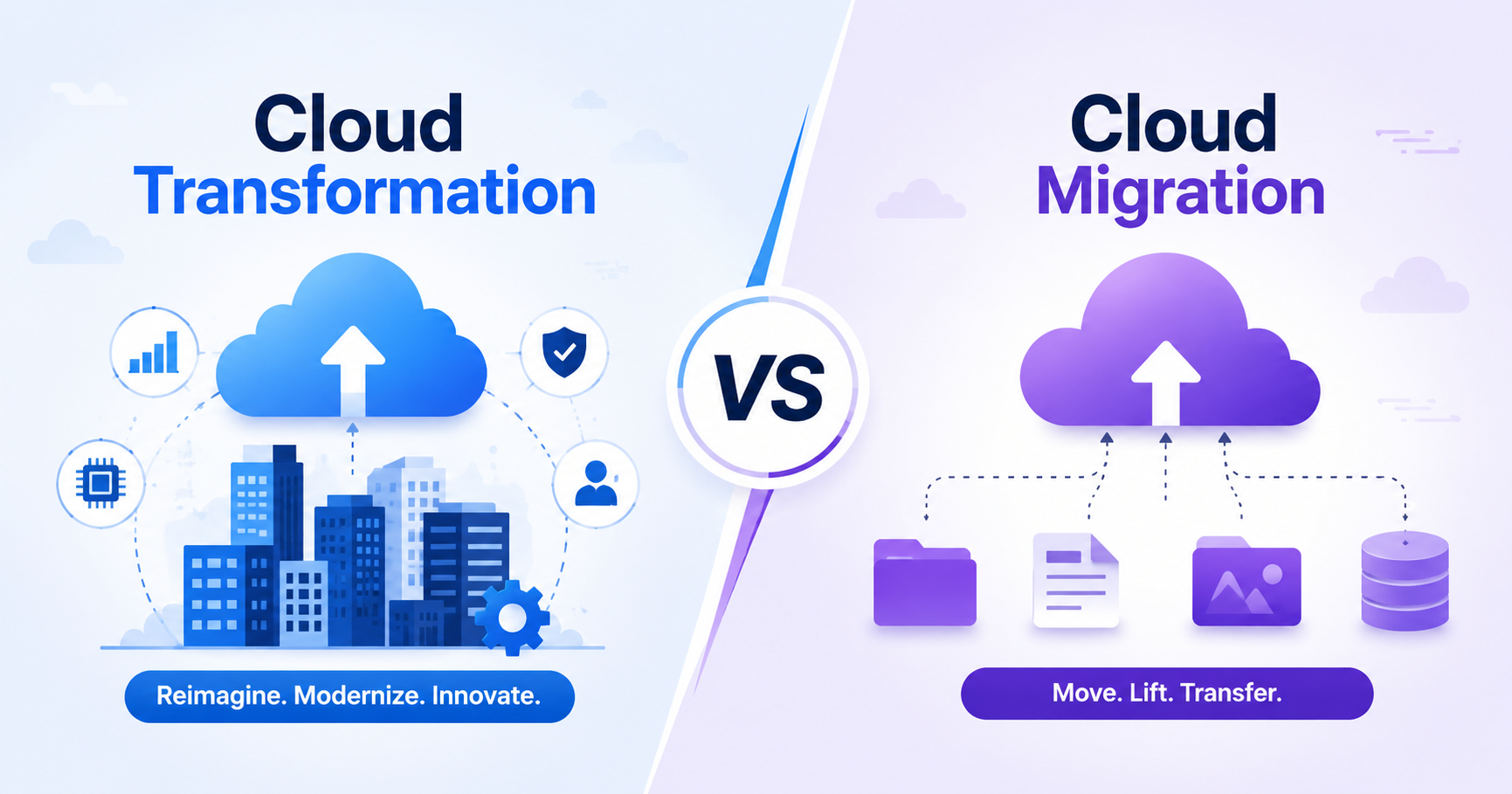
To compare Cloud Transformation vs Cloud Migration, enterprises must align cloud strategy with business outcomes. Cloud migration enables fast movement of existing applications to the cloud, while cloud transformation modernises systems, processes & operating models to support long‑term scalability, innovation & digital competitiveness.
As enterprises modernise their IT ecosystems, the debate around Cloud Transformation vs Cloud Migration has become more relevant than ever. While both approaches aim to move organisations closer to the cloud, they serve very different business objectives and deliver vastly different outcomes.
Cloud migration focuses on relocating existing workloads, whereas cloud transformation redefines how applications, data & processes operate in a cloud‑native world. This distinction directly impacts scalability, innovation, cost efficiency & long-term competitiveness.
Organisations looking to go beyond basic infrastructure changes increasingly rely on expert led cloud transformation services to unlock real business value. At Ledgesure, our Cloud Transformation Services are designed to help enterprises modernise strategically, not just migrate workloads.
Key Highlights:
- Cloud migration moves existing systems to the cloud with minimal changes
- Cloud transformation modernises applications, processes & operating models
- Migration is tactical; transformation is strategic
- Each approach comes with unique challenges and solutions
- Most enterprises need both, executed in the right sequence
Drive Digital Innovation & Transform Your Business
Struggling to find tailored IT solutions that truly accelerate your digital transformation journey? Partner with LedgeSure to unlock the true potential of technology.
What Is Cloud Migration and Why Do Enterprises Still Choose It?
To move existing applications, data & workloads from on‑premises environments to the cloud, enterprises rely on cloud migration. This approach prioritises speed and continuity, making it attractive for organisations seeking rapid infrastructure modernisation without major architectural changes.
Cloud migration is often the first step in a broader cloud journey and is commonly delivered through structured cloud migration services.
Common Cloud Migration Approaches
- Lift and shift – Moving applications as it is to the cloud
- Re‑platforming – Minor optimisations without redesign
- Re‑hosting with security enhancements
Enterprises typically choose migration to reduce data‑centre costs, improve disaster recovery, or meet compliance requirements quickly. However, these benefits come with notable cloud migration challenges if not planned carefully.
What Is Cloud Transformation and How Is It Fundamentally Different?
To build a future‑ready digital enterprise, organisations need cloud transformation, not just migration. Cloud transformation re‑architects applications, workflows & operating models to fully leverage cloud‑native capabilities such as microservices, DevOps, automation & AI‑driven analytics.
Unlike migration, transformation aligns technology with long‑term business strategy. This is why advanced cloud transformation services focus equally on people, processes & platforms.
| 💡 Did You Know? “Organisations that adopt cloud‑native architectures see up to 30–40% improvement in application deployment speed compared to traditional architectures.” |
| Source: https://www.mckinsey.com/capabilities/mckinsey-digital/our-insights |
Cloud Transformation vs Cloud Migration: What Are the Key Differences?
To choose the right approach, enterprises must understand how Cloud Transformation vs Cloud Migration differs across business and technical dimensions.
| Criteria | Cloud Migration | Cloud Transformation |
| Primary Objective | Move workloads | Enable digital innovation |
| Application Changes | Minimal | Extensive modernisation |
| Time Horizon | Short‑term | Long‑term |
| Cost Focus | Infrastructure savings | Business value & optimisation |
| Complexity | Lower initially | Higher but strategic |
| Business Impact | Operational continuity | Competitive advantage |
This comparison highlights why migration alone rarely delivers sustained ROI.
What Are the Most Common Cloud Migration Challenges Enterprises Face?
To migrate successfully, enterprises must overcome multiple cloud migration challenges that often emerge during execution rather than planning.
Legacy Application Compatibility
Many legacy systems were not designed for distributed cloud environments. Without refactoring, performance bottlenecks and latency issues arise. One of the most common cloud migration problems.
Security and Compliance Risks
Moving sensitive workloads without proper identity management, encryption & governance introduces compliance gaps, especially in regulated industries.
Cost Overruns After Migration
Unexpected cloud spend is a frequent issue when workloads are not optimised post‑migration.
| “62% of organisations report higher cloud costs than expected after migration due to poor workload optimisation.” |
| Source: https://aws.amazon.com/aws-cost-management/ |
What Cloud Migration Problems Should Enterprises Plan for Early?
To avoid disruption, enterprises must anticipate recurring cloud migration problems that surface during execution.
- Downtime during data and application transfer
- Skill gaps in cloud operations
- Inconsistent performance across environments
- Limited visibility into cloud resource usage
Addressing these issues early ensures migration delivers its intended benefits rather than becoming a costly IT exercise.
Empower Your Workforce with AI & Automated Innovations
Want to boost efficiency and reduce costs? Explore how LedgeSure’s AI-driven solutions simplify workflows and drive real outcomes.
What Are the Most Effective Cloud Migration Solutions?
To reduce risk and improve outcomes, enterprises must adopt structured cloud migration solutions aligned with business priorities.
Proven Cloud Migration Solutions Include –
- Cloud readiness and dependency assessments
- Phased migration roadmaps
- Security‑first architecture design
- Post‑migration performance optimisation
- Managed cloud migration services for governance and control
These solutions ensure stability while laying the foundation for future transformation.
What Are the Biggest Cloud Transformation Challenges for Enterprises?
To modernise at scale, organisations face unique cloud transformation challenges that extend beyond infrastructure.
Cultural and Skill Barriers
Cloud transformation requires DevOps practices, automation & continuous delivery. Many enterprises struggle with skill gaps and resistance to change.
Process and Operating Model Redesign
Legacy processes slow innovation unless redesigned for agility and scalability.
Complex System Integration
Cloud‑native platforms must integrate seamlessly with existing ERP, CRM & data systems which is often a major challenge.
For a deeper understanding, explore our guide on Cloud Transformation Solutions.
How Can Enterprises Overcome Cloud Transformation Challenges?
To overcome cloud transformation challenges, enterprises must adopt an outcome driven approach rather than a purely technical one.
Effective Cloud Transformation Solutions –
- Application refactoring and modernisation
- Cloud‑native DevOps pipelines
- Automation and infrastructure‑as‑code
- Continuous optimisation frameworks
- Expert led cloud transformation services
This approach ensures transformation delivers agility, innovation & long-term value.
How Do Hybrid and Multi‑Cloud Strategies Fit into Cloud Transformation?
To balance flexibility and risk, many enterprises adopt hybrid or multi‑cloud strategies as part of their cloud journey.
Hybrid models integrate on-premises and cloud environments, while multi‑cloud strategies distribute workloads across providers. Understanding these models is essential when evaluating Cloud Transformation vs Cloud Migration decisions.
Read our detailed comparison –
Hybrid Cloud vs Multi‑Cloud: Key Differences Explained
When Should You Choose Cloud Migration vs Cloud Transformation?
To choose the right path, enterprises must align cloud strategy with business maturity and goals.
Choose Cloud Migration When –
- Speed is the priority
- Legacy systems must remain unchanged
- Immediate cost reduction is required
Choose Cloud Transformation When –
- Innovation and agility are strategic goals
- Applications need modernisation
- Long-term scalability matters
Most successful organisations adopt a phased approach. Starting with migration and evolving into transformation.
Conclusion: Align Cloud Strategy with Business Outcomes
Choosing between Cloud Transformation vs Cloud Migration is not about technology alone; it’s about business outcomes.
By addressing cloud migration challenges, resolving cloud migration problems & adopting proven cloud migration solutions, enterprises can modernise their infrastructure. However, sustainable growth depends on overcoming cloud transformation challenges through modern architectures, processes & operating models.
Connect with Ledgesure’s cloud specialists to assess your cloud readiness and identify whether migration, transformation, or a hybrid strategy will deliver the most value for your business.