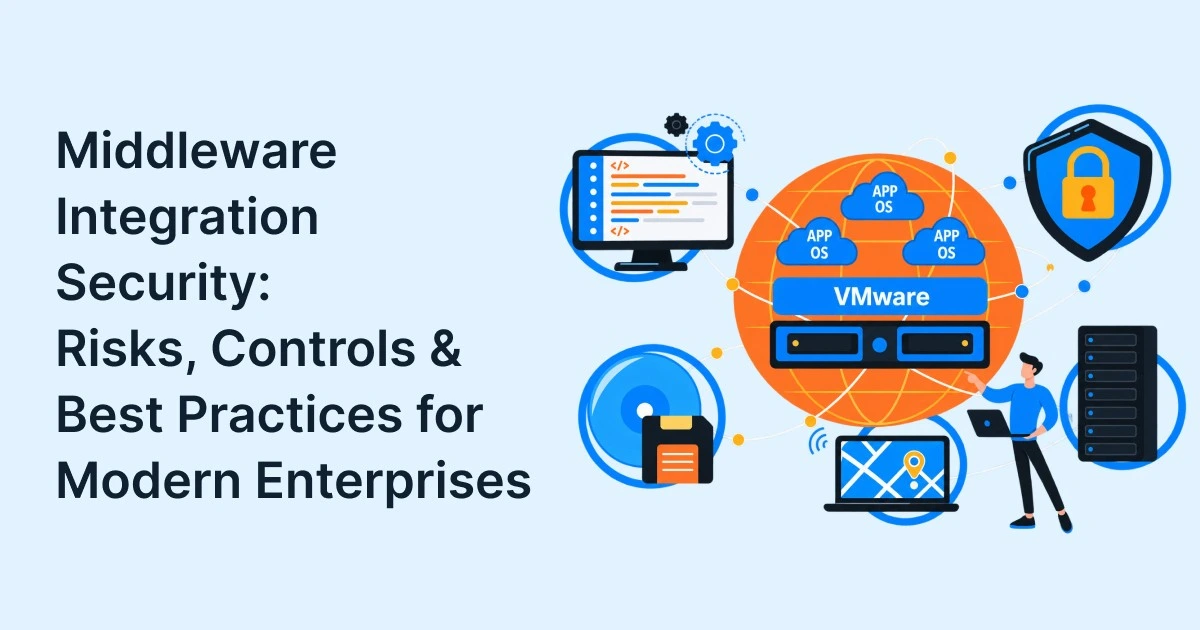
Enterprise systems are more connected than ever. Applications, cloud platforms, APIs, data warehouses, AI tools, ERPs, CRMs, and partner ecosystems continuously exchange information through middleware. While these integrations drive efficiency, they also create new security risks that many organizations overlook until a breach, outage, or compliance issue occurs.
Middleware integration security protects the systems, APIs, users, machine identities, and data flows that enable modern business applications to work together. Strong integration security combines identity controls, API protection, encryption, monitoring, governance, and Zero Trust principles to reduce risk across connected environments.
As organizations invest in integration solutions and middleware integration services, security must become a core design principle rather than an afterthought.
Organizations planning secure enterprise integration initiatives can benefit from LedgeSure’s Integration Engineering Services, which help businesses design, modernize, and secure complex integration environments.
Summary
- Middleware security protects the connections between enterprise systems.
- Integration security now extends beyond applications to APIs, machine identities, AI tools, and cloud services.
- Common risks include unauthorized access, API vulnerabilities, data leakage, misconfiguration, and third-party exposures.
- Zero Trust, API governance, and machine identity security are becoming critical security requirements.
- AI-powered integrations introduce entirely new attack surfaces.
- Organizations need both technical controls and governance frameworks to secure enterprise integrations.
What Is Middleware Integration Security?
Middleware integration security is the practice of securing data flows, integrations, APIs, middleware platforms, connectors, and system-to-system communications across enterprise environments.
Middleware acts as the operational layer for connecting applications that would otherwise function independently. Every integration point creates a potential pathway between systems, making middleware a strategic security concern.
Without proper middleware security controls, organizations can face:
- Unauthorized system access
- Sensitive data exposure
- API abuse
- Compliance violations
- Lateral movement by attackers
- Business disruption
For readers looking to understand the foundations of middleware, our guide explaining how middleware integration works across enterprise architectures provides additional context before exploring security considerations.

Why Has Middleware Security Become a Business Priority?
Middleware security has become a business priority because organizations rely on more connected systems, APIs, cloud services, and external partners than ever before.
A modern enterprise ecosystem may include:
- Microsoft Dynamics
- Salesforce
- SAP
- ServiceNow
- Workday
- Azure services
- AWS services
- AI-powered platforms
- Partner APIs
Each integration expands the attack surface.
An attacker no longer needs direct access to a core application. Compromising a poorly secured connector, service account, API, or integration workflow may provide access to multiple systems simultaneously.
Security should also be evaluated as part of overall integration planning. Organizations often focus on development and deployment budgets while underestimating long-term security requirements. Factoring security into middleware investment planning and cost considerations helps reduce future remediation costs and lowers operational risk.
What Are the Biggest Middleware Integration Security Risks?
The most significant middleware integration security risks involve identity compromise, API vulnerabilities, data leakage, configuration errors, third-party exposure, and governance gaps.
Unauthorized Access and Credential Abuse
Service accounts, OAuth tokens, API keys, and privileged integrations often hold extensive permissions.
Common weaknesses include:
- Shared credentials
- Excessive permissions
- Stale accounts
- Missing MFA controls
- Weak secret management
Attackers frequently target these accounts because they are less visible than end-user identities.
API Security Vulnerabilities
Modern integrations depend heavily on APIs.
Poor API security can expose:
- Customer data
- Transaction records
- Business processes
- Administrative functions
According to the OWASP API Security Top 10, common API risks include broken authorization, excessive data exposure, and security misconfigurations.
Organizations comparing integration approaches should also understand the relationship between middleware and APIs. Our article discussing middleware versus API integration strategies explores these differences in greater detail.
Data Leakage Across Connected Systems
Many organizations encrypt databases but overlook integration channels.
Data may pass through:
- Middleware platforms
- Message queues
- API gateways
- Cloud connectors
- Workflow orchestration tools
Without proper control, sensitive information may be exposed during transmission or processing.
Third-Party and Supply Chain Risks
Enterprise integration increasingly depends on external services.
Examples include:
- SaaS applications
- Vendor APIs
- Managed services
- AI platforms
- Data providers
A security gap in any connected third-party environment can introduce risk into the entire integration ecosystem.
Many of these risks emerge because organizations struggle with visibility, governance, and integration complexity as environments grow. In fact, several of the common integration challenges enterprises face often have direct security implications, particularly when multiple applications, cloud platforms, and third-party systems must communicate securely.
What Is API Sprawl and Why Is It Becoming a Security Risk?
API sprawl occurs when organizations accumulate hundreds or thousands of APIs without maintaining consistent visibility, governance, or security controls.
As digital transformation initiatives accelerate, organizations frequently deploy APIs faster than they can govern them.
API sprawl creates:
- Unknown attack surfaces
- Shadow APIs
- Inconsistent security policies
- Poor visibility
- Compliance challenges
Many security teams only discover forgotten APIs after they become vulnerabilities.
Strong API security programs should include:
- API inventory management
- API discovery tools
- API gateways
- Continuous monitoring
- Lifecycle governance
Why Is Machine Identity Security Becoming Critical?
Machine identities are rapidly becoming one of the most targeted attack surfaces in enterprise environments because integrations depend heavily on non-human credentials.
Examples include:
- Service accounts
- OAuth tokens
- Certificates
- API keys
- Client secrets
Unlike employees, machine identities often operate continuously across multiple systems.
A compromised machine identity can grant broad access while avoiding traditional user-focused security controls.
Organizations should:
- Rotate secrets regularly
- Limit permissions
- Monitor usage patterns
- Implement centralized secrets management
- Audit machine credentials frequently
How Does API Security Support Middleware Security?
API security strengthens middleware integration security by protecting the communication layer that powers modern integrations.
Although related, the two disciplines address different security concerns.
| Middleware Security | API Security |
| Protects the integration ecosystem | Protects API endpoints |
| Focuses on workflows and system connectivity | Focuses on requests and responses |
| Includes governance and orchestration | Includes authentication and authorization |
| Covers application-to-application interactions | Covers API traffic protection |
Organizations should treat API security as a foundational component of broader integration security strategies.
Which Security Controls Should Every Integration Platform Implement?
Organizations can significantly reduce integration risks by combining identity protection, encryption, monitoring, governance, and continuous validation controls.
Security controls are most effective when they are incorporated from the beginning rather than added after deployment. Organizations planning new integration programs should build security requirements directly into their implementation roadmap for enterprise integrations to avoid costly remediation and compliance challenges later.
Essential controls include:
Identity and Access Management
- Role-based access control
- Least-privilege access
- MFA
- Privileged access management
Encryption
- TLS encryption
- Data-at-rest encryption
- Secure key management
Monitoring and Observability
- Centralized logging
- SIEM integration
- Threat detection
- Behavioral analytics
Security Testing
- Penetration testing
- Vulnerability assessments
- API testing
- Configuration reviews
Secrets Management
Tools such as Azure Key Vault, HashiCorp Vault, and AWS Secrets Manager help protect credentials used within integrations.
How Does Zero Trust Improve Middleware Integration Security?
Zero Trust improves middleware integration security by continuously verifying users, devices, systems, workloads, and APIs instead of assuming trust based on network location.
The core principles include:
- Verify Explicitly
Authenticate and authorize every request.
- Use Least Privilege
Provide only the minimum access required.
- Assume Breach
Design controls assuming an attacker may already be present.
- Enable Continuous Monitoring
Continuously evaluate activities across APIs, integrations, and workloads.
Zero Trust architectures are increasingly recommended within cloud-first and hybrid integration environments.
Which Compliance Standards Apply to Middleware Security?
Middleware integration security often supports broader regulatory and compliance requirements that govern sensitive data and business processes.
Common frameworks include:
| Standard | Why It Matters |
| ISO 27001 | Information security management |
| SOC 2 | Security and operational controls |
| GDPR | Protection of EU personal data |
| HIPAA | Healthcare information security |
| PCI DSS | Payment card protection |
| NIST Cybersecurity Framework | Security governance and risk management |
Integration security programs should align with applicable regulatory obligations and internal governance requirements.
How Is AI Changing Middleware Integration Security?
AI-powered integrations create new security challenges because they connect models, data sources, workflows, and business applications in ways traditional security architectures were not designed to handle.
New risks include:
Prompt Injection
Attackers manipulate AI inputs to influence outputs or workflows.
Excessive AI Privileges
AI agents often require access across multiple applications.
Sensitive Data Exposure
Integrated AI systems may access confidential information.
AI Connector Risks
Many organizations deploy AI tools without fully understanding how third-party providers store, process, or use data.
Emerging Governance Challenges
Organizations need policies governing:
- AI access permissions
- Data retention
- Model security
- AI workflow monitoring
This area remains largely underserved by existing middleware security content, creating a significant opportunity for enterprises to strengthen future-ready security programs.
The LedgeSure SAFE Framework for Middleware Security
Many organizations implement security controls individually. The challenge is creating a consistent framework that scales across growing integration environments.
- S — Secure Identities
Protect human and machine identities.
- A — Audit Integrations
Maintain visibility into every connection, API, and workflow.
- F — Fortify APIs
Implement authentication, monitoring, rate limiting, and threat detection.
- E — Enforce Governance
Establish policies covering onboarding, monitoring, compliance, and retirement of integrations.
The LedgeSure Integration Security Maturity Model
Organizations can evaluate their security posture across five maturity stages:
| Level | Focus |
| Level 1 | Integration Visibility |
| Level 2 | Access Control |
| Level 3 | API Governance |
| Level 4 | Zero Trust Integration Security |
| Level 5 | Continuous Security Intelligence |
The goal is not simply implementing more controls but developing a security model that scales alongside business growth.
How Can Genova IQ Support Secure Enterprise Operations?
Security depends on visibility. As integrations grow, organizations need better intelligence into interconnected business environments, operational dependencies, and data flows.
Genova IQ helps organizations improve visibility across data ecosystems, enabling more informed operational decisions and stronger governance across connected environments.

Conclusion
Modern integration environments have become a primary part of the enterprise attack surface. Organizations that focus only on application security while ignoring the integration layer leave significant risk unaddressed.
Effective middleware integration security requires a combination of API security, machine identity protection, Zero Trust principles, governance, compliance alignment, and continuous monitoring. As AI-powered integrations become more common, the need for a structured and scalable security strategy will only grow.
Whether you’re evaluating integration solutions, modernizing legacy infrastructure, or scaling middleware integration services, security should be embedded throughout the integration lifecycle.
Ready to strengthen your enterprise integration strategy? Contact the LedgeSure team.
Frequently Asked Questions
Q: What is middleware integration security?
A: Middleware integration security is the practice of protecting applications, APIs, workflows, users, machine identities, and data that move through integration platforms. It combines identity management, API security, encryption, monitoring, governance, and compliance controls to reduce risk across connected enterprise systems.
Q: Why is middleware security important?
A: Middleware security is important because middleware acts as the communication layer between business-critical systems. If attackers compromise the integration layer, they may gain access to multiple connected applications, data sources, and workflows, increasing the potential impact of a security incident.
Q: How does API security relate to integration security?
A: API security protects the interfaces that applications use to exchange data, while integration security covers the broader ecosystem of connected systems, middleware platforms, workflows, governance policies, and operational controls. API security is a critical part of an overall integration security strategy.
Q: What are the most common middleware security risks?
A: Common risks include credential theft, unauthorized access, API vulnerabilities, excessive permissions, machine identity compromise, third-party exposure, data leakage, and configuration errors. Organizations should address each through layered security controls and governance frameworks.
Q: What is an API sprawl?
A: API sprawl occurs when organizations deploy large numbers of APIs without maintaining proper visibility, inventory management, governance, or security oversight. This can create hidden vulnerabilities and increase the overall attack surface.
Q: How can organizations secure AI-powered integrations?
A: Organizations should apply Zero Trust principles, control permissions carefully, monitor AI workflows, secure AI connectors, establish governance policies, and review data access regularly to reduce security risks associated with AI-powered integrations.
Q: What compliance standards affect middleware security?
A: Common standards include ISO 27001, GDPR, HIPAA, SOC 2, PCI DSS, and the NIST Cybersecurity Framework. The relevant requirements depend on the industry, geography, and types of data being processed.
Q: How often should integration security be reviewed?
A: Integration security should be monitored continuously, with formal assessments conducted at least annually and whenever significant changes are made to architecture, APIs, cloud environments, or business-critical integrations.