Summary
Enterprises today operate across disconnected systems ERP, CRM, procurement, finance, HR, and compliance platforms. While each system performs well individually, process gaps between them create delays, data silos, compliance risks, and poor visibility.
This is where bpm software becomes critical. It does not replace core systems. It orchestrates them.
A structured integration approach enables enterprises to standardize workflows, enforce governance, and gain end-to-end process visibility without disrupting existing infrastructure. This guide explains how to integrate BPM strategically from architecture planning to measurable impact.
What Is BPM Software?
Business Process Management software is a technology framework that models, automates, monitors, and optimizes enterprise workflows.
It acts as a coordination layer between systems and teams.
Instead of relying on emails, spreadsheets, or manual follow-ups, BPM:
- Defines standardized workflows
- Automates routing and approvals
- Enforces policy controls
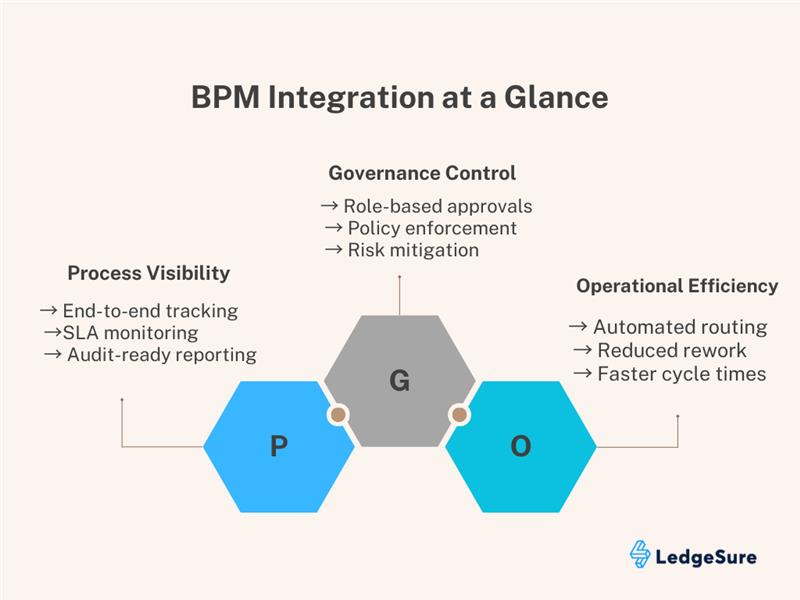
- Tracks process performance in real time
For large enterprises, this means fewer process breakdowns and stronger governance.
Drive Digital Innovation & Transform Your Business
Struggling to find tailored IT solutions that truly accelerate your digital transformation journey? Partner with LedgeSure to unlock the true potential of technology.
What Is Enterprise System Integration?
Enterprise integration connects multiple business applications so data flows seamlessly between them.
Common integrations include:
- ERP ↔ Procurement
- CRM ↔ Finance
- HR ↔ Compliance
- ITSM ↔ Operations
Without orchestration, integration alone can create complexity. BPM adds structured workflow logic on top of system connectivity.
BPM Software vs Traditional Integration: Core Differences
Many enterprises mistake integration middleware for process management. They are related but not the same.
| Metric | BPM Software | Traditional Integration |
| Time Horizon | Continuous process optimization | Data transfer enablement |
| Focus | Workflow orchestration | System connectivity |
| Risk Level | Reduces operational risk | Can increase complexity if unmanaged |
| Financial Impact | Improves cycle time & cost control | Reduces manual data handling |
| Governance | Built-in approval & compliance logic | Limited governance enforcement |
Integration moves data. BPM manages the business process. Enterprises need both but they serve different purposes.
Financial Impact of BPM Integration
Financial leaders often underestimate how much fragmented processes cost at scale.
When BPM integration is executed correctly:
- Cycle times across departments reduce
- Approval bottlenecks are eliminated
- Contract and compliance leakage declines
- Manual rework and exception handling decrease
Improved workflow governance directly supports enterprise cost optimization initiatives by standardizing controls across procurement, finance, operations, and compliance functions.
The ROI typically appears in three areas:
- Reduced operational overhead
- Faster working capital movement
- Lower compliance and audit risk exposure
Operational Impact
Operationally, BPM integration provides clarity across departments.
Instead of siloed dashboards:
- Managers see real-time workflow status
- Escalations trigger automatically
- SLAs are monitored systematically
- Audit trails are recorded centrally
For example, in environments that rely on ticket management systems, BPM adds structured routing logic and policy-based approvals that improve service efficiency.
The result is operational discipline without increasing headcount.
When to Use BPM vs Basic Integration
Not every integration problem requires full workflow orchestration.
Use traditional integration when:
- You only need data synchronization
- There is no approval logic required
- Process complexity is minimal
Use BPM software when:
- Multiple approvals are involved
- Compliance checkpoints must be enforced
- Cross-functional collaboration is required
- Process metrics must be tracked
Enterprises scaling rapidly benefit more from BPM because complexity grows faster than team size.
How Technology Enables BPM Integration
Modern BPM platforms integrate through:
- REST APIs
- Webhooks
- Enterprise Service Bus (ESB)
- Prebuilt connectors
- Low-code workflow builders
Cloud-native architectures make integration lighter and more scalable. This aligns with broader cloud transformation strategies, where modular systems are preferred over monolithic stacks.
Advanced BPM platforms now include:
- AI-driven process optimization
- Predictive bottleneck detection
- Automated compliance validation
- Real-time performance dashboards
The focus is no longer automation alone it is intelligent orchestration.
Empower Your Workforce with AI & Automated Innovations
Want to boost efficiency and reduce costs? Explore how LedgeSure’s AI-driven solutions simplify workflows and drive real outcomes.
A 3-Point Enterprise Integration Framework
To integrate BPM successfully, enterprises should follow a structured model:
1. Process Standardization First
Map and simplify workflows before automation. Avoid digitizing inefficiency.
2. API-Led Architecture
Ensure systems communicate via scalable APIs to avoid rigid dependencies.
3. Governance by Design
Embed approval hierarchies, audit logs, and compliance controls at workflow level.
This framework prevents technology sprawl and ensures long-term scalability.
This structured approach turns process management into a measurable enterprise capability.
Implementation Roadmap
Successful integration requires phased execution.
Phase 1: Assessment
Identify high-impact processes (procurement, finance approvals, contract lifecycle).
Phase 2: Design
Define workflows, SLAs, escalation logic, and compliance checkpoints.
Phase 3: System Mapping
Map ERP, CRM, HR, and finance touchpoints.
Phase 4: Pilot Deployment
Start with one department before enterprise-wide rollout.
Phase 5: Performance Optimization
Use analytics to refine process timing and identify bottlenecks.
Enterprises that attempt full-scale deployment without phased governance often face adoption resistance.
Common Integration Challenges
Even advanced organizations face barriers:
- Legacy systems lacking APIs
- Change resistance among teams
- Poorly documented processes
- Data quality inconsistencies
These challenges are solvable with structured planning and executive sponsorship.
Technology alone does not fix process chaos. Structured governance does.
Future Outlook
The next evolution of BPM integration will focus on:
- Hyperautomation
- AI-assisted decision routing
- Autonomous compliance validation
- Real-time risk scoring
Enterprises will shift from reactive workflow tracking to predictive process management.
Integration will no longer be about connectivity, it will be about intelligence.
Organizations investing today in scalable BPM architectures position themselves for adaptive, resilient operations.
Conclusion
Enterprise complexity will continue to grow as organizations expand systems, teams, and compliance requirements.
BPM integration is not simply about automation. It is about structured orchestration, aligning systems, enforcing governance, and delivering measurable operational clarity across departments.
Enterprises that treat process management as an architectural priority, not a tactical tool, build scalable, transparent, and resilient operating models.
The future of enterprise performance lies in connected systems governed by intelligent workflows.
FAQs
Q: What is bpm software used for in enterprises?
A: It is used to automate, monitor, and optimize structured business workflows across departments.
Q: How does bpm software differ from ERP systems?
A: ERP manages core business data and transactions. BPM orchestrates workflows across ERP and other systems.
Q: Can bpm software integrate with legacy systems?
A: Yes, through APIs, middleware connectors, or integration layers, though modernization improves performance.
Q: Is bpm software only for large enterprises?
A: While highly beneficial for enterprises, mid-sized organizations also use it for governance and scalability.
Q: How long does BPM integration take?
A: Depending on complexity, pilot deployment can take 6–12 weeks, with phased enterprise rollout thereafter.
Q: Does bpm software improve compliance?
A: Yes. It enforces structured approvals, audit trails, and policy checkpoints within workflows.