Summary
This guide unpacks the essential components of modern cloud transformation solutions, shifting the conversation from simple migrations to comprehensive operational overhauls. We examine how IT leaders can orchestrate complex legacy systems into scalable, cloud-native architectures that genuinely drive business value. By breaking down strategic frameworks, hybrid models, and real-world deployment challenges, this post provides an actionable blueprint for enterprise leaders. Readers will walk away with a clear understanding of how to align technology investments with long-term agility and measurable ROI.
Maintaining legacy IT infrastructure is like trying to upgrade a city’s power grid while keeping the lights on. The technical debt slows down deployment cycles, hardware maintenance eats up the IT budget, and integration bottlenecks stall critical data initiatives. For technology leaders, shifting workloads off-premises is no longer the endgame; the real mandate is rebuilding the operational foundation to support immediate scale and advanced AI capabilities.
You need more than a lift-and-shift migration. True cloud transformation solutions address the entire lifecycle of your IT environment, from application refactoring and data governance to continuous cost optimization. This guide deconstructs the enterprise approach, exploring the frameworks, service models, and strategic decisions that separate successful deployments from stalled projects.
Drive Digital Innovation & Transform Your Business
Struggling to find tailored IT solutions that truly accelerate your digital transformation journey? Partner with LedgeSure to unlock the true potential of technology.
Decoding the Cloud Transformation Solutions Framework
A structured cloud transformation solutions framework is the difference between a controlled evolution and an architectural chaotic sprawl. It provides a methodical path to evaluate, migrate, and run workloads without disrupting business continuity.
Phase 1: Assessment and Architecture Strategy
Before moving a single byte, enterprise IT teams must audit their existing environment. This involves mapping application dependencies, evaluating security protocols, and deciding which workloads belong in a public, private, or hybrid environment. An effective strategy defines the baseline metrics for success, whether that means reducing data center footprint or improving application response times.
Phase 2: Execution and Cloud Transformation Services
This is the heavy lifting phase where cloud transformation services come into play. It requires selecting the right migration pattern for each application. Some systems will be retired, others simply rehosted, but the highest value comes from re-platforming or refactoring legacy applications into microservices. Partnering with specialized managed service providers during this stage ensures that security configurations and compliance mandates are strictly enforced as data moves.
Phase 3: Continuous Optimization and Governance
The post-migration environment demands rigorous financial operations (FinOps) and automated governance. Without centralized oversight, cloud environments quickly suffer from resource sprawl and unpredicted billing spikes. Optimization involves right-sizing compute instances, utilizing reserved capacity, and continuously monitoring performance dashboards to ensure the infrastructure aligns with shifting business demands.
| 💡 Did You Know? By 2027, 90% of organizations will adopt a hybrid cloud approach, and the most urgent generative AI challenge necessary to address over the next year will be data synchronization across the complex hybrid environment. |
| Source: Gartner Forecasts Worldwide Public Cloud End-User Spending to Total $723 Billion in 2025 — 2024 |
Real-World Case Study: Enterprise Cloud Transformation in Action
📋 Illustrative Example (based on documented industry patterns):
Consider the well-documented trajectory of Capital One, a massive financial institution that recognized early on that its on-premises data centers were a liability to its speed of innovation. Their enterprise cloud transformation was not merely about storage; it was a fundamental shift in how they built software.
By fully committing to a public cloud infrastructure, they refactored core banking applications and established robust data lakes. This move allowed their engineering teams to deploy code multiple times a day rather than quarterly. The transformation fundamentally reduced their infrastructure provisioning time from months to minutes, proving that an aggressive, well-managed strategy directly correlates with market agility.
Hybrid Cloud Transformation vs. Multi-Cloud Models
Choosing the right deployment model is the most consequential architectural decision you will make. While the public cloud offers immense scalability, heavily regulated industries often cannot commit to a single public vendor.
A hybrid cloud transformation intentionally blends on-premises private infrastructure with public cloud resources, allowing sensitive data to remain secure while burstable workloads utilize public compute power. Conversely, a multi-cloud approach distributes workloads across several public cloud providers (like AWS and Azure) to avoid vendor lock-in and optimize for specific platform strengths. Understanding hybrid cloud vs. multi-cloud key differences is critical for aligning your architecture with your compliance and budget requirements.
Deployment Strategy Comparison
| Criteria | Hybrid Cloud | Multi-Cloud | Best Fit For |
|---|---|---|---|
| Architecture | Private infrastructure combined with one or more public clouds. | Multiple distinct public cloud providers used simultaneously. | Hybrid: Financial services, healthcare (strict data residency). |
| Complexity | High integration demands between on-prem and cloud. | High management complexity across different provider portals. | Multi-Cloud: Global enterprises seeking risk mitigation and specialized tools. |
| Vendor Lock-In | Moderate; tied to the chosen public cloud partner for external workloads. | Low; workloads are distributed to prevent dependency on one vendor. | Both models require advanced orchestration tools. |
| Cost Management | Predictable baseline costs (private) with variable burst costs (public). | Highly variable; requires strict FinOps practices across multiple billing models. | Organizations prioritizing cost-efficiency need rigorous governance. |
The Business Case: Metrics Driving Cloud Transformation Solutions
Enterprise leaders do not approve architectural overhauls based on technological novelty. The shift is driven by verifiable economic potential and risk mitigation.
- The Trillion-Dollar Opportunity: Cloud adoption could generate $3 trillion in global business value by 2030. The majority of this value stems not from IT cost reduction, but from accelerated product development, hyper scalability, and innovation-driven growth enabled by modern infrastructure.
- Expanding Budgets: As of 2026, global end-user spending on public cloud services is forecast to reach approximately $850 billion, reflecting a 21.3% increase from the previous year. This massive capital reallocation demonstrates that maintaining legacy systems is no longer a viable long-term strategy.
| “The use of AI technologies in IT and business operations is unabatedly accelerating the role of cloud computing in supporting business operations and outcomes… Cloud use cases continue to expand with increasing focus on distributed, hybrid, cloud-native, and multicloud environments supported by a cross-cloud framework.” — Sid Nag, Vice President Analyst, Gartner |
| Source: Gartner Press Release (2024) |
Organizations exploring these transitions must understand how businesses can achieve growth with a cloud transformation strategy, as the technological shift must run parallel to a cultural shift within engineering and operations teams.
Empower Your Workforce with AI & Automated Innovations
Want to boost efficiency and reduce costs? Explore how LedgeSure’s AI-driven solutions simplify workflows and drive real outcomes.
Conclusion
Embracing robust cloud transformation solutions is ultimately about removing friction from your organizational capabilities. When infrastructure ceases to be a bottleneck, engineering teams can focus entirely on solving business problems rather than patching legacy servers. Whether you pursue a targeted hybrid cloud transformation or a sprawling multi-cloud architecture, the underlying goal remains consistent: building an operational foundation resilient enough to handle whatever technological shifts come next. Start by auditing your current state, defining clear success metrics, and holding your architecture accountable to tangible business outcomes.
A successful migration requires precise execution and a strategy tailored to your specific technical debt. Contact Us and let’s explore strategies to design a resilient architecture that supports your next phase of growth.
FAQs
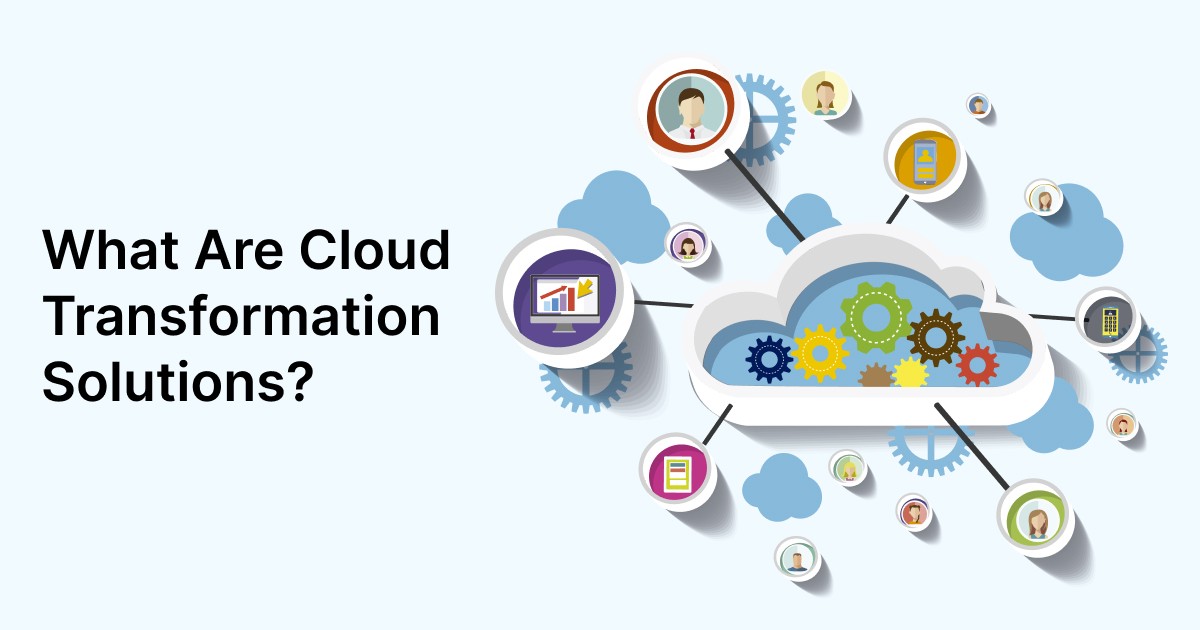
What are cloud transformation solutions?
|They are comprehensive strategies and technologies used to migrate, modernize, and manage an organization’s IT infrastructure within a cloud environment. This involves replacing legacy hardware with scalable, virtualized resources to improve operational agility.
How long does an enterprise cloud transformation typically take?
For mid-to-large enterprises, a full-scale transformation usually spans 12 to 24 months. The timeline depends heavily on the complexity of legacy applications, security requirements, and the specific migration strategies employed.
What is the difference between a migration and a cloud transformation?
A migration is simply moving existing applications and data from local servers to the cloud (lift-and-shift). A transformation involves fundamentally rearchitecting those applications to leverage cloud-native features, improving performance, scalability, and long-term cost efficiency.
Why are cloud transformation services necessary for large businesses?
Large organizations possess highly complex, interdependent systems that carry significant compliance and security risks. Specialized services provide the architectural expertise, tooling, and governance required to execute the transition without halting daily operations.
What is the primary benefit of hybrid cloud transformation?
It allows an organization to maintain strict control over sensitive, highly regulated data on private, on-premises servers while still utilizing the massive computing power and scalability of the public cloud for less critical workloads.