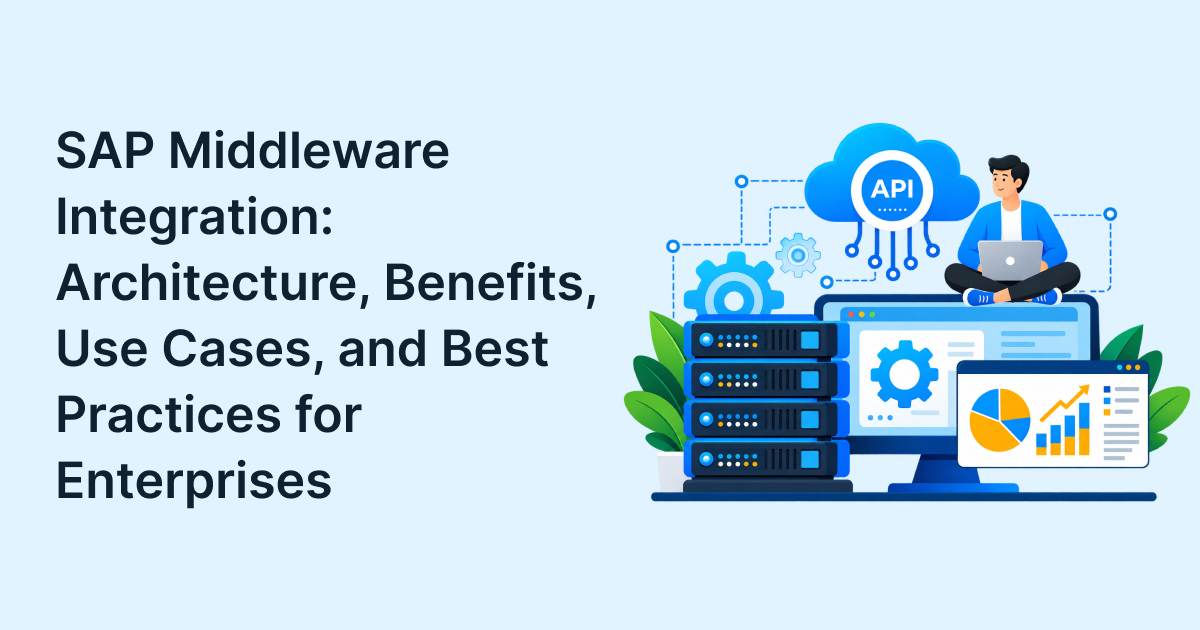
SAP middleware integration enables SAP and non-SAP systems to communicate through a central integration layer that manages data exchange, process orchestration, security, and monitoring. It helps organisations reduce integration complexity, improve operational efficiency, and create scalable digital ecosystems capable of supporting modern business requirements.
Most enterprises today operate within a complex application environment rather than a single ERP platform. SAP systems must continuously exchange information with CRM platforms, eCommerce applications, HR systems, data warehouses, logistics platforms, supplier networks, and cloud services.
As the technology landscape expands, maintaining direct connections between systems becomes increasingly difficult. Every new application introduces additional integration requirements, governance challenges, and maintenance overhead. Without a structured integration strategy, organisations often find themselves managing dozens or even hundreds of disconnected interfaces.
This is where SAP middleware integration becomes a critical part of enterprise architecture. Middleware creates a central layer that simplifies communication between systems while improving reliability, scalability, and visibility.
Companies investing in enterprise-wide integration programmes often work with specialised integration engineering services to design architectures that support long-term growth while reducing operational risk.
What Is SAP Middleware Integration and Why Does It Matter?
SAP middleware integration creates a central communication layer between SAP and non-SAP systems. Instead of building direct connections between every application, organisations use middleware to manage data exchange, workflow automation, security, monitoring, and process orchestration from a single platform.
In a traditional point-to-point environment, each application requires custom connections with other systems. As the business grows, the number of integrations increases exponentially.
Middleware addresses this challenge by acting as an intermediary between systems.
Core middleware functions include:
- Data transformation
- Message routing
- API management
- Security enforcement
- Workflow orchestration
- Monitoring and alerting
- Event management
Consider a global manufacturer running SAP S/4HANA, Salesforce, Workday, and a warehouse management system. Without middleware, each application may require separate integrations. With middleware, all communication flows through a standardised framework.
This improves maintainability while reducing development effort.
For readers looking to understand the broader architecture behind enterprise integration, this guide on how middleware integration works across enterprise environments provides useful context.

Why Do Enterprises Need SAP Middleware Integration?
Enterprises use SAP middleware integration to eliminate data silos, support real-time business processes, improve operational efficiency, and create scalable architectures that can accommodate future business growth without increasing technical complexity.
Digital transformation initiatives often fail when disconnected systems cannot share data efficiently.
For example:
- Sales teams depend on customer data from CRM systems.
- Finance teams rely on accurate ERP information.
- Supply chain teams require inventory visibility.
- Leadership needs consistent analytics.
Without integration, employees spend time reconciling conflicting information across systems.
Common Business Challenges Middleware Solves
| Business Challenge | Impact Without Middleware | Impact With Middleware |
| Data silos | Inconsistent reporting | Unified information flow |
| Manual processing | Higher operational costs | Workflow automation |
| Limited scalability | Difficult expansion | Flexible architecture |
| Poor visibility | Slow decision-making | Real-time insights |
| Integration sprawl | High maintenance costs | Centralised governance |
The larger the organisation becomes, the greater the value of centralised integration management.
How Does SAP Integration Suite Support Enterprise Integration?
SAP Integration Suite provides a unified cloud-based platform for connecting SAP and non-SAP applications, managing APIs, orchestrating workflows, and supporting event-driven integration across hybrid enterprise environments.
SAP Integration Suite has become SAP’s strategic integration platform for organisations modernising their technology landscapes.
The platform supports:
- Application Integration – Connects SAP applications with cloud and on-premises systems through reusable integration flows.
- API Management – Allows organisations to create, secure, publish, and monitor APIs from a central location.
- Event-Driven Architecture – Supports real-time communication between applications through business events.
- B2B Integration – Facilitates secure communication with suppliers, partners, and external stakeholders.
- Integration Advisory Capabilities – Provides tools for governance, modelling, and lifecycle management.
A major advantage of SAP Integration Suite is its extensive library of prebuilt integrations and accelerators. Organisations can deploy integrations faster without developing every connection from scratch.
What Role Does SAP BTP Integration Play in Modern SAP Architectures?
SAP BTP integration serves as the connectivity foundation within SAP Business Technology Platform, enabling organisations to connect applications, data, processes, and business events across hybrid landscapes.
Many organisations mistakenly view integration only as application connectivity.
Modern enterprises require integration across:
- Applications
- Data
- Processes
- Analytics
- AI services
- Partner ecosystems
This is where SAP BTP integration becomes particularly valuable.
SAP BTP Master Data Integration
SAP BTP master data integration helps organisations synchronise business-critical records across systems.
Examples include:
- Customer data consistency
- Product catalog synchronisation
- Supplier master management
- Financial data alignment
Without strong master data integration, businesses often encounter reporting discrepancies, duplicate records, and operational inefficiencies.
SAP BTP Cloud Integration
SAP BTP cloud integration enables seamless communication between cloud applications and on-premises systems.
For example, an organisation may connect:
- SAP S/4HANA
- SuccessFactors
- Salesforce
- ServiceNow
- Microsoft applications
without requiring extensive custom development.
This capability is particularly important for businesses operating hybrid architectures where cloud and legacy systems must coexist.
Which Business Processes Benefit Most from SAP Integration?
SAP integration delivers the greatest value when business processes span multiple applications and departments. The more systems involved in a workflow, the more important integration becomes.
Several use cases consistently deliver measurable business value.
SAP ERP and CRM Integration
Customer information, sales activities, quotations, and order data can move seamlessly between platforms. This reduces duplicate data entry and improves customer experience.
SAP and eCommerce Integration
eCommerce systems rely on accurate inventory, pricing, and order information. Real-time integration enables businesses to provide customers with up-to-date information.
SAP and Supply Chain Integration
Manufacturers frequently integrate production, procurement, logistics, and warehouse systems with SAP. This improves visibility and operational responsiveness.
SAP and HR Systems
Connecting SAP with HR platforms enables automated employee onboarding, payroll synchronisation, and workforce reporting.
SAP and Analytics Platforms
Analytics solutions require access to reliable operational data. Middleware helps ensure consistent reporting across business units.
To understand how integration approaches differ, this guide comparing middleware and API integration strategies provides additional insights.
What Are the Most Common SAP Middleware Integration Challenges?
Most SAP integration projects struggle because of governance, data quality, legacy technology constraints, and growing integration complexity rather than purely technical issues.
Technology is rarely the primary obstacle. Instead, organisations encounter challenges such as:
Data Quality Issues
Poor-quality data creates complications across every connected system. Duplicate customer records and inconsistent business rules frequently undermine integration success.
Legacy Technology Constraints
Many legacy applications lack APIs or modern connectivity options. This often requires additional middleware capabilities and transformation logic.
Security and Compliance Requirements
Financial, operational, and customer data must be protected during transmission. Organisations need robust authentication, authorisation, encryption, and monitoring processes.
Integration Sprawl
As new applications are added, unmanaged integrations become increasingly difficult to maintain.
Monitoring and Visibility Gaps
Teams often struggle to identify failed transactions or performance bottlenecks.
Solutions such as Genova IQ can support improved operational visibility by helping organisations better understand and monitor their complex technology environments.
For a deeper exploration of enterprise integration issues, this article on overcoming common middleware integration challenges is a useful next read.
Ledgesure’s SAP Middleware Readiness Framework
Successful SAP integration programmes evaluate business, data, application, security, and operational readiness before implementation begins. Organisations that invest in readiness assessments typically experience fewer delays and governance issues.
The Five-Layer SAP Integration Readiness Framework
| Layer | Focus Area | Key Question | Business Impact |
| Business Process | Workflow alignment | Which processes need integration? | Faster automation |
| Data | Data quality and ownership | Is data trustworthy? | Better decision-making |
| Applications | Connectivity requirements | Which systems participate? | Reduced complexity |
| Security | Access and compliance | How is data protected? | Lower risk |
| Operations | Monitoring and governance | Who manages integrations? | Long-term sustainability |
Why This Framework Matters
Many integration programmes start with technology selection before addressing business readiness.
This often leads to rework, delays, and poor adoption.
By evaluating readiness across these five layers, enterprises create a stronger foundation for future integration initiatives and broader middleware integration services strategies.
How Should Enterprises Approach SAP Middleware Integration Implementation?
Enterprise SAP integration projects succeed when organisations follow a structured implementation roadmap that aligns business priorities, architectural requirements, governance standards, and operational objectives.
A disciplined implementation approach generally includes six phases.
- Step 1: Assess the Current Landscape – Document applications, integration points, business processes, and pain points.
- Step 2: Prioritise Business Outcomes – Identify which integrations generate the highest operational value.
- Step 3: Design Integration Architecture – Select patterns, protocols, APIs, events, and middleware platforms.
- Step 4: Establish Governance – Define ownership, standards, security policies, and monitoring procedures.
- Step 5: Validate Through Testing – Conduct performance, security, functional, and disaster recovery testing.
- Step 6: Monitor and Optimise – Track performance indicators and continuously improve integrations.
For organisations preparing implementation plans, this practical guide to a middleware integration deployment roadmap and checklist offers additional implementation guidance.
SAP Integration Suite vs Traditional Middleware: Which Is Better?
SAP Integration Suite is generally better suited for cloud-first and hybrid enterprises, while traditional middleware may remain appropriate for organisations with extensive on-premises environments and highly specialised integration requirements.
The right choice depends on business goals and existing architecture.
| Criteria | SAP Integration Suite | Traditional Middleware |
| Deployment Model | Cloud-native | Primarily on-premises |
| SAP Connectivity | Native | Additional configuration |
| Innovation Updates | Frequent | Dependent on vendor |
| Infrastructure Management | Reduced | Higher operational burden |
| Scalability | High | Varies by platform |
| API Management | Integrated | Often separate |
| Event-Driven Integration | Strong support | Platform-dependent |
| Governance | Centralised | Varies |
| Maintenance Effort | Lower | Higher |
Organisations should evaluate not only licensing costs but also operational overhead, scalability requirements, and long-term architecture goals.
Additional cost considerations are discussed in this guide on enterprise middleware integration pricing factors.
What Are the Best Practices for Long-Term SAP Integration Success?
Long-term SAP integration success depends on governance, standardisation, monitoring, security, and architectural consistency rather than individual project implementation efforts alone.
Several best practices consistently appear in successful programmes.
- Establish Integration Governance – Create clear ownership and accountability structures.
- Standardise APIs and Data Models – Consistency reduces maintenance complexity.
- Prioritise Security from the Start – Security controls should be embedded within architecture rather than added later.
- Implement Continuous Monitoring – Visibility allows teams to proactively address issues.
- Document Every Integration – Documentation improves supportability and knowledge transfer.
- Design for Future Scalability – Today’s integrations should support tomorrow’s business requirements.

Key Takeaways
- SAP middleware integration centralises application connectivity and governance.
- SAP Integration Suite supports modern cloud-first integration strategies.
- SAP BTP integration enables connectivity across applications, data, and processes.
- Integration challenges are often operational and governance-related rather than technical.
- A structured readiness framework improves implementation success.
- Long-term integration success relies on governance, monitoring, and scalability planning.
Conclusion
SAP middleware integration has evolved from a technical necessity into a strategic business capability. As organisations continue connecting ERP systems, cloud applications, supplier networks, analytics platforms, and customer-facing technologies, the need for scalable and governed integration architectures becomes increasingly important.
Whether you’re evaluating SAP Integration Suite, exploring SAP BTP integration opportunities, or modernising legacy interfaces, the most successful initiatives begin with a clear integration strategy supported by governance, architecture, and operational readiness.
If your organisation is planning a large-scale SAP integration initiative, consider connecting with the team discussing the right approach for your enterprise environment.
Frequently Asked Questions
Q: What is SAP middleware integration?
A: SAP middleware integration refers to the use of an intermediary platform that enables SAP and non-SAP systems to communicate efficiently. It manages data transformations, workflow orchestration, security, monitoring, and application connectivity through a centralised integration layer, reducing complexity and improving scalability.
Q: Is SAP Integration Suite considered middleware?
A: Yes. SAP Integration Suite functions as a modern middleware platform. It provides application integration, API management, event-driven capabilities, B2B connectivity, and integration governance within SAP’s cloud ecosystem.
Q: What is SAP BTP integration?
A: SAP BTP integration refers to the connectivity capabilities available within SAP Business Technology Platform. It enables organisations to connect applications, data, processes, and business events across SAP and non-SAP systems in hybrid environments.
Q: Can SAP integrate with non-SAP applications?
A: Yes. Modern SAP integration platforms support connectivity with a wide range of third-party applications, including Salesforce, Microsoft Dynamics, ServiceNow, Workday, Shopify, Oracle solutions, and custom-built enterprise platforms.
Q: How long does SAP middleware integration implementation take?
A: Implementation timelines vary depending on architecture complexity, business requirements, integration volume, governance needs, and testing requirements. Smaller projects may require only a few integrations, while enterprise programmes often follow phased implementation approaches.
Q: What is the biggest challenge in SAP integration projects?
A: Data quality and governance are often the biggest challenges. Even the most advanced integration platform cannot produce reliable results if source data is incomplete, inconsistent, or poorly governed.