Summary
Small businesses often face operational challenges as teams grow and workflows become more complex. Tasks may move slowly between departments, approvals get delayed, and tracking progress becomes difficult without structured systems.
Process management tools help businesses organize workflows, automate repetitive tasks, and monitor operational performance in a centralized environment. By implementing the right Business Process Management (BPM) platform, companies can streamline collaboration, reduce manual work, and improve decision-making.
This guide explores the best process management tools for small business, the different types of BPM systems available, and how modern approaches like Intelligent Business Process Management (iBPM) help organizations improve efficiency and scalability.
What Are Process Management Tools?
Process management tools are software platforms that help businesses design, execute, and optimize workflows across teams. These tools replace manual coordination with structured processes that guide tasks through predefined steps.
Instead of relying on email chains or spreadsheets, teams can manage workflows through centralized dashboards where tasks, approvals, and documents are tracked in real time.
Drive Digital Innovation & Transform Your Business
Struggling to find tailored IT solutions that truly accelerate your digital transformation journey? Partner with LedgeSure to unlock the true potential of technology.
Common capabilities of process management tools include:
- Workflow automation
- Process visualization
- Task and approval management
- Integration with existing software systems
- Analytics for monitoring operational performance
Businesses adopting structured workflows often begin with BPM integration to connect applications and automate process flows across departments.
Types of Process Management Systems
Before choosing a platform, businesses should understand the different types of process management systems available.
Integration-Centric BPM
Integration-focused BPM solutions connect multiple applications and automate data movement between them. These systems are useful when organizations rely on several digital tools that need to exchange information.
Human-Centric BPM
Human-centric BPM focuses on workflows that involve people, such as approvals, onboarding processes, or internal collaboration tasks. These systems prioritize usability and transparency for teams.
Document-Centric BPM
Document-centric BPM platforms manage workflows where documents are central to the process. This includes contract approvals, compliance workflows, procurement documents, and records management.
Best Process Management Tools for Small Business
Selecting the right platform depends on workflow complexity, team size, and automation needs. Below is a comparison of commonly used tools that help small businesses improve operational efficiency.
| Tool | Best For | Key Features | Ideal Users |
| Ledgsure BPM Solutions | Process automation and digital transformation | Workflow automation, analytics dashboards, integration capabilities | Growing businesses modernizing operations |
| Kissflow | No-code workflow automation | Drag-and-drop workflow builder, automated approvals | Small teams and startups |
| Microsoft Power Automate | Automation across Microsoft applications | Workflow automation, integrations with Microsoft tools | Businesses using Microsoft ecosystem |
| Bizagi | Process modeling and automation | Visual workflow mapping and analytics | Process-driven organizations |
| monday.com | Team workflow management | Visual boards, task automation, collaboration tools | Small and mid-sized teams |
| Appian | Enterprise automation | Low-code development and AI-driven workflows | Organizations scaling operations |
These platforms help businesses automate routine processes while improving visibility into operational workflows.
Why Ledgsure Is Relevant for Business Process Management
Many BPM tools focus primarily on workflow automation. Ledgsure extends this capability by supporting broader business process transformation initiatives.
Ledgsure enables organizations to:
- Automate operational workflows
- Integrate legacy systems with modern applications
- Monitor performance through centralized analytics
- Build scalable digital infrastructure
This combination of automation and integration makes it easier for businesses to improve operational efficiency without disrupting existing systems.
Intelligent Business Process Management (iBPM)
Traditional BPM systems focus on automating workflows based on predefined rules. However, modern organizations are adopting Intelligent Business Process Management (iBPM) to improve decision-making.
iBPM platforms incorporate technologies such as:
- Artificial intelligence
- Machine learning
- predictive analytics
- process mining
Through AI automation, these systems can analyze workflow data, detect bottlenecks, and recommend improvements.
For example, an iBPM system may identify delays in approval processes and automatically suggest workflow adjustments to improve efficiency.
How to Choose the Best Process Management Tools for Small Business
Selecting the right BPM platform requires evaluating several factors.
Workflow Automation
Automation reduces repetitive tasks and ensures workflows move efficiently between departments.
Process Visualization
Visual workflow maps help teams understand processes and identify areas for improvement.
Integration Capabilities
A BPM system should connect with existing tools such as CRM platforms, accounting software, and HR systems.
Performance Monitoring
Analytics dashboards help organizations measure productivity and improve performance management by tracking workflow metrics.
Scalability
The platform should support business growth and adapt to evolving operational requirements.
Many companies also combine BPM platforms with cloud transformation strategies to enable flexible and scalable infrastructure.
Empower Your Workforce with AI & Automated Innovations
Want to boost efficiency and reduce costs? Explore how LedgeSure’s AI-driven solutions simplify workflows and drive real outcomes.
How Process Management Tools Improve Business Performance
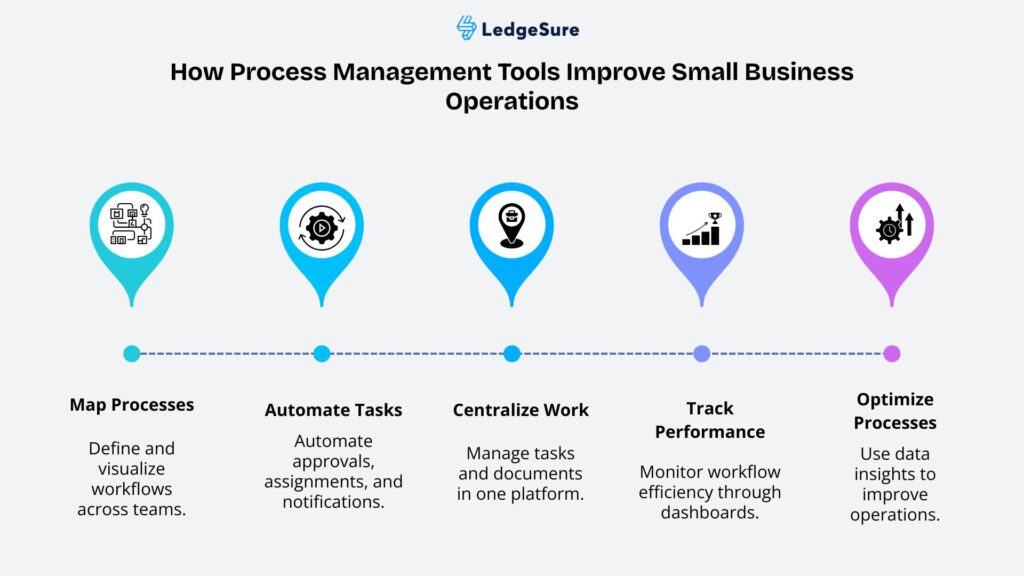
Implementing process management tools helps businesses operate more efficiently by introducing structure into everyday workflows.
Key benefits include:
- Faster task completion
- Reduced operational delays
- Improved collaboration between teams
- Better compliance and process governance
- Enhanced visibility into operational performance
For small businesses, these improvements help maintain productivity while supporting long-term growth.
Conclusion
As organizations grow, managing workflows manually becomes increasingly difficult. Structured systems are essential for maintaining efficiency and ensuring tasks move smoothly across teams.
The best process management tools for small business provide automation, analytics, and integration capabilities that streamline operations.
Solutions such as Kissflow, Bizagi, monday.com, and Microsoft Power Automate offer strong workflow management capabilities, while platforms like Ledgsure support broader digital transformation initiatives.
With advancements in Intelligent Business Process Management, businesses can now move beyond simple automation toward data-driven process optimization. Implementing the right BPM platform today can help small businesses build scalable operations and improve long-term performance.
FAQs
Q: What are process management tools used for?
A: Process management tools help businesses organize workflows, automate tasks, and track operational performance across teams.
Q: Which process management tools are suitable for small businesses?
A: Tools such as Kissflow, monday.com, Bizagi, Microsoft Power Automate, and Ledgsure are commonly used by small and growing businesses to automate workflows.
Q: What is the difference between workflow management and BPM?
A: Workflow management focuses on automating specific tasks, while Business Process Management (BPM) manages complete operational processes across departments.
Q: What is Intelligent Business Process Management (iBPM)?
A: Intelligent Business Process Management combines BPM with technologies like AI and analytics to continuously optimize workflows.
Q: How do BPM tools improve performance management?
A: BPM tools provide analytics dashboards and workflow insights that help organizations track efficiency and improve operational performance.