Summary:
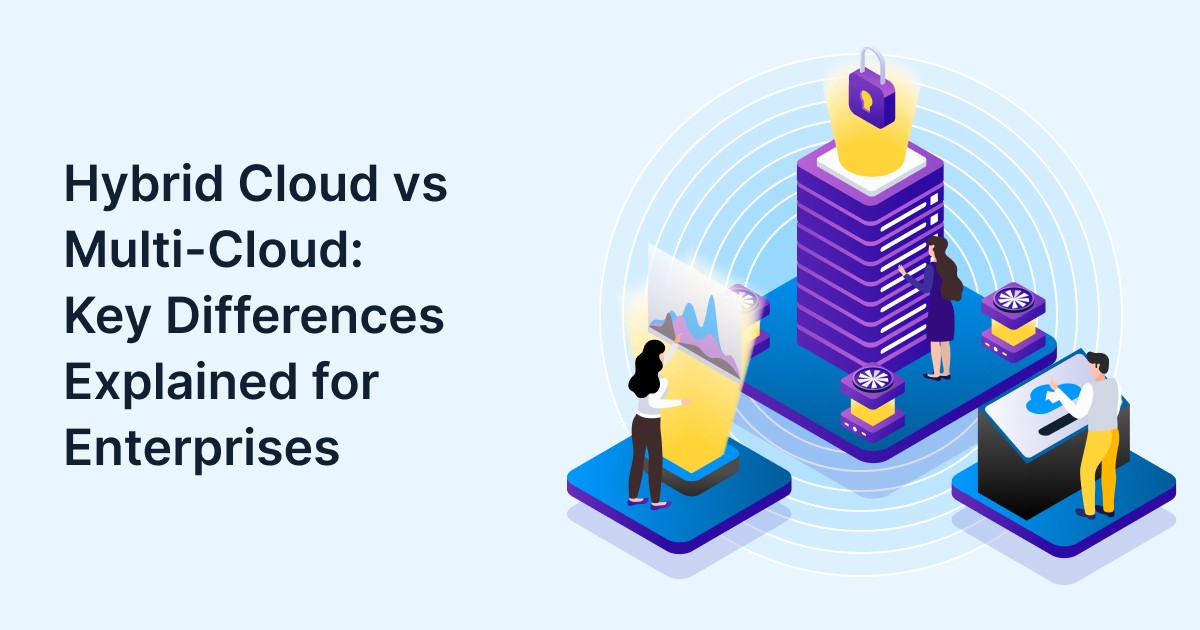
Choosing between hybrid cloud vs multi cloud is a key decision for modern enterprises. While both models offer flexibility and scalability, they differ in architecture, integration, and control.
In this guide, we explain the difference between hybrid cloud and multi cloud, along with their core use cases and business benefits. By understanding how multi cloud and hybrid cloud strategies work, organizations can select the right approach to improve performance, reduce costs, and build a future-ready cloud infrastructure.
As enterprises modernize their infrastructure, the debate around hybrid cloud vs multi cloud has become more important than ever. This is no longer just an IT architecture choice. It shapes how businesses balance scalability, resilience, compliance, and cost.
Many organizations still confuse multi cloud and hybrid cloud models, even though they solve different problems. Understanding the difference between hybrid cloud and multi cloud is essential if you want to build a cloud strategy that supports both present needs and future growth.
According to IBM’s explanation of hybrid cloud, hybrid cloud combines on-premises, private cloud, and public cloud environments into a unified infrastructure. In contrast, multi-cloud focuses on using multiple providers to improve flexibility and reduce dependency, a concept further explored in discussions around multi-cloud strategy.
This guide breaks down the key distinctions, business use cases, and decision factors so you can evaluate hybrid vs multi cloud with confidence.
Drive Digital Innovation & Transform Your Business
Struggling to find tailored IT solutions that truly accelerate your digital transformation journey? Partner with LedgeSure to unlock the true potential of technology.
Understanding Hybrid Cloud and Multi-Cloud
To evaluate hybrid cloud vs multi cloud, you first need a clear definition of each model.
What is Hybrid Cloud?
Hybrid cloud is a computing model that connects on-premises or private infrastructure with one or more public clouds. The goal is to create a single operating environment where workloads and data can move where they make the most sense.
For enterprises with legacy systems, compliance requirements, or sensitive workloads, hybrid cloud often becomes the practical first step. Many businesses start with a structured cloud transformation strategy so they can modernize in phases rather than force a risky full migration. At the same time, strong integration solutions help connect applications, databases, and systems across environments so the architecture remains usable and scalable.
What is Multi-Cloud?
Multi-cloud refers to the use of multiple public cloud platforms, such as AWS, Microsoft Azure, or Google Cloud, within the same enterprise environment. Unlike hybrid cloud, multi-cloud does not require on-premises infrastructure as part of the strategy.
The purpose of multi vs hybrid cloud in this case is diversification. Businesses choose multiple providers so they can avoid vendor lock-in, place workloads where they perform best, and build greater resilience across regions and services.
This approach also involves key architectural considerations such as identity federation, landing zones, and cross-provider connectivity, which are critical for scaling multi-cloud environments effectively.
Core Differences Between Hybrid Cloud and Multi-Cloud
When comparing hybrid cloud vs multi cloud, the differences become much clearer when you look at architecture, operations, and business outcomes.
- Architecture
The most basic difference between hybrid cloud and multi cloud is structural.
Hybrid cloud combines private and public environments into one integrated ecosystem. Multi-cloud uses more than one public cloud platform, often without any private infrastructure involved.
That means hybrid cloud is usually about integration and workload portability, while multi-cloud is about provider choice and distribution. IBM also notes that modern organizations increasingly operate in hybrid multicloud environments, where both ideas can overlap in practice.
- Integration Complexity
Hybrid cloud usually demands deeper integration. Businesses need to connect data, apps, identity, and operations across on-prem and cloud environments. This often requires more planning, especially if legacy systems are involved.
By contrast, multi-cloud environments tend to focus more on orchestration and management across providers. The challenge is not always tight integration, but consistent governance, visibility, and deployment controls across platforms. This is why many enterprises pair multi-cloud adoption with broader cloud migration strategies to reduce complexity during rollout.
- Data Control and Compliance
Hybrid cloud is often preferred when data control is critical. Sensitive workloads can remain on-premises or in private environments, while other workloads benefit from public cloud elasticity.
In multi cloud and hybrid cloud planning, this is one of the biggest decision points. Regulated industries often lean toward hybrid cloud first because it gives them tighter control over where data resides and how it is handled. IBM’s hybrid cloud guidance emphasizes that hybrid architectures are especially valuable when organizations need flexibility without losing operational control.
- Vendor Lock-In
A key reason enterprises explore multi cloud and hybrid cloud models is to avoid becoming overly dependent on a single provider.
Hybrid cloud may still rely heavily on one dominant cloud vendor alongside private infrastructure. Multi-cloud, however, is more explicitly designed to spread risk across providers. That makes it attractive for businesses that want more bargaining power, better redundancy, or cloud-native specialization by workload.
- Cost Optimization
In hybrid cloud vs multi cloud comparisons, cost optimization works differently in each model.
Hybrid cloud can reduce costs by keeping predictable or regulated workloads in private infrastructure while shifting burst demand to the public cloud. Multi-cloud gives organizations the flexibility to place workloads with the provider that offers the best fit on cost, geography, or service capability.
Neither model saves money automatically. Costs improve only when the architecture is mapped to real workload requirements and governed properly over time. This is why structured planning becomes critical when adopting cloud architectures, especially when aligned with a well-defined cloud transformation strategy.
Core Enterprise Use Cases
Choosing between hybrid vs multi cloud depends on what the business actually needs to solve.
Hybrid Cloud Use Cases
Hybrid cloud is commonly chosen by enterprises that need to modernize without fully abandoning existing systems. Typical examples include:
- financial services firms managing sensitive data
- healthcare organizations with strict compliance obligations
- manufacturers or large enterprises with legacy operational systems
For these businesses, hybrid cloud offers a controlled path to modernization. It allows them to adopt cloud services while keeping mission-critical or tightly regulated workloads in a more controlled environment. IBM also highlights digital transformation as one of the most compelling use cases for hybrid cloud adoption.
Multi-Cloud Use Cases
Multi-cloud is often a better fit for organizations that need flexibility, resilience, and service distribution across multiple providers.
Common examples include:
- SaaS companies serving global user bases
- enterprises that want to reduce vendor dependency
- businesses that require stronger disaster recovery or regional performance
For these organizations, the multi vs hybrid cloud choice is usually driven by uptime, flexibility, and provider diversification rather than by legacy integration needs.
Measuring the Real Benefits of Cloud Strategies
Understanding the difference between hybrid cloud and multi cloud also means measuring business outcomes, not just technical features.
Hybrid Cloud Benefits
- stronger data control
- easier support for compliance-heavy workloads
- smoother modernization of legacy systems
Multi-Cloud Benefits
- improved resilience across providers
- reduced vendor lock-in
- better freedom to optimize for cost or performance by workload
Enterprises are increasingly aligning deployment models with business objectives rather than treating cloud as a one-size-fits-all solution, as highlighted in this analysis of private cloud vs public cloud. That reflects the broader reality behind hybrid cloud vs multi cloud decisions: architecture must serve business priorities, not the other way around.
Did You Know?IBM states that “IBM Cloud is designed for hybrid multi-cloud environments,” enabling businesses to run workloads where they perform best, including on-premises, private cloud, public cloud, or at the edge. |
| Source: IBM Cloud Solutions. |
The Technology Stack: Choosing the Right Approach
Selecting between hybrid cloud vs multi cloud requires more than vendor comparison. It requires a clear view of workload design, governance, and long-term operating model.
Key Considerations
- Workload Requirements
You need toidentify which applications require tighter control and which benefit more from cloud elasticity. - Integration Needs
Hybrid cloud depends heavily on strong integration solutions so systems can exchange data reliably across private and public environments. - Management and Visibility
Multi-cloudsetups require centralized monitoring, orchestration, and policy enforcement across providers. IBM’s guidance on hybrid cloud management reinforces the importance of unified oversight across environments. - Security and Compliance
Both models require strong identity, access, networking, and governance frameworks from the beginning.
Enterprises that align these decisions with a broader cloud transformation roadmap usually adopt faster and with less operational friction.
Real-World Case Study: Enterprise Cloud Strategy
Illustrative Example: Global Retail Enterprise
A multinational retailer needed to modernize its infrastructure while maintaining strict control over sensitive operational data.
Approach
- it adopted hybrid cloud for internal and compliance-heavy systems
- it used multi-cloud for customer-facing digital applications
- it supported rollout through phased architecture planning and integration controls
Outcome
- stronger resilience across customer-facing platforms
- better control over sensitive internal workloads
- improved flexibility in scaling during peak demand periods
This kind of blended model shows why hybrid cloud vs multi cloud is not always a binary decision. In practice, many enterprises use both, depending on workload type and business priorities. IBM’s guidance also reflects this reality by referring to the modern hybrid multicloud model rather than treating each as entirely separate in every enterprise context.
Hybrid vs Multi Cloud: Which One Should You Choose?
The right answer depends on what the business values most.
Choose Hybrid Cloud If:
- you need stricter control over sensitive workloads
- you operate in a regulated industry
- you rely on legacy systems that cannot move all at once
Choose Multi-Cloud If:
- you want to reduce vendor lock-in
- you need broader resilience across providers
- you want flexibility to optimize performance by platform
In other words, the difference between hybrid cloud and multi cloud is not about which one is universally better. It is about which operating model best matches your technical, financial, and regulatory needs.
Empower Your Workforce with AI & Automated Innovations
Want to boost efficiency and reduce costs? Explore how LedgeSure’s AI-driven solutions simplify workflows and drive real outcomes.
Why LedgeSure for Cloud Strategy Implementation
LedgeSure helps enterprises design modern architectures around cloud transformation, integration, and scalable delivery models.
Its capabilities in cloud transformation, integration solutions, and practical cloud strategy content such as how to implement a multi-cloud strategy make it a strong fit for organizations that need both architectural clarity and execution support.
Conclusion
The conversation around hybrid cloud vs multi cloud ultimately comes down to choosing the right fit for your business needs.
Hybrid cloud offers stronger control, especially for organizations balancing legacy systems and compliance requirements. Multi-cloud, on the other hand, provides flexibility, diversification, and greater freedom in vendor selection. Once you clearly understand the difference between hybrid cloud and multi cloud, it becomes easier to design an architecture that supports performance, resilience, and long-term growth.
For many enterprises, the most effective approach is not choosing one over the other, but combining both strategically based on workload requirements.
If you’re planning to implement or optimize your cloud strategy and need expert guidance, contact us to get tailored advice from our specialists and build a solution that fits your business needs.
Frequently Asked Question
What is the main difference between hybrid cloud and multi cloud?
The main difference between hybrid cloud and multi cloud is that hybrid cloud combines private and public environments, while multi-cloud uses multiple public cloud providers.
Is hybrid cloud better than multi-cloud?
Not universally. In hybrid vs multi cloud decisions, hybrid cloud is often better for control and compliance, while multi-cloud is often better for flexibility and vendor diversification.
Can a business use both multi cloud and hybrid cloud?
Yes. Many enterprises run blended environments, often described as hybrid multicloud, to match different workloads to different requirements.
Why do companies choose multi vs hybrid cloud?
The multi vs hybrid cloud choice usually depends on whether the main goal is integration with private infrastructure or diversification across public providers.
How should enterprises evaluate hybrid cloud vs multi cloud?
Start with workload sensitivity, compliance needs, integration complexity, scalability goals, and the level of vendor flexibility the business wants.