Summary:
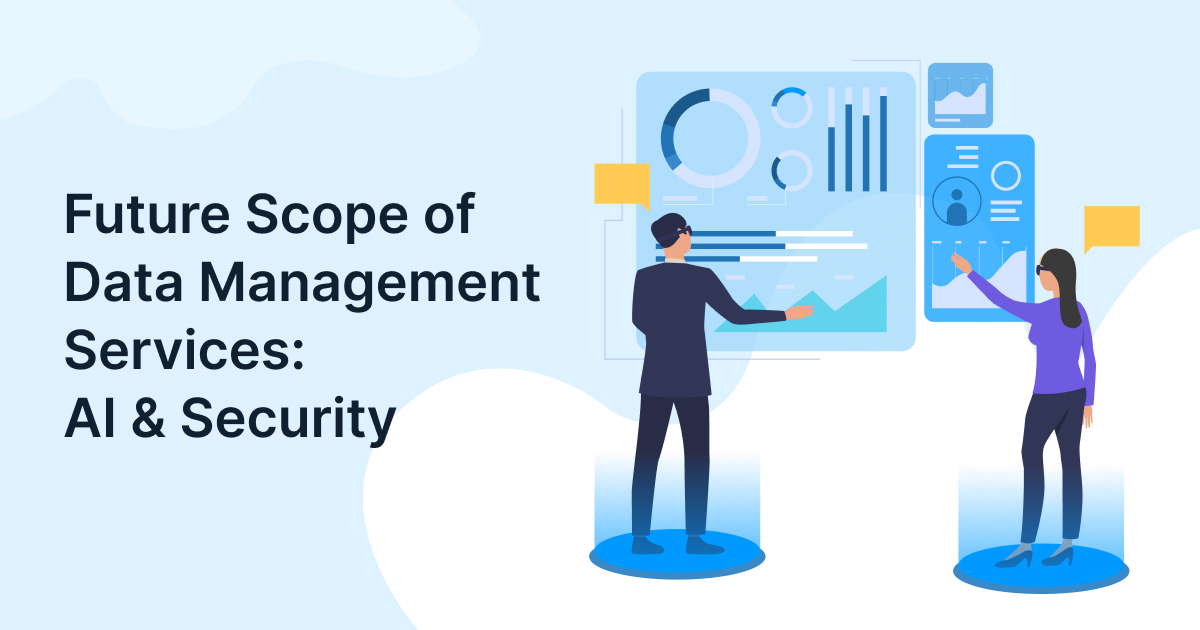
Enterprise environments face rapid architectural changes, making the future scope of data management services highly critical for CIOs. This post explores how big data trends and data analytics trends are forcing organizations to upgrade legacy systems. We will deeply cover AI trends in data management services and examine how escalating data security trends impact modern infrastructures. Understanding these future trends in data security is essential for maintaining compliance while scaling. Discover how our Data Management Services seamlessly adapt to the evolving future scope of data management services to deliver comprehensive data management services that drive immediate business value.
Enterprise IT leaders are currently managing petabytes of fragmented data, prompting a critical review of the future scope of data management services. The sheer complexity of governing this information requires IT directors to closely monitor big data trends. Because big data trends move quickly, keeping pace with evolving data analytics trends and corresponding AI trends in data management services is no longer optional.
As reliance on cloud architectures grows, analyzing data security trends and adopting the latest future trends in data security is paramount. In this post, we explore the future scope of data management services, unpacking how big data trends, data analytics trends, AI trends in data management services, and future trends in data security are actively reshaping enterprise IT strategies. By leveraging robust data management services, you can future-proof your ecosystem.
These massive big-data trends force enterprises to adopt AI trends in data management services just to maintain visibility over the expanding future scope of data management services.
This highlights why data analytics trends and modern data management services must integrate future trends in data security to ensure these automated decisions are safe and reliable.
Drive Digital Innovation & Transform Your Business
Struggling to find tailored IT solutions that truly accelerate your digital transformation journey? Partner with LedgeSure to unlock the true potential of technology.
How Big Data Trends Influence the Future Scope of Data Management Services
The centralized enterprise data warehouse is struggling under the weight of modern big data trends. Funneling massive pipelines through a single IT team creates bottlenecks that restrict the future scope of data management services. To solve the issues brought on by these big data trends, enterprises are shifting architectures to match new data analytics trends.
These big data trends point toward decentralization, such as Data Mesh frameworks. A Data Mesh treats data as a product, perfectly aligning with the future scope of data management services by empowering domain-specific teams. As big data trends push for faster insights, data analytics trends emphasize real-time processing within decentralized data management services.
Understanding the future scope of data management services requires adapting to big data trends continuously. Many organizations are realizing the benefits of outsourcing data management services for enterprises and how to measure the ROI to effectively manage these complex big data trends and volatile data analytics trends without straining internal resources.
| “Without a systematic way to start and keep data clean, bad data will happen.” — Donato Diorio, Data and Technology Executive |
| Source: [DigitalDefynd Analytics Quotes] |
Core Data Analytics Trends and AI Trends in Data Management Services
Historically, data cataloging required manual tagging, which cannot scale with current data analytics trends. Today, AI trends in data management services are fundamentally shifting the paradigm. These AI trends in data management services introduce machine learning algorithms that automate data discovery, perfectly matching the future scope of data management services.
By adopting AI trends in data management services, enterprises can automate active metadata management. These data analytics trends ensure that downstream dashboards reflect changes instantly. Furthermore, generative AI represents one of the most exciting AI trends in data management services, allowing users to query data via natural language.
As data analytics trends prioritize user accessibility, AI trends in data management services bridge the gap between engineers and business teams. Following these data analytics trends expands the future scope of data management services, making insights instantaneous.
Architectural Comparison: Adapting to Big Data Trends
| Feature | Data Mesh (Big Data Trends) | Data Fabric (AI Trends in Data Management Services) |
| Core Philosophy | Decentralized ownership matching data analytics trends | Centralized metadata via AI trends in data management services |
| Primary Driver | Scaling the future scope of data management services | Technological integration in data management services |
| Security Impact | Relies on data security trends at the node | Unified future trends in data security policies |
| Best For | Massive enterprises tracking big data trends | Enterprises pursuing data analytics trends via AI |
To accommodate escalating big data trends, organizations implementing modern architectures demonstrated a 63% improvement in time-to-market. According to a BTA research report, integrating AI trends in data management services into a decentralized framework allows teams to bypass central IT waitlists, directly capitalizing on current data analytics trends and expanding the future scope of data management services.
Evaluating Data Security Trends and Future Trends in Data Security
As data environments become decentralized to follow big data trends, securing them becomes harder. Consequently, data security trends are evolving rapidly. The most critical future trends in data security focus on zero-trust architectures, which are now foundational to the future scope of data management services.
Data security trends dictate that perimeter-based defense is obsolete. Zero-trust future trends in data security require continuous access verification. Modern data management services now embed dynamic masking directly into the access layer to address these data security trends.
Moreover, as data security trends prioritize compliance, automated governance represents the convergence of AI trends in data management services and future trends in data security. Automated pipelines continuously scan for PII to enforce future trends in data security in real-time. Establishing a comprehensive data management overview, types, challenges, and best practices strategy is the best way to incorporate these data security trends into your data management services.
| 💡 Did You Know? Nearly two-thirds of firms fail to scale their AI projects because they ignore crucial data security trends and AI trends in data management services, leaving their data foundation siloed. |
| Source: McKinsey: The State of AI in 2025 |
The Ongoing Impact of Data Security Trends
Ignoring data security trends severely limits the future scope of data management services. Future trends in data security, like fine-grained row-level security, protect assets while enabling data analytics trends to flourish. By aligning data security trends with AI trends in data management services, enterprises can confidently scale.
Amongst all the future trends in data management is about enabling safe data sharing. Data security trends show that when data is secure at the cellular level, business units can aggressively pursue data analytics trends and big data trends without risk. Thus, future trends in data security directly expand the future scope of data management services.
Empower Your Workforce with AI & Automated Innovations
Want to boost efficiency and reduce costs? Explore how LedgeSure’s AI-driven solutions simplify workflows and drive real outcomes.
Conclusion
The future scope of data management services relies heavily on adapting to relentless big data trends and volatile data analytics trends. As volumes explode, relying on legacy systems will hinder your ability to leverage AI trends in data management services.
By embracing AI trends in data management services, keeping pace with data analytics trends, and embedding strict data security trends directly at the data layer, you transform your IT infrastructure. Enterprises that adopt these data management services today and respect the latest future trends in data security and big data trends will secure a decisive advantage. The future scope of data management services demands proactive alignment with these future trends in data security and AI trends in data management services.
Mastering the future scope of data management services requires aligning your infrastructure with the latest big data trends and AI trends in data management services. Talk to our experts at LedgeSure and they can help you navigate data analytics trends and implement robust future trends in data security.
Frequently Asked Questions
What defines the future scope of data management services?
The future scope of data management services is defined by the integration of AI trends in data management services, the scale of big data trends, and the protective measures of future trends in data security.
How do big data trends impact data analytics trends?
Big data trends introduce massive volume and variety, forcing data analytics trends to shift toward decentralized architectures and real-time processing within modern data management services.
What are the most important AI trends in data management services?
Key AI trends in data management services include automated metadata tagging, AI-driven governance, and natural language querying, all of which expand the future scope of data management services.
Why are future trends in data security adopting zero-trust?
Future trends in data security rely on zero-trust because modern big data trends and cloud environments lack traditional perimeters, making new data security trends essential for data management services.
How do data security trends affect data management services?
Data security trends force data management services to embed continuous verification and dynamic masking, ensuring that as organizations pursue data analytics trends, their future trends in data security prevent breaches.