Summary:
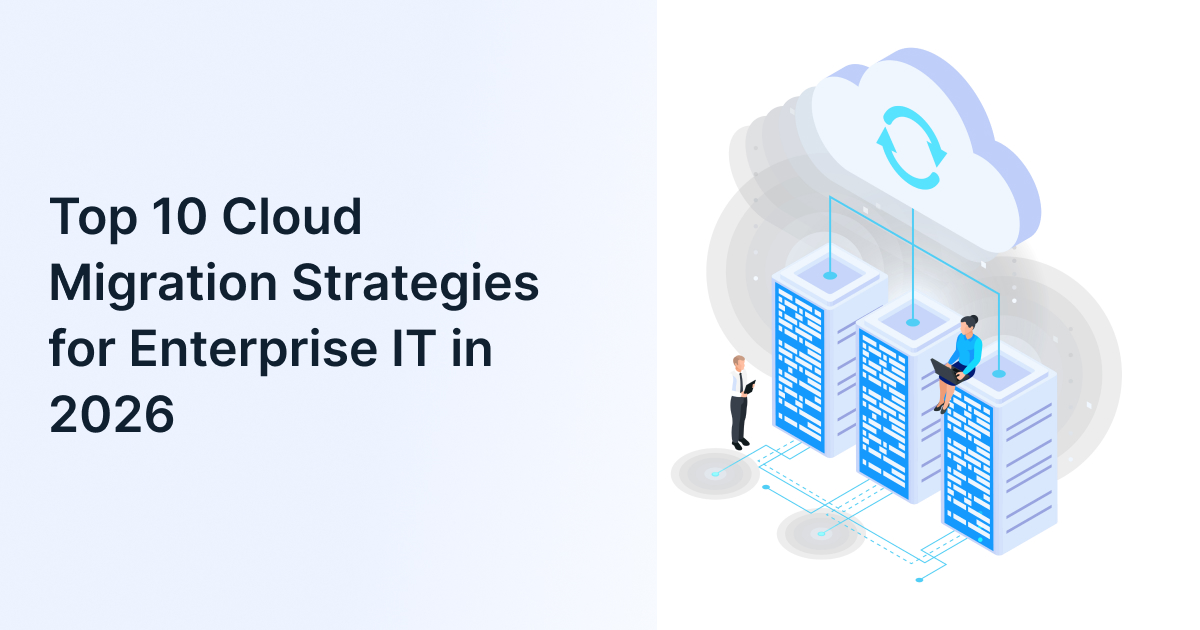
Migrating enterprise workloads to the cloud is no longer just about infrastructure replacement; it’s about decoupling legacy dependencies to unlock AI and real-time data capabilities. This guide breaks down the top 10 cloud migration strategies for 2026, shifting focus from simple lift-and-shift operations to targeted refactoring and database modernization. You will learn how to evaluate your current application portfolio, map the right migration pattern to each workload, and avoid the hidden costs of poor cloud orchestration.
In 2026, migrating 1,000 virtual machines to a public cloud and calling it a transformation is a guaranteed path to bloated infrastructure costs. Enterprise IT leaders are realizing that moving technical debt to AWS or Azure doesn’t magically dissolve it; it simply changes the billing address. The friction now lies in untangling monolithic applications and heavily integrated legacy databases without stalling daily operations.
You need a Cloud Transformation strategy that treats different workloads with distinct approaches, retiring dead weight, rehosting what’s stable, and refactoring applications that directly impact customer experience.
After reading this, you will understand the top 10 cloud migration strategies driving enterprise agility today. You will also see how to assign the right approach to your specific architectural bottlenecks, ensuring your transition enhances performance rather than just replicating legacy limitations in a new environment.
Drive Digital Innovation & Transform Your Business
Struggling to find tailored IT solutions that truly accelerate your digital transformation journey? Partner with LedgeSure to unlock the true potential of technology.
1. The Foundational Migration Patterns
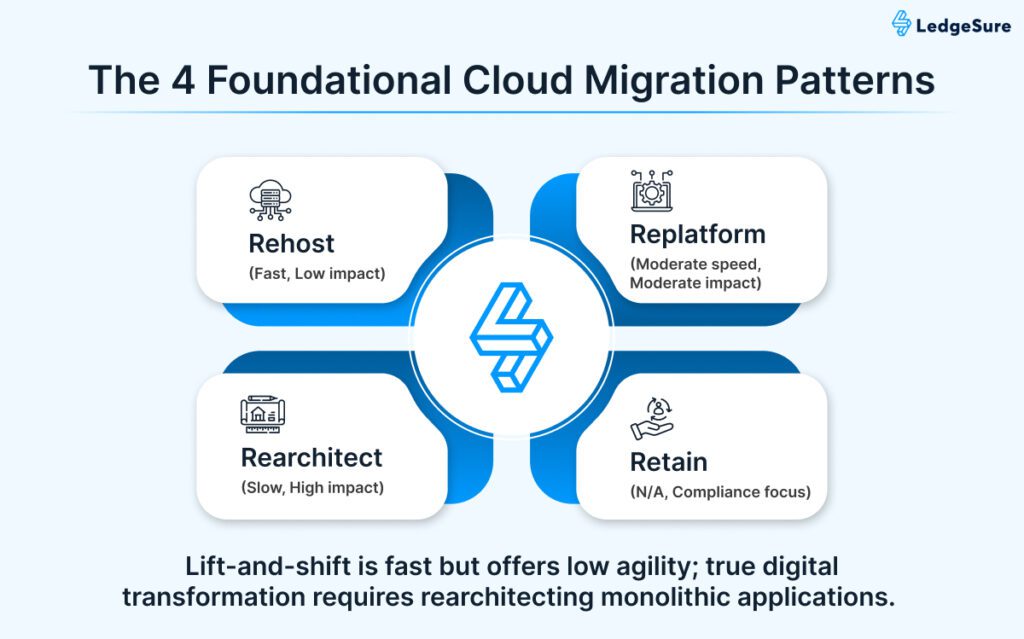
A successful cloud migration plan rarely relies on a single approach. Enterprises must categorize their application portfolio and apply these core strategies based on technical viability and business value.
Strategy 1: Automated Rehosting (Lift and Shift 2.0)
Rehosting moves applications from on-premises servers to cloud Infrastructure-as-a-Service (IaaS) without modifying the underlying code. While traditional lift-and-shift is often criticized for bringing legacy inefficiencies into the cloud, “Lift and Shift 2.0” utilizes advanced automation tools to instantly map dependencies and right-size virtual machines during the move. This is ideal for stable, legacy applications that do not require immediate feature updates.
Strategy 2: Re-platforming (Lift, Tinker, and Shift)
Re-platforming involves making localized optimizations to an application without changing its core architecture. For instance, moving an application to the cloud while simultaneously shifting its database to a managed service like Amazon RDS or Azure SQL Database. This approach reduces database administration overhead and licensing costs while keeping the migration timeline relatively short.
Strategy 3: Strategic Rearchitecting
Rearchitecting is the most powerful cloud transformation strategy, requiring you to rebuild monolithic applications into cloud-native microservices. This is mandatory for applications requiring high scalability, rapid feature deployment, or integration with advanced AI and machine learning tools. While it carries the highest upfront cost, it delivers the highest long-term agility.
Strategy 4: Intentional Retainment
Not everything belongs to the public cloud. A mature cloud migration approach involves knowing what to leave behind. Workloads bound by extreme regulatory compliance, ultra-low latency requirements, or those nearing end-of-life should be retained on-premises. This forms the basis of a deliberate hybrid cloud strategy, rather than accidental fragmentation.
Enterprise Migration Strategy Comparison Matrix
| Migration Strategy | Implementation Speed | Initial Cost | Long-Term Agility & ROI | Best Suited For |
| Rehosting | Fast | Low | Low | Stable apps, quick data center exits |
| Replatforming | Moderate | Moderate | Medium | Apps needing managed database backing |
| Rearchitecting | Slow | High | Very High | Core customer-facing monolithic apps |
| Retaining | N/A | None | N/A | High-compliance or sunsetting apps |
2. Data and Database-Centric Strategies
Data gravity is the tendency of large datasets to attract applications and services that often stalls enterprise migrations. Addressing the data layer first is critical.
Strategy 5: Decoupled Database Migration
Migrating a database simultaneously with its highly coupled application often leads to unacceptable downtime. A decoupled database migration strategy replicates data to the cloud in real-time while the application still runs on premises. Once the cloud database is synchronized and validated, the application is pointed to the new cloud endpoint.
Strategy 6: Master Data Management (MDM) First Approach
Before migrating scattered data siloes into a centralized cloud data lake, enterprises must clean and unify the data. Executing an MDM-first strategy ensures that data quality is enforced before it moves. LedgeSure’s data management teams often see enterprises save millions in cloud storage costs simply by deduplicating and governing their data prior to migration.
Strategy 7: Phased Data Lakehouse Transition
Instead of dumping raw data into a data lake, enterprises are moving directly to data lakehouse architectures. This strategy involves migrating structural reporting data to a cloud data warehouse (like Amazon Redshift) while streaming unstructured data into a data lake, unified by a single query engine.
Did You Know?Over 60% of cloud migration delays and cost overruns are caused by hidden dependencies in legacy databases that were not properly mapped during the initial assessment phase. |
| Source: Gartner — How to Mitigate Cloud Migration Risks — 2024 |
3. Advanced Orchestration Tactics
Executing the migration requires specialized orchestration to minimize risk.
Strategy 8: Container-Driven Portability
Instead of migrating an application directly to cloud VMs, enterprises first package the application into a Docker container on premises. Once containerized, the workload becomes completely environmentally agnostic. It can then be easily deployed to managed Kubernetes services (like EKS or AKS), drastically simplifying the actual migration event.
Strategy 9: Multi-Cloud Workload Placement
Relying on a single vendor is a risk many large enterprises are no longer willing to take. A multi-cloud migration strategy deliberately places specific workloads in the cloud environment best suited for them—for example, running machine learning workloads on AWS while keeping enterprise productivity and directory services integrated with Microsoft Azure.
Strategy 10: AI-Assisted Migration Planning
In 2026, manual infrastructure assessments are obsolete. AI-assisted planning tools ingest network logs and application performance metrics to automatically generate migration wave plans. These tools predict exactly which applications should be grouped together during the move to prevent latency between dependent services.
| “Cloud computing is not just a technology; it is a catalyst for enterprise innovation. The strategies that succeed are those that align infrastructure modernization directly with business outcomes, rather than just treating it as a data center exit.” — Sid Nag, Vice President Analyst, Gartner |
| Source: Gartner IT Symposium/Xpo |
Capital One’s All-In AWS Migration
Capital One became the first major US bank to completely exit its legacy data centers, moving its core enterprise operations entirely to AWS. Rather than defaulting to a massive lift-and-shift, they leaned heavily on Strategy 3 (Strategic Rearchitecting).
They deliberately rebuilt their core monolithic applications into microservices and adopted a modern database migration strategy, moving away from legacy commercial databases to cloud-native alternatives. The outcome was profound: they reduced the time required to provision new infrastructure from months to minutes, significantly improved disaster recovery capabilities, and accelerated their fraud-detection machine learning models using real-time cloud data streams.
Empower Your Workforce with AI & Automated Innovations
Want to boost efficiency and reduce costs? Explore how LedgeSure’s AI-driven solutions simplify workflows and drive real outcomes.
Industry Benchmarks on Cloud Migration Outcomes
Understanding the broader market impact helps validate the necessary investments in rearchitecting and modernization.
- Cost of Inaction: Migrating to the cloud without optimizing the underlying architecture can result in a 15% to 20% increase in total cost of ownership over time. [McKinsey Global Institute]. This underscores why simple rehosting is rarely a long-term solution.
- Strategic Imperative: By 2026, 75% of organizations will adopt a digital transformation model predicated on the cloud as the fundamental underlying platform. [Gartner Press Release]
Building a Future-Proof Foundation
Executing a massive IT transition successfully comes down to alignment. A cloud migration plan fails when it treats complex software architecture as simple infrastructure. By assigning the right strategy, whether that is container-driven portability for modern apps or an MDM-first approach for your data; you protect your operations from unnecessary risk.
Stop viewing migration as a data center exit strategy. View it as an opportunity to shed technical debt, decouple your data, and build an environment where AI, automation, and rapid deployment become your standard operating procedure. Partnering with a proven integration and cloud orchestrator like LedgeSure ensures your journey to the cloud is deliberate, secure, and permanent.
Navigating technical debt, monolithic databases, and complex dependencies requires more than just migration tools, it requires an architectural roadmap. If your team is evaluating how to safely decouple legacy systems and move them to AWS or Azure; Contact us and LedgeSure’s architects can outline a clear, risk-mitigated path forward.
Frequently Asked Questions
Q: What is the difference between rehosting and re-platforming?
A: Rehosting (lift and shift) moves an application to the cloud exactly as it is, without any code or structural changes. Re-platforming makes minor adjustments; like swapping a self-hosted legacy database for a cloud-managed database service, to gain immediate cloud efficiencies without entirely rebuilding the application.
Q: How do we choose a database migration strategy without causing downtime?
A: The most effective approach is a decoupled, continuous replication strategy. This involves setting up the new cloud database and syncing data from the on-premises database in real time. Once the data is fully validated and synced, the application traffic is redirected to the cloud endpoint with near zero downtime.
Q: Why is an MDM-first strategy recommended before moving data to the cloud?
A: Moving unverified, duplicated, or siloed data into a cloud data lake simply creates a more expensive, cloud-hosted problem. Master Data Management (MDM) ensures that you are cleaning, governing, and establishing a single source of truth for your data before you pay to store and process it in a cloud environment.
Q: How long does enterprise cloud migration typically take?
A: For mid-to-large enterprises, a comprehensive cloud migration typically spans 12 to 24 months. The timeline depends heavily on the chosen strategies; a high volume of lift-and-shift workloads will move faster, while a strategy focused heavily on rearchitecting legacy monoliths into microservices will extend the timeline but deliver greater long-term value.